The countries that look, feel, and act most like the United States
When people talk about America’s closest allies, they often focus on politics, trade, or military partnerships. But what about cultural DNA, the deep similarities in demographics, politics, infrastructure, and everyday life?
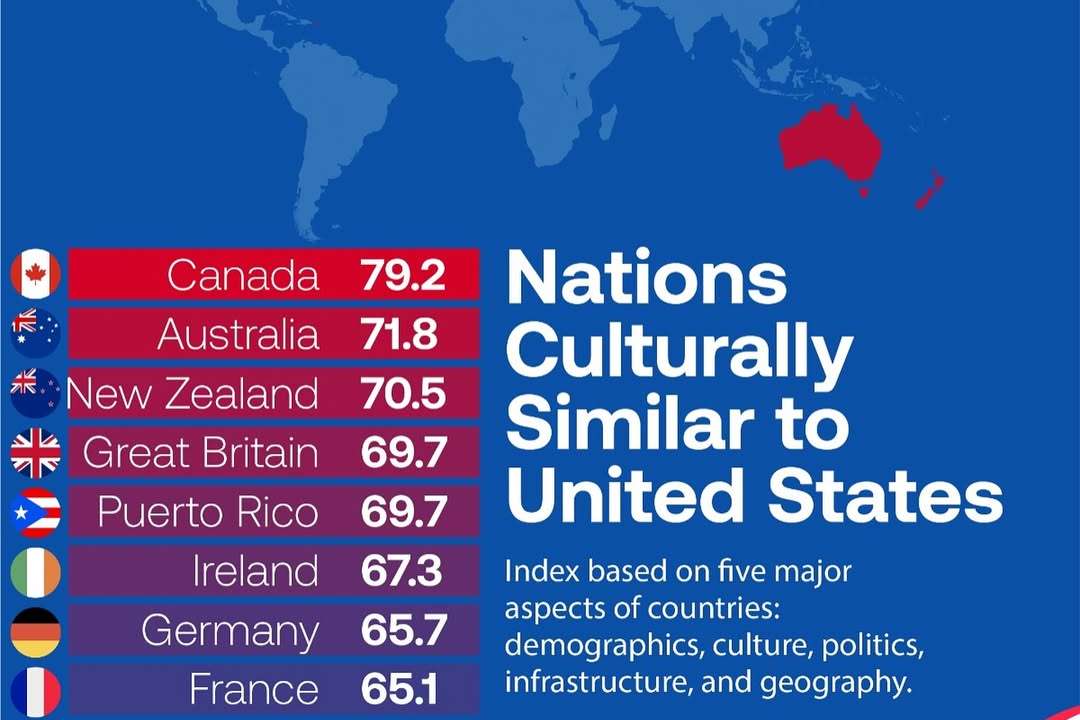
According to the Country Similarity Index, a data-driven ranking that compares nations across five major dimensions, the United States’ closest cultural cousin is its neighbour to the north, Canada, with a striking similarity score of 79.2.
Trailing behind Canada are fellow English-speaking democracies Australia (71.8), New Zealand (70.5), and Great Britain (69.7), with Puerto Rico tying Britain at 69.7, which is unsurprising given its political connection to the U.S.
Ireland (67.3) rounds out the top five before the ranking widens to include European partners like Germany, France, Norway, and Switzerland. These nations share much of the United States’ institutional, infrastructural, and political framework, even if geography and some cultural elements diverge.
Canada and the U.S. not only share the longest undefended border in the world, but their economies are closely integrated under the USMCA trade agreement, their media and entertainment industries cross-pollinate, and both societies are shaped by waves of immigration and shared democratic norms.
The inclusion of Australia and New Zealand reflects a similar pattern, countries built on British colonial legal systems, English language dominance, and comparable political models. Even across the Atlantic, Germany, France, Norway, and Switzerland land on the list thanks to their high standard of living, advanced infrastructure, and liberal democratic traditions, making them natural partners for Washington on global issues.
This cultural and institutional proximity carries weight in today’s geopolitical climate. It explains why the U.S. often finds it easier to coordinate policy and form coalitions with these nations, whether in trade negotiations, climate summits, or military alliances.
Canada and the U.S., for example, are currently negotiating joint energy and security frameworks, while Australia and New Zealand are playing central roles in the U.S.’s Indo-Pacific strategy.
Across the Atlantic, Germany and France continue to collaborate with Washington on everything from NATO’s security posture to AI governance frameworks, even amid occasional tensions over industrial policy.
This story is written and edited by the Global South World team, you can contact us here.