The deepest places on each continent – A global dive beneath sea level
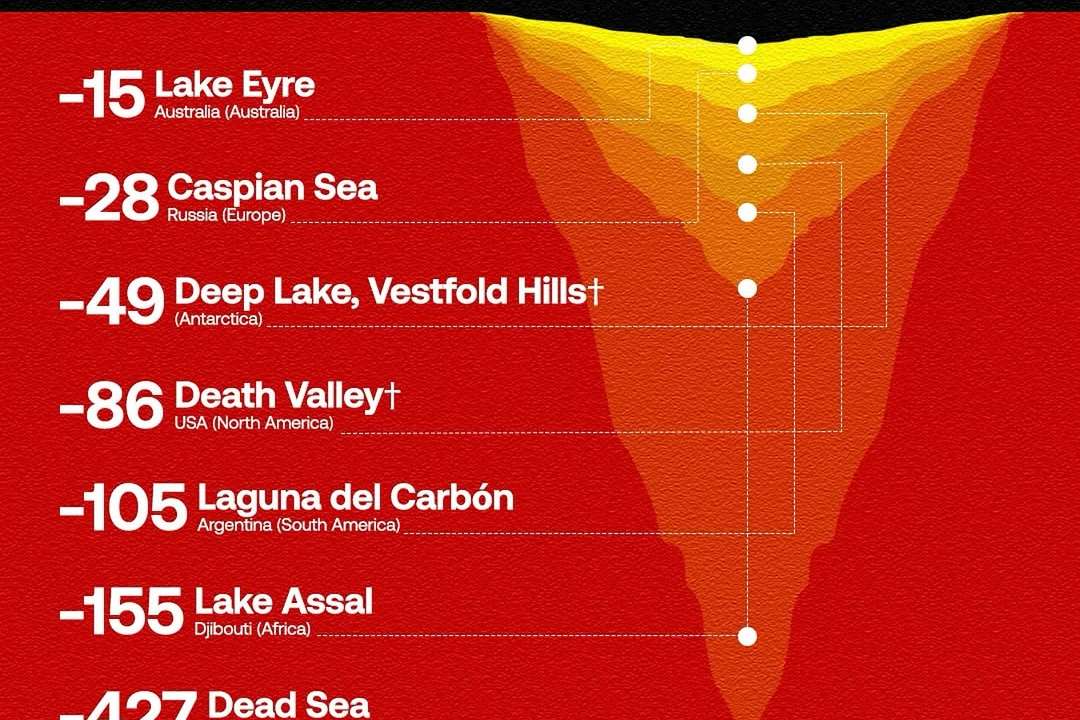
From saline basins to remote deserts, the deepest points on each continent reveal a fascinating interplay of geology, climate, and human interaction. According to data compiled by World Atlas, these locations—measured by their depth below sea level—offer dramatic landscapes and scientific, economic, and environmental insights.
Asia: Dead Sea – Earth’s Deepest Exposed Point
At –427 metres (–1,401 feet), the Dead Sea is the lowest point on Earth’s surface not covered by water or ice. Bordering Israel and Jordan, this hypersaline lake is fed by the Jordan River, yet has no outlet, causing intense evaporation that leaves behind a dense concentration of minerals. Its unique chemical makeup makes it inhospitable to most life forms but ideal for mineral extraction and wellness tourism, drawing thousands for its therapeutic muds and buoyant waters.
Africa: Lake Assal, Djibouti – A Salty Depression
Lake Assal is the lowest point in Africa, at 155 metres (–509 feet) below sea level. Located in Djibouti, this salt lake is ringed by volcanic ridges and subject to extreme heat, often exceeding 50°C (122°F). The lake plays a vital role in local salt mining economies, yet its harsh conditions pose serious ecological stress due to rapid evaporation and climate pressures.
South America: Laguna del Carbón – Hidden Scientific Treasure
Argentina’s Laguna del Carbón reaches a depth of –105 metres (–344 feet), making it the lowest point in both the Southern and Western Hemispheres. Though not a major tourist destination, the surrounding desert region holds significant paleontological value, with fossil records offering insight into prehistoric life.
North America: Death Valley’s Badwater Basin – A Hotbed of Extremes
In California’s Death Valley, Badwater Basin lies at –86 metres (–282 feet). Known for its record-setting temperature of 56.7°C (134°F) in 1913, it is one of the hottest places on Earth. Despite its name and environment, Death Valley supports a surprisingly rich ecosystem and remains protected under Death Valley National Park.
Antarctica: Deep Lake – Salty and Ice-Resistant
Though relatively shallow at 49 metres (–160 feet), Deep Lake in Antarctica’s Vestfold Hills is extraordinary for staying liquid year-round, despite freezing temperatures. Its hypersaline composition prevents it from freezing, making it a key location for studying extremophile organisms and polar climatology.
Europe: Caspian Sea – A Strategic Sinkhole
The Caspian Sea, straddling Russia and several bordering nations, sits at –28 metres (–92 feet). Though called a sea, it's the world's largest enclosed inland body of water. Rich in oil, gas, and fisheries, the Caspian Sea is crucial for regional geopolitics and energy resources, making it Europe’s lowest and most strategically important depression.
Australia: Lake Eyre – A Temporary Marvel
Australia’s Lake Eyre reaches –15 metres (–49 feet), the continent’s lowest point. Normally dry, it transforms into a shallow lake during infrequent heavy rains. These rare flood events spark short-lived ecological booms, attracting migratory birds and generating temporary tourism interest.