The EU can't make up its mind about Peking Duck. Opinion
On a warm summer day in 2025, I sat down for dinner with a British friend (His name is Duncan) at Shikumen, a Chinese restaurant nestled in Shepherd's Bush. While the establishment is renowned for its Shanghainese cuisine, what truly draws London’s discerning foodies is its remarkably authentic Peking roast duck.
Here, dining on roast duck is elevated into a ritual that blends tradition with culinary avant-garde. Alongside the standard sweet bean sauce and shredded scallions, the restaurant playfully offers raspberry jam. More impressively, it preserves the most traditional method: dipping the crispy duck skin in white sugar. The moment the skin melts on the tongue with the sugar, an explosion of rich, savory aroma ensues. After the duck meat is carved, diners can opt for salt-and-pepper duck bones or a rich, comforting tofu and duck bone soup.
Duncan adored this restaurant, viewing it almost as a tangible embodiment of Chinese culture. Of course, this culinary excellence does not come cheap—a single roast duck carries a price tag of £78. Beyond London, I have sampled similar authentic versions in Paris; while slightly less expensive at €65, it remains a premium dining experience. In the eyes of European financial elites and the middle class, this duck represents the refinement and prestige of Eastern gastronomy.
Yet, this delightful moment of personal memory was unknowingly intertwining, in a somewhat surreal fashion, with a major geopolitical headline.
RECOMMENDED FOR YOU
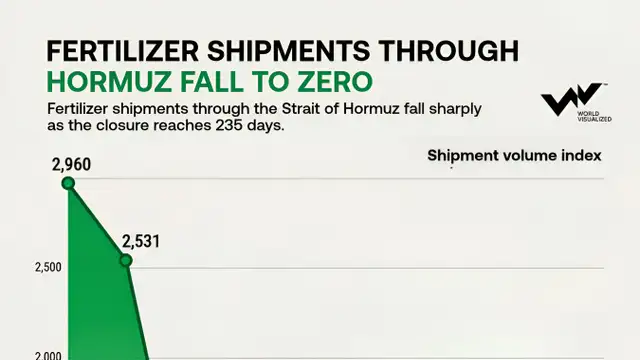
Fertilizer shipments through Strait of Hormuz fall to zero as food security fears grow
From GI recognition to Anti-Dumping
Unlike, most items you will find on restaurant menus, "Peking Duck" can also be found on international trade documents.
As early as September 2020, when China and the EU formally signed the China-EU Agreement on Geographical Indications, Peking Duck stood out as a flagship representative of Chinese products. It was placed on the second list of 175 products scheduled to "complete mutual recognition and protection procedures within four years." Under the original timeline, with the agreement officially taking effect in March 2021, the EU’s legal procedures for this list were expected to be finalised around 2025.
Over the past few years, the verification process for this second list had been steadily advancing. Relevant right holders were actively applying for international trademark registration under the Madrid System, and trade officials from both sides were working diligently through the reviews. At the EU level, the approval of Peking Duck as a Protected Geographical Indication (GI) had reached its final stretch, awaiting little more than an official rubber stamp. Once approved, it would erect a strict legal fortress in the EU market: no non-Chinese duck meat could ever misappropriate the prestigious name of "Peking Duck."
However, the drama of history often unfolds at the final hurdle. A sudden geopolitical chill instantly froze this cross-continental culinary pact.
On July 9, 2026, the European Commission formally announced the launch of an anti-dumping investigation into imports of Peking duck - both whole ducks and skin-on/bone-in parts used for making Peking roast duck -originating in China. This trade defence measure was triggered by a joint complaint filed by five EU domestic poultry producers, who alleged that duck meat exported from China was underpriced, thereby constituting "unfair competition" against the European industry.
What was meant to be the finish line for legal protection abruptly morphed into the starting line for a trade war.
The EU’s vision of "Market Distortion"
RECOMMENDED FOR YOU

‘Who will take responsibility?’ - October 7 families confront Netanyahu on Israel election day
In this newly initiated investigation, the EU has cast a remarkably wide net. The scope covers not only the whole "Peking Duck"—the core breed for meat production—but also extends to duck parts, whether fresh, chilled, frozen, salted, smoked, or deeply processed. Furthermore, the European Commission explicitly stated it would retroactively scrutinise trade data covering the period from January 1 to December 31, 2025.
On what grounds do European producers claim Chinese duck meat is "unfair"? In their complaint, the operative phrase is "severe market distortions."
The "Original Sin" of State Planning: The complainants cited China’s 14th Five-Year Plan for Agricultural Modernisation, arguing that its support measures for the livestock and poultry industries constitute state intervention. They further projected that such support would persist under China’s newly unveiled 15th Five-Year Plan.
The Feed Connection: European producers also pointed to Chinese government backing for the feed sector as a driver of market distortion, arguing it artificially lowers the cost of duck feed.
To construct a so-called "normal value," the European Commission designated Brazil as an appropriate representative third country. After comparative calculations, the Commission concluded that the evidence presented was "sufficient to justify the initiation of an investigation."
An absurd logic
To anyone familiar with the realities of the global poultry supply chain, this investigation order evokes a sense of profound absurdity.
First, is this cost advantage driven by "dumping" or "efficiency"?
RECOMMENDED FOR YOU

Lula and Flávio Bolsonaro over economy, crime and personal attacks in final Brazil election debate
While the roast duck we enjoy in London and Paris is undoubtedly expensive, the competitiveness of exported Chinese duck meat is by no means artificially depressed by subsidies. China possesses the world’s largest and most deeply rooted tradition of consuming duck, which has fostered the most sophisticated and complete waterfowl supply chain globally. According to The Financial Times (FT), data from 2025 shows that the EU duck meat market is valued at approximately €800 million, with imports from China accounting for about €199 million—capturing nearly a quarter of the market. Globally, the data from the UN Food and Agriculture Organisation (FAO) is even more staggering: of the roughly 5 million tons of duck meat produced globally each year, China alone accounts for approximately 4.8 million tons. This means that out of every 100 ducks in the world, 96 are raised in China.
Behind these astronomical figures lies an unparalleled, fully integrated supply chain: from massive feed production and large-scale farming systems to high-efficiency processing that utilises everything from the meat and internal organs to the down feathers. The economies of scale and industrial efficiency generated by this hyper-density are the natural outcomes of market evolution, not the "malicious dumping" depicted in geopolitical narratives.
The Chinese government's initiatives under the 15th Five-Year Plan to promote agricultural and rural modernisation, such as "developing characteristic industrial clusters" and provisions in the Livestock Law to "support the protection of genetic resources and national breeding schemes", are designed to leverage local agricultural characteristics and boost farmers' incomes. How is this fundamentally different from France developing its wine regions in Bordeaux, or Italy fostering its prosciutto industry in Parma? Is this not the very ethos upon which Geographical Indications were founded? If a government’s formulation of basic industrial planning, promotion of regional production clusters, and provision of foundational public services are deemed structural distortions, the European Commission’s logic would effectively call into question the very necessity of a state's existence.
Globally, from the EU’s European Green Deal and Common Agricultural Policy to long-standing industrial strategies in the United States and Japan, policy guidance and industrial planning are standard features of any mature economy. The core issue is not whether a nation formulates a plan, but whether specific measures genuinely violate WTO and multilateral international trade disciplines.
Second, the EU is clearly operating on a double standard regarding agricultural subsidies. As the China Chamber of Commerce to the EU (CCCEU) pointed out, agricultural subsidies are by no means a policy tool exclusive to China. As one of the largest agricultural support frameworks in the world, the EU’s Common Agricultural Policy (CAP) consistently consumes nearly one-third of the total EU budget. For decades, the CAP has played a decisive role in securing European farmers' incomes and stabilising agriculture through direct payments and massive market support. For the EU to maintain such an immense protective umbrella of its own, while turning around to investigate Chinese waterfowl on the grounds that "subsidies distort prices," represents a striking logical inconsistency.
Furthermore, the choice of a " representative third country " to calculate normal value is completely mismatched. In anti-dumping investigations, European authorities lean toward selecting Brazil as a surrogate country to calculate the so-called "normal value." However, a vast chasm separates the poultry industries of China and Brazil. Whether in breeding systems, feed supply, industrial clustering, slaughtering and processing models, or overall supply chain efficiency, the integrated advantages built by the Chinese duck industry over decades of iteration cannot be easily replicated or compared to the Brazilian model.
In truth, this is not the first time Beijing and Brussels have clashed over this bird. Back in 2015, China challenged the EU at the WTO over unfair tariff-rate quota allocations for poultry meat and ultimately won. In 2018, the two sides signed an implementation agreement establishing an annual country-specific tariff-rate quota of 6,600 tons of prepared duck meat for China. That victory was supposed to create a stable and predictable horizon for Chinese duck meat entering the EU. The current resurgence of hostility begs a troubling question: in the grand scheme of current China-EU trade relations, has this duck, with "Peking" stamped on its name, unfortunately been turned into a symbolic casualty of geopolitics?
The trade pendulum
RECOMMENDED FOR YOU

‘Politics is not a show’ - Delcy Rodriguez slams Maria Corina Machado's return
Senior European agricultural trade negotiators and media observers have candidly admitted the deep irony of the current situation. On one side of the aisle, the EU’s legal machinery was preparing to solemnly recognise and protect the GI status of "Peking Duck"; on the other side, its trade defence apparatus chose almost the exact same moment to aggressively swing its protectionist gavel.
With the initiation of the anti-dumping probe, the legal finalisation of Peking Duck’s GI mutual recognition in the EU has been politicised and complicated. Over the next year or two, whether this delicacy will ever receive the European legal protection it rightfully earned will depend entirely on the outcome of this anti-dumping chess game. For now, the process remains stranded in an awkward phase of "technical stagnation and substantive jockeying."
Perhaps the answer to this question does not require complex macroeconomic modeling. The trade representatives in Brussels might find it much faster to simply sit down at that fragrant roast duck restaurant in West London and taste the reality for themselves.
Yubin Du is a veteran journalist, producer, and managing editor at China Global Television Network (CGTN). He served as a foreign correspondent stationed in Washington, D.C., and London for six years each, focusing on U.S.-China and EU-China relations. He has worked in Chinese international communication and new media for over 16 years. The views expressed in this article are solely those of the author. Author email: [email protected]
