The world’s cinnamon comes from fewer places than you think
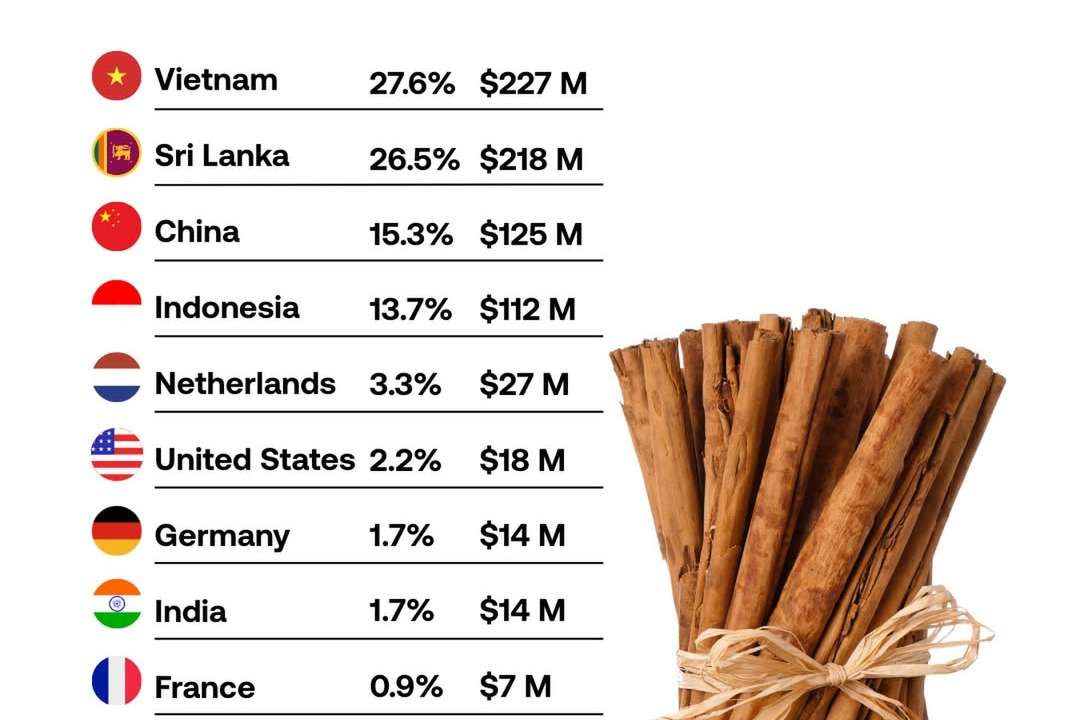
Cinnamon feels universal. It shows up in kitchens from Accra to Amsterdam, in everything from breakfast oats to festive desserts. But behind that familiar warmth is a global trade that’s far more concentrated than most people realise.
Cinnamon feels universal. It shows up in kitchens from Accra to Amsterdam, in everything from breakfast oats to festive desserts. But behind that familiar warmth is a global trade that’s far more concentrated than most people realise.
Today, just two countries, Vietnam and Sri Lanka, control more than half of the world’s cinnamon exports by value. New trade data shows how these nations have turned an ancient spice into a modern export powerhouse, reshaping supply chains and global food markets in the process.
According to figures compiled by the International Trade Centre and supported by CIA World Factbook export and commodities data, Vietnam is currently the world’s largest exporter of cinnamon. The country accounts for 27.6% of global exports, valued at approximately $227 million.
Sri Lanka follows closely with a 26.6% share, worth around $218 million. What this really means is that the cinnamon trade is anchored firmly in Asia.
RECOMMENDED FOR YOU

GTA V dominates global search interest as Grand Theft Auto VI nears release
Vietnam’s rise has been rapid and deliberate. Large-scale cultivation, particularly in Yen Bai and Quang Nam provinces, has allowed the country to meet rising global demand at competitive prices. Government support for agricultural exports and efficient processing systems has further strengthened its position.
Sri Lanka’s success is built on a different foundation. As the world’s primary source of Ceylon cinnamon, the country commands higher prices due to its distinctive flavour profile and lower coumarin levels.
International Trade Centre data shows that Sri Lankan cinnamon is especially sought after in Europe and other health-conscious markets. Despite higher production costs, its strong reputation has preserved its global competitiveness.
China ranks third in global cinnamon exports, with 15.3% of the market valued at 125 million US dollars. Indonesia follows with 13.7%, or roughly $112 million.
Both countries benefit from integrated agricultural systems and strong regional trade networks. China’s exports often feed into processing and re-export chains, while Indonesia’s production remains closely tied to smallholder farmers, particularly in Sumatra.
Countries such as the Netherlands, the United States, Germany, and France are not major cinnamon growers, but they remain significant exporters by value. Their role is largely logistical.
The Netherlands, for example, accounts for 3.3% of global exports, reflecting its position as a key European trade and redistribution hub. International Trade Centre data shows that spices frequently enter Europe through Dutch ports before being re-exported across the region.
Global demand for cinnamon continues to grow, driven by interest in natural foods, wellness products, and plant-based diets. The market is expected to reach about $1.95 billion by 2034.
RECOMMENDED FOR YOU

Dutch founders of Bali run club banned after discrimination allegations spark immigration probe
This story is written and edited by the Global South World team, you can contact us here.