The world’s longest canals driving global strategic shipping routes
From the narrow locks of Panama to the vast stretch of China’s Grand Canal, artificial waterways continue to underpin global trade, acting as critical shortcuts that reshape maritime routes and economic flows.
From the narrow locks of Panama to the vast stretch of China’s Grand Canal, artificial waterways continue to underpin global trade, acting as critical shortcuts that reshape maritime routes and economic flows.
According to maritime analyses and industry insights reported by Marine Insight, canals serve as strategic connectors between seas, rivers, and industrial regions, reducing transit times and fuel costs while easing congestion around longer natural routes.
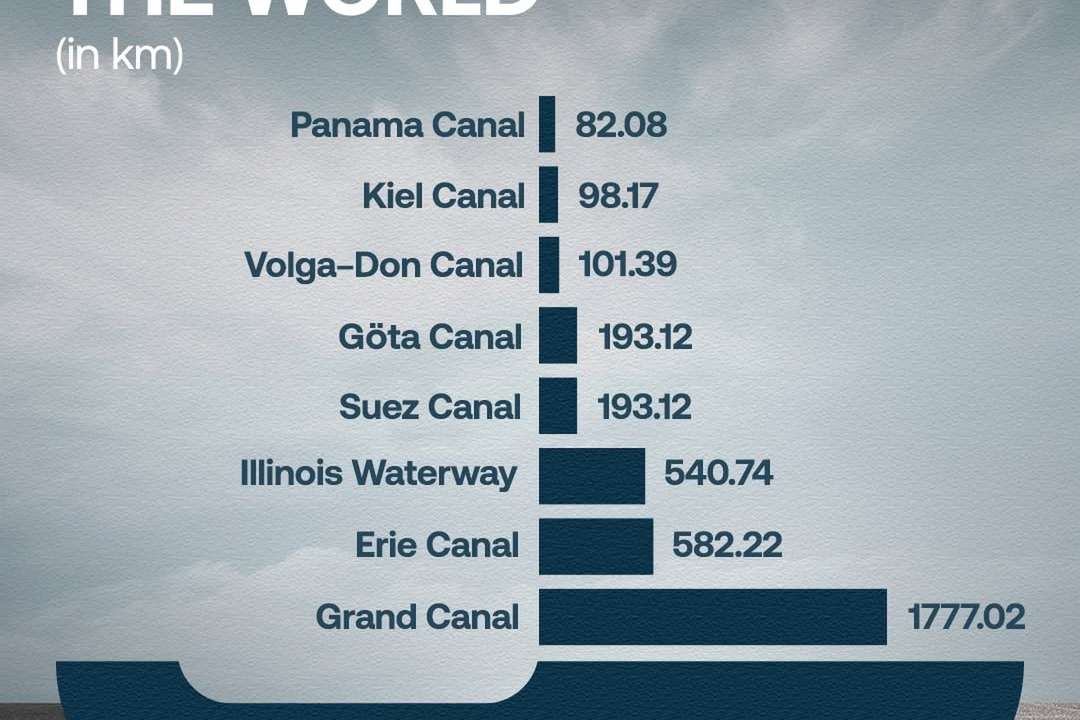
The Panama Canal, which stretches roughly 82 km, remains one of the most economically vital waterways globally. It links the Atlantic and Pacific Oceans, saving ships from the lengthy and hazardous journey around South America’s Cape Horn. Despite its relatively modest length, its geopolitical and commercial significance is outsized.
Similarly, Europe’s Kiel Canal in Germany, measuring just over 98 km, is one of the world’s busiest artificial waterways, allowing vessels to bypass the Danish Straits and significantly cut transit time between the North Sea and the Baltic Sea.
RECOMMENDED FOR YOU

More than 6 billion people are now online as global internet access reaches new high
Russia’s Volga–Don Canal, at approximately 101 km, plays a key role in connecting the Caspian Sea basin with global shipping routes, forming part of a larger inland water transport network that supports regional trade.
Further north, Sweden’s historic Göta Canal, spanning about 193 km, is less commercially dominant today but remains a notable engineering achievement and an important cultural waterway.
However, Egypt’s Suez Canal, also around 193 km long, is a cornerstone of global trade. It provides the shortest maritime route between Europe and Asia, handling a significant share of the world’s container traffic. Disruptions to the canal, as seen in recent years, have demonstrated its critical role in supply chains and energy shipments.
Longer inland systems, such as the Illinois Waterway in the United States (over 540 km) and the Erie Canal (around 582 km), highlight the importance of canals in domestic trade. These waterways connect major river systems and industrial hubs, facilitating the movement of bulk goods like grain, coal, and petroleum.
Towering above all is China’s Grand Canal, extending approximately 1,777 km. Recognised as the world's longest canal, it links key economic regions from Beijing to Hangzhou. According to Marine Insight, the Grand Canal has historically supported internal trade and continues to play a role in water transport and regional development.