Uganda Roundup: Besigye detention talks, Karamoja hunger crisis and parliament funding cuts

Justice minister confirms talks over detention of Besigye and Lukwago
Uganda's Minister of Justice and Constitutional Affairs, Norbert Mao, has confirmed that discussions are underway to seek a political resolution to cases involving detained opposition figures Dr Kizza Besigye and Erias Lukwago. Speaking in remarks reported on October 21, Mao said the negotiations were taking place under the direction of President Yoweri Museveni and involved government officials, relatives of the detainees and representatives of their political organisations. Mao, who also leads the Democratic Party (DP), described the talks as part of a broader effort to address political tensions. Concerns about the health and continued detention of the two opposition figures have increased pressure on the government to find a resolution. Besigye, a former presidential candidate and longtime critic of Museveni, has faced treason-related proceedings following his arrest in November 2024. His case has attracted international attention because of questions surrounding his arrest, detention and prosecution. Lukwago, a lawyer and prominent opposition politician who previously served as Kampala's lord mayor, has also become a focus of concerns about the treatment of opposition figures.
2. Government and opposition clash over political prisoners ahead of national dialogue
Uganda's ruling National Resistance Movement (NRM) and opposition parties have disagreed over the treatment of political detainees, complicating efforts to establish a national dialogue following the 2026 general elections. The disagreement emerged during a political parties' retreat in Jinja, organised by the Netherlands Institute for Multiparty Democracy (NIMD). The meeting was intended to explore ways of managing political differences, strengthening democratic participation and promoting national cohesion after the elections. Opposition representatives insisted that meaningful dialogue could not begin while political activists remained detained or opposition figures continued living in exile. They demanded the unconditional release of political detainees and the safe return of exiled politicians as essential steps towards restoring confidence in the proposed process. The ruling party and opposition disagreed over whether those demands should be treated as conditions for beginning talks. The dispute reflects longstanding disagreements over political freedoms, the conduct of security agencies and the prosecution of opposition activists. It also comes as negotiations continue over the cases of Besigye and Lukwago, making the treatment of detained opposition figures a central issue in the wider political debate.
3. Karamoja drought leaves at least 19 dead as crop losses reach Shs56 billion
At least 19 people have died from starvation in Kotido District, northeastern Uganda, as a prolonged drought devastates crops, leaves thousands facing severe food shortages and forces some households to move in search of food and water. The drought began in late May 2026 and continued through October, affecting communities across the Karamoja sub-region. According to local agricultural authorities, approximately 98% of crops have been destroyed by the prolonged dry conditions. The 19 reported deaths occurred across five sub-counties in Kotido District, illustrating the severity of the emergency in one of Uganda's most food-insecure regions. On October 20, representatives of the United States Mission, the United Nations World Food Programme (WFP) and the Food and Agriculture Organisation (FAO) visited Kotido to assess conditions and review humanitarian interventions. Robert Kennedy Okuda, the Kotido District Agricultural Officer, attributed the crisis partly to two consecutive failed planting attempts. Farmers planted crops in March and April, but irregular rainfall caused many plants to wither before reaching maturity. Some households planted again after brief rains in late May, only for the crops to be destroyed when the prolonged drought began.
4. Parliamentary committees face funding cuts over failure to deliver reports
Uganda's Deputy Speaker of Parliament, Thomas Tayebwa, has warned that parliamentary committees that fail to fulfil their responsibilities could lose operational funding under a proposed performance-based allocation system. Speaking during parliamentary proceedings on October 20, Tayebwa criticised committees that had received public resources but failed to produce the reports required under Parliament's Rules of Procedure. He said future funding would be tied more closely to whether committees carry out their mandates and deliver measurable results. The Deputy Speaker singled out the Committee on Climate Change, saying it had failed to present a single report throughout the term of the 11th Parliament, despite receiving operational funding. "If your committee is not working, there is no reason for giving you money," Tayebwa said. Parliamentary committees must justify their existence through their work rather than simply continue receiving allocations. He added: "This is therefore to require committees to conform to the reporting requirements and justify their existence."Parliamentary committees play an important role in reviewing legislation, examining government expenditure, investigating public concerns and overseeing ministries and agencies.
RECOMMENDED FOR YOU
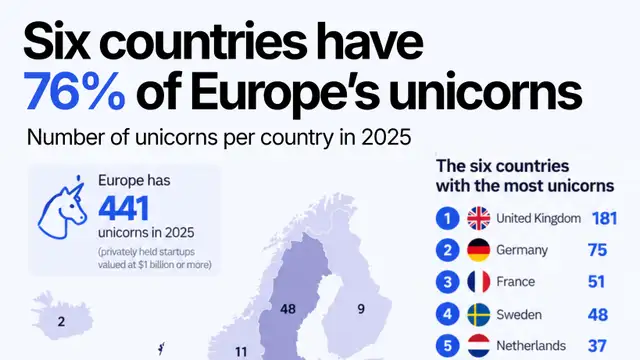
Six countries account for three-quarters of Europe’s unicorn startups
5. Museveni and Muhoozi promise tougher action against violent crime
President Yoweri Museveni and Uganda's Chief of Defence Forces, General Muhoozi Kainerugaba, have pledged tougher action against violent criminals following concerns about killings, robberies and thefts affecting communities and businesses. Museveni made the remarks while commissioning 280 Uganda People's Defence Forces (UPDF) officer cadets at Kabamba in Mubende District on October 20. The president said criminal activities were undermining government programmes intended to improve household incomes and support wealth creation. "The CDF spoke of rising crime, and it must be combated firmly because it interferes with the wealth creation." Museveni specifically cited the theft of livestock distributed to farmers under the government's Parish Development Model (PDM). "For instance, if thieves steal goats and cows given to farmers under PDM, it is sabotage." The Parish Development Model is intended to help households move into income-generating economic activities through financial support and local development initiatives. Museveni argued that theft and violent crime undermine those efforts by depriving beneficiaries of the assets they need to earn a living. Muhoozi also raised concerns about violent criminal activity and called for stronger measures to protect communities.
This story is written and edited by the Global South World team, you can contact us here.