UN backs remote address by Palestinian President Abbas after US denies visa
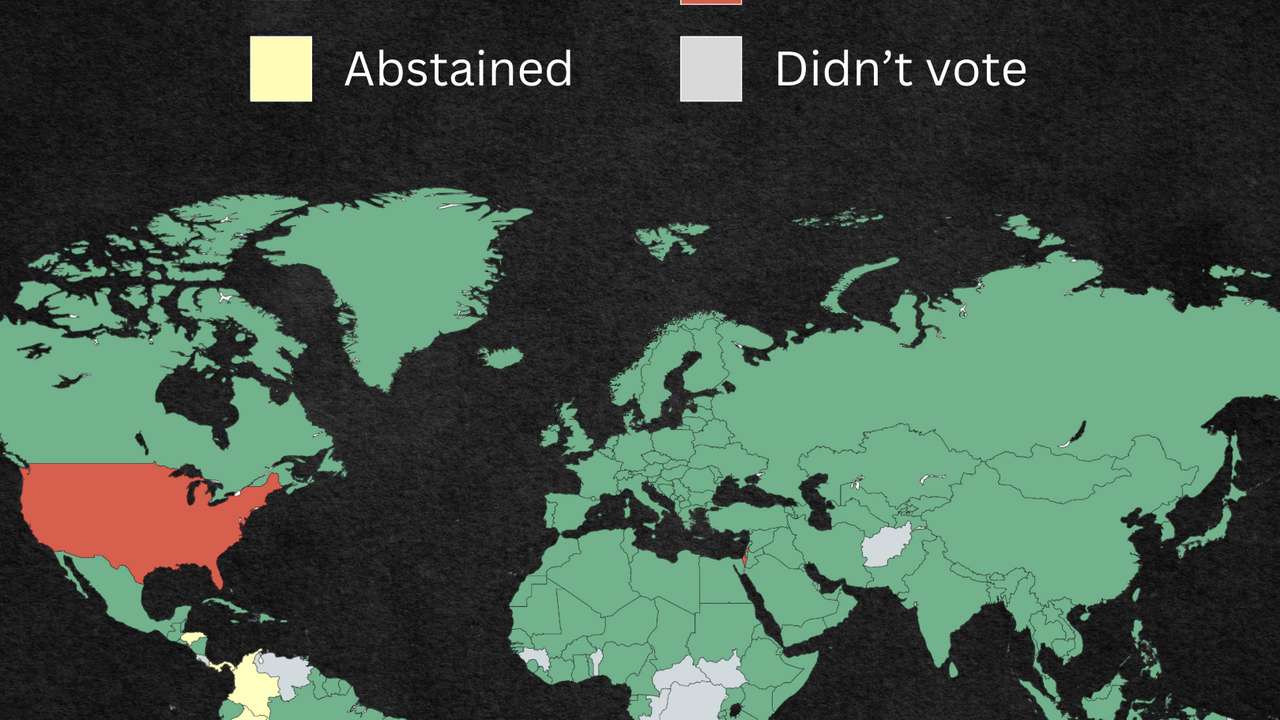
The United Nations General Assembly has overwhelmingly voted to allow Palestinian President Mahmoud Abbas to address its annual gathering remotely after the United States denied him a visa to travel to New York for the second consecutive year.
Key points
- UN vote passes by 152 to three
- US again denies Abbas a visa
- Abbas will address the assembly remotely
The United Nations General Assembly has overwhelmingly voted to allow Palestinian President Mahmoud Abbas to address its annual gathering remotely after the United States denied him a visa to travel to New York for the second consecutive year.
The resolution passed on September 17 with 152 countries voting in favour, three against and four abstaining. The United States, Israel and Paraguay opposed the measure, while Colombia, Honduras, Panama and Peru abstained.
The decision allows Abbas to deliver a pre-recorded address during the General Assembly's 81st session. It also permits other senior Palestinian officials to participate remotely in certain UN meetings over the next year if they are prevented from travelling to the United States.
Nearly 130 world leaders are gathering in New York City this week for the 81st session of the United Nations General Assembly, with the annual general debate beginning on Tuesday, September 22, 2026.
RECOMMENDED FOR YOU

More than 6 billion people are now online as global internet access reaches new high
US extends visa restrictions
Washington extended visa restrictions on officials from the Palestine Liberation Organisation and Palestinian Authority shortly before world leaders were due to gather in New York.
The US State Department said the restrictions were linked to what it described as Palestinian actions to “internationalise” the conflict with Israel, including pursuing cases at international courts. US Deputy Ambassador to the UN Tammy Bruce also accused the Palestinian Authority of failing to meet commitments and urged countries to vote against allowing remote participation.
Palestinian officials rejected the US decision. Palestinian UN Ambassador Riyad Mansour told the assembly that the Palestinian leadership condemned being prevented from attending and expressed hope that it would be the last time such restrictions were imposed.
The dispute also raises questions about the United States' responsibilities as host of UN headquarters. Under the 1947 UN Headquarters Agreement, the US is generally required to allow representatives travelling on UN business access to the organisation's headquarters. Washington maintains that it can restrict entry on security, extremism and foreign-policy grounds.
Second remote appearance in two years
The latest vote follows a similar dispute in 2025, when the US also denied visas to Palestinian representatives.
That year, the General Assembly voted 145 to five, with six abstentions, to allow Palestine to participate virtually. Abbas subsequently addressed a high-level UN meeting remotely.
Palestine has held non-member observer state status at the UN since 2012. This allows its representatives to participate in much of the General Assembly's work, but Palestine does not have the same voting rights as the UN's 193 full member states.
This story is written and edited by the Global South World team, you can contact us here.