United States retains world's largest economy
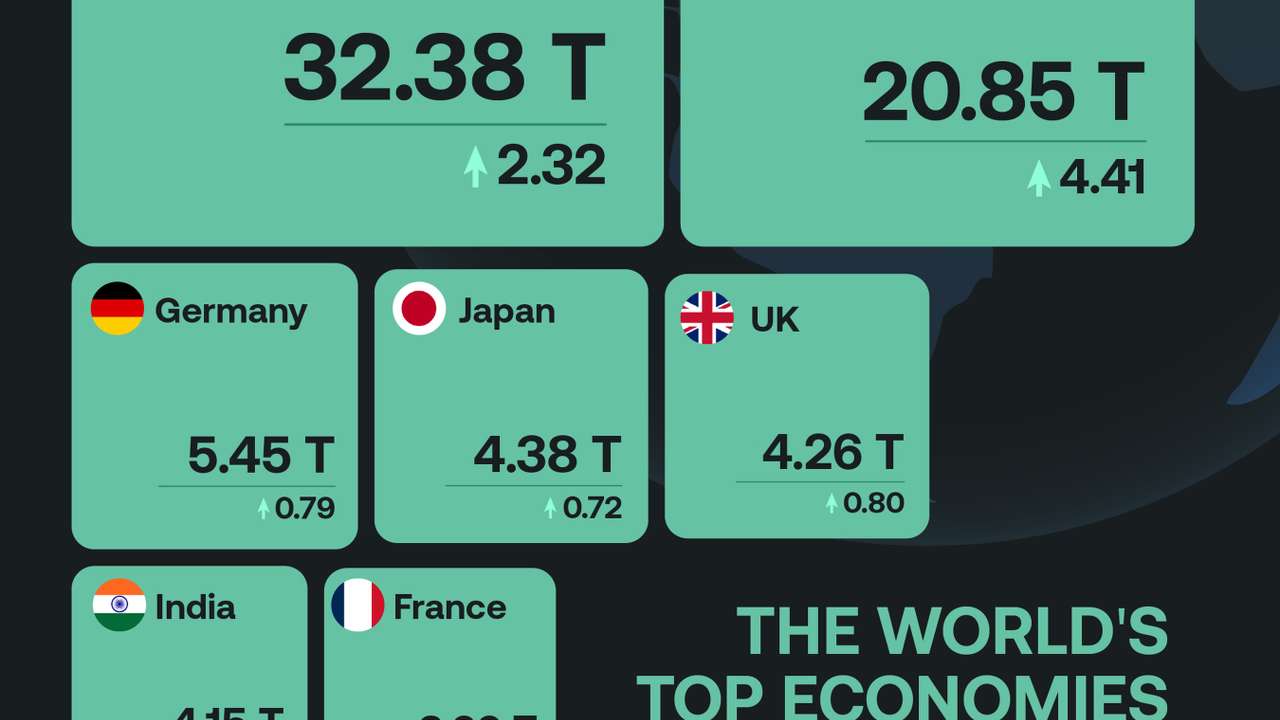
The United States remained the world's largest economy in 2025 with a nominal gross domestic product (GDP) of US$32.38 trillion, while India recorded the fastest annual growth among the world's 10 biggest economies, according to the International Monetary Fund (IMF).
Main Points
- The United States remains the world's largest economy
- India records the fastest growth among the top 10 economies
- China remains the world's second-largest economy
The United States remained the world's largest economy in 2025 with a nominal gross domestic product (GDP) of US$32.38 trillion, while India recorded the fastest annual growth among the world's 10 biggest economies.
The IMF's World Economic Outlook estimates show the U.S. economy expanded by 2.3% in 2025, maintaining a substantial lead over second-placed China, whose economy reached US$20.85 trillion after growing 4.4%.
Together, the United States and China accounted for more than 40% of global nominal GDP, underscoring their continued dominance of the world economy despite slower growth than many emerging markets.
Germany remained the world's third-largest economy with an output of US$5.45 trillion, followed by Japan at US$4.38 trillion and the United Kingdom at US$4.26 trillion. Germany's economy grew 0.7%, Japan expanded 0.7%, while the United Kingdom recorded 0.8% growth.
India ranked sixth with a nominal GDP of US$4.15 trillion, overtaking several advanced economies in recent years. The IMF projects India to grow 6.5% in 2025, the fastest pace among the world's 10 largest economies, supported by strong domestic consumption, public infrastructure investment and a rapidly expanding services sector.
France remained seventh with an economy valued at US$3.60 trillion, followed by Italy at US$2.74 trillion, Russia at US$2.66 trillion and Brazil at US$2.64 trillion.
Among the top 10 economies, Brazil recorded the second-fastest growth rate at 1.9%, while Russia expanded 1.1% despite continued international sanctions and geopolitical pressures. Italy grew 0.5%, and France recorded 0.8% growth.
The World Bank defines GDP as the total monetary value of all final goods and services produced within a country's borders over a specific period and uses it as one of the principal measures of economic size. Nominal GDP, reported in current U.S. dollars, is widely used for comparing the relative scale of national economies.
While advanced economies continue to dominate global output, the IMF expects emerging markets, particularly India, to contribute a growing share of global economic expansion over the coming years as investment, industrial production and consumer demand continue to rise
This story is written and edited by the Global South World team, you can contact us here.