US leads the world’s biggest agricultural exporters ahead of Brazil and the Netherlands
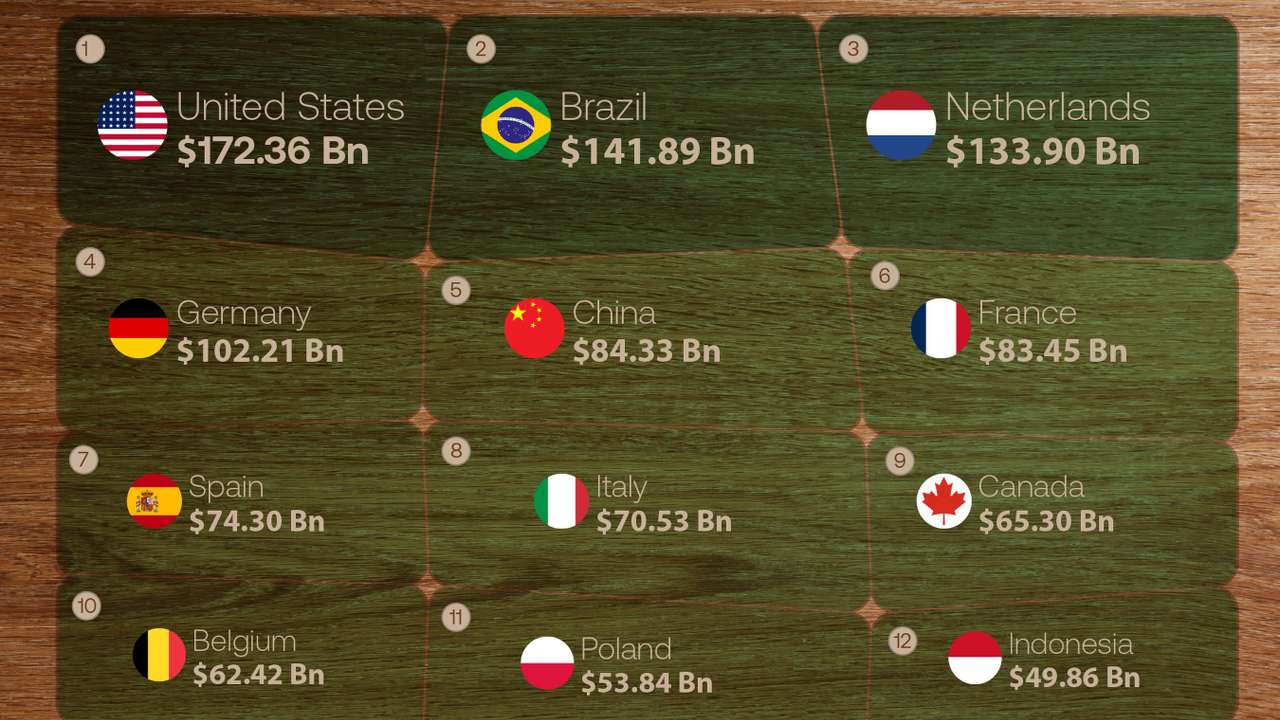
The United States was the world’s biggest exporter of crop and livestock products in 2024, while Brazil and the Netherlands completed the top three, according to FAOSTAT data compiled by World Population Review.
Main points
- US agricultural exports reached $172.36 billion
- Brazil ranked second with $141.89 billion
- European countries hold six of the top 10 spots
The United States was the world’s biggest exporter of crop and livestock products in 2024, while Brazil and the Netherlands completed the top three, according to FAOSTAT data compiled by World Population Review.
US exports were valued at $172.36 billion, ahead of Brazil at $141.89 billion and the Netherlands at $133.90 billion. Germany ranked fourth at $102.21 billion, followed by China at $84.33 billion and France at $83.45 billion.
Spain was seventh with $74.30 billion, followed by Italy at $70.53 billion, Canada at $65.30 billion and Belgium at $62.42 billion. Poland, Indonesia, Mexico, Australia and Thailand completed the top 15 shown in the graphic.
The ranking shows that being a major agricultural exporter is not simply about having vast amounts of farmland. The Netherlands, a relatively small country, exported nearly $134 billion worth of agricultural products, placing it ahead of much larger agricultural economies such as China and France.
RECOMMENDED FOR YOU

Premier League dominates summer transfer spending as clubs set new record
Its position also helps explain why Europe features so heavily in the ranking. European countries benefit from extensive cross-border trade and highly developed food-processing and distribution networks. FAO says Europe has particularly strong intra-regional agricultural trade and became a net food exporter in the previous decade.
Brazil’s position reflects a different strength. The country is one of the world’s major producers and exporters of agricultural commodities, particularly soybeans. FAO says global agricultural trade remains highly concentrated in several key commodities, with the two biggest exporters of soybeans and palm oil accounting for about 85% of global exports in 2024.
The figures also underline the scale of agricultural trade beyond food consumed directly by people. FAO says food commodities accounted for about 86% of global trade in crop and livestock products in 2024, but notes that some food commodities are traded for uses such as animal feed rather than direct human consumption.
The ranking is based on the value of crop and livestock exports in 2024, rather than the amount of food produced or exported by weight. FAOSTAT records international agricultural trade using export quantities and values, with values reported in US dollars.
That distinction is important. A country can rank highly because it exports large volumes of agricultural goods, sells higher-value products, has a major food-processing industry or serves as an important trading and distribution hub.
FAO also reported that while the value of global crop and livestock exports continued to increase in current prices after 2020, export volumes did not rise in the same way, showing how changes in prices can affect rankings based on dollar value.
This story is written and edited by the Global South World team, you can contact us here.