Venezuela Roundup: US diplomatic talks, amnesty push, oil control
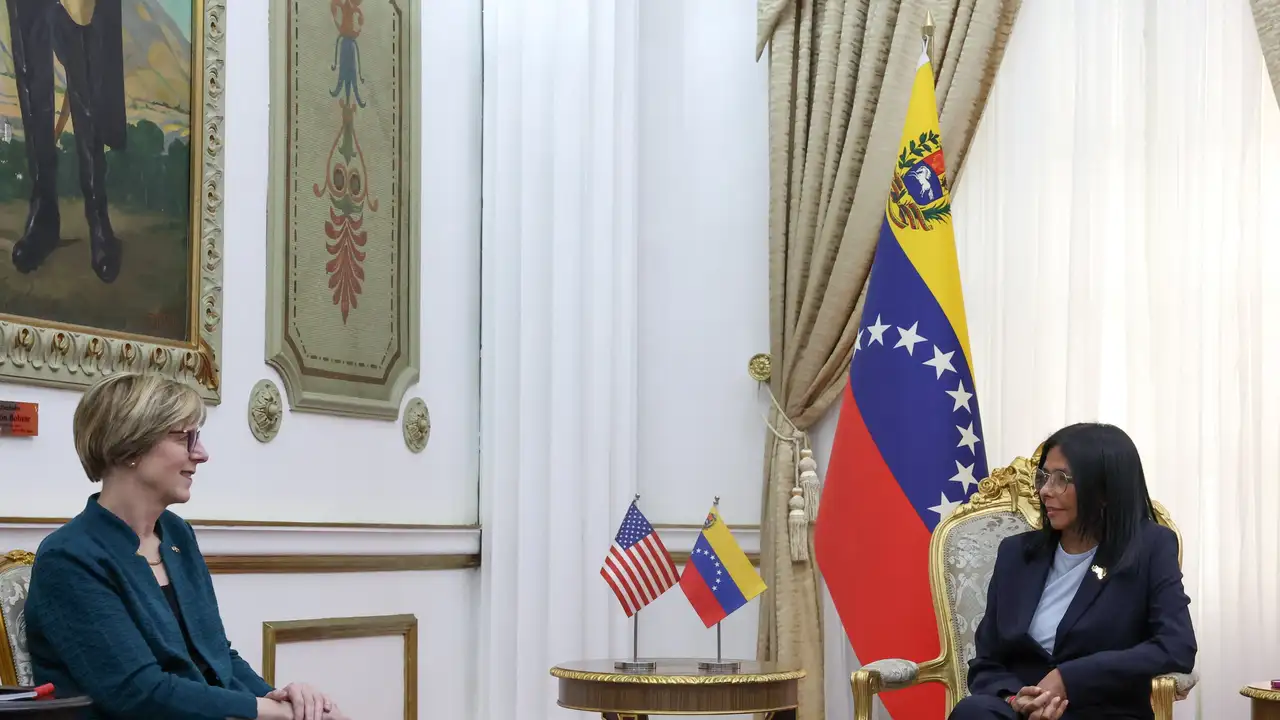
Rodríguez meets US envoy as Caracas-Washington talks intensify
Venezuelan Acting President Delcy Rodríguez met US Chargé d’Affaires Laura Dogu at the Miraflores Presidential Palace on the afternoon of Monday, February 2, in what Communications Minister Miguel Pérez Pirela described as part of a “working agenda” between Caracas and Washington. National Assembly President Jorge Rodríguez also attended. Dogu confirmed the meeting on social media, saying she reiterated US Secretary of State Marco Rubio’s proposed “three-phase plan” for Venezuela: “stabilisation, economic recovery and reconciliation, and transition.” Dogu arrived in Caracas on Saturday, January 31, pledging her team was “ready to work,” as US officials continue assessing conditions for reopening the US embassy. Foreign Minister Yván Gil said Venezuela seeks cooperation on “issues of bilateral interest,” and announced that Félix Plasencia will serve as Venezuela’s diplomatic representative in the United States and will travel to Washington soon.
US issues OFAC license delaying Citgo debt actions
The US Treasury Department’s Office of Foreign Assets Control (OFAC) issued a new license on Monday, February 2, allowing holders of Petróleos de Venezuela SA (PDVSA) bonds maturing in 2020 to conduct certain transactions beginning March 20, while keeping the Citgo auction blocked. The measure effectively delays creditors from invoking US courts to collect debts against Citgo Petroleum Corporation. The Venezuelan government has condemned the process authorising the auction as “fraudulent,” arguing the country was excluded from legal proceedings and denied the right to defend itself. Caracas has also warned that the “illegal sale” of its main foreign asset is in its “final phase,” and maintains the US judicial process violates international law.
Delcy Rodríguez proposes mass amnesty and justice reforms
Acting President Delcy Rodríguez announced on Friday, January 30, a proposal for a broad amnesty law covering “the entire period of political violence from 1999 to the present.” Speaking at the Venezuelan supreme court before top officials, Rodríguez said the measure aims to “heal the wounds left by political confrontation, fuelled by violence and extremism,” while also launching a “major national consultation for a new judicial system.” She further announced plans to close El Helicoide prison in Caracas—long criticised by rights groups—and convert the facility into a sports, cultural, and commercial centre for police families and surrounding communities.
Brazilian labour leader warns US aims to dominate Venezuelan oil
A senior Brazilian labour leader accused Washington of targeting Venezuela’s energy sector to gain control over its oil resources, warning that US actions mirror strategies used to reshape Brazil’s own industry. Deyvid Bacelar, general coordinator of Brazil’s Unified Federation of Oil Workers (FUP), told Xinhua that US pressure “has nothing to do with defending democracy or combating drug trafficking,” but instead seeks “imperial domination and the appropriation of natural wealth.” He argued weakening PDVSA would open the door for US firms, and compared the situation to Brazil’s Operation Car Wash (Lava Jato), which he claimed facilitated foreign access to Petrobras-linked deep-water reserves.
RECOMMENDED FOR YOU

Six countries account for three-quarters of Europe’s unicorn startups
Chinese refiners shift to Iranian crude as Venezuelan shipments stall
Chinese independent refiners are reportedly purchasing discounted Iranian heavy crude to replace Venezuelan shipments that have slowed sharply after the US claimed control of Venezuela’s oil sales last month. Sources said the drawdown of Iranian oil stored in China and on ships is helping cover the drop in Venezuelan supply. Venezuelan shipments to China reportedly fell significantly after mid-December following a US blockade on sanctioned vessels, amid a broader campaign that culminated in Nicolás Maduro’s capture by US forces on January 3. Washington has reportedly assigned trading firms Vitol and Trafigura to market Venezuelan crude, but China’s “teapot” refiners in Shandong have prioritised heavily discounted sanctioned grades over Venezuelan cargoes and other alternatives.
This story is written and edited by the Global South World team, you can contact us here.
