Where snow really falls in the Middle East
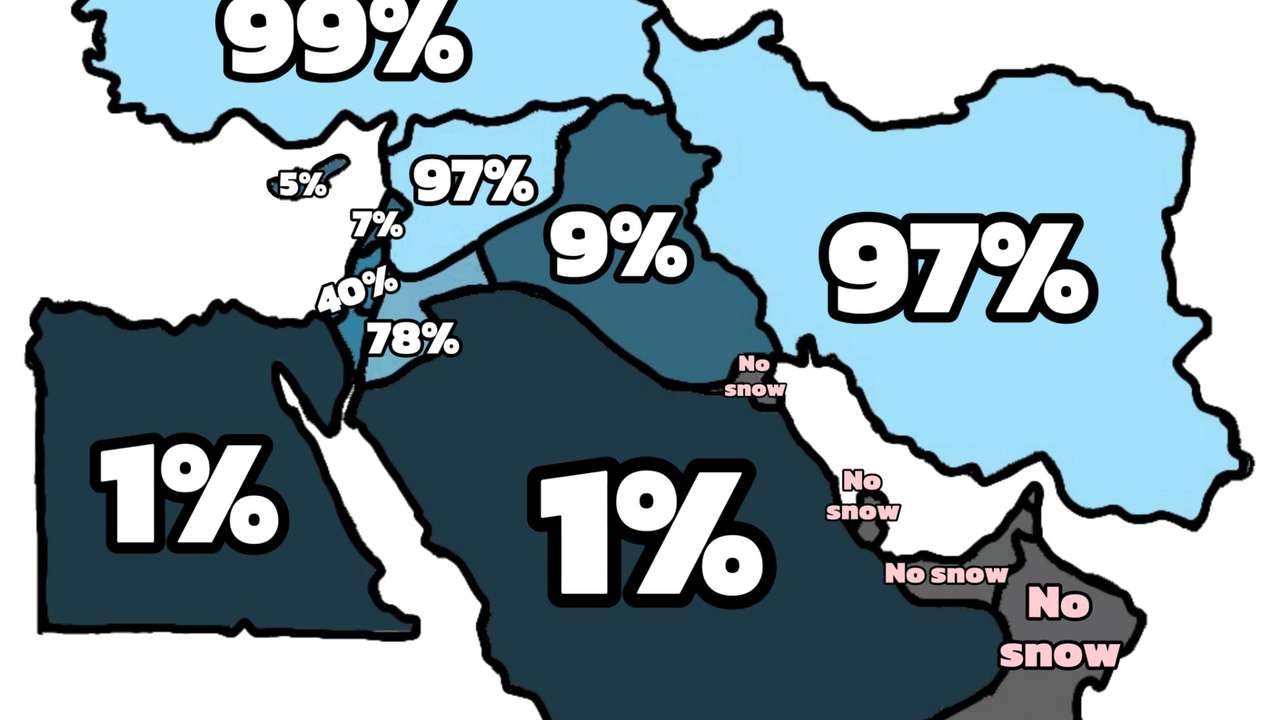
While some countries in the Middle East record snow almost every year, others have virtually no chance of witnessing it at all.
While some countries in the Middle East record snow almost every year, others have virtually no chance of witnessing it at all.
At the highest end of the scale is Ankara, where snowfall probability reaches 99%, consistent with long-term observations from the Turkish State Meteorological Service, which documents regular annual snowfall in the Turkish capital.
Similarly, Tehran records a 97% likelihood of snow. Its position at the base of the Alborz Mountains has long made winter snowfall a normal occurrence in the Iranian capital.
By contrast, several Gulf capitals, including Riyadh, Abu Dhabi, Doha, and Muscat, are shown with no measurable chance of snow. Data from the World Bank Climate Change Knowledge Portal supports this assessment, with average winter temperatures in these cities staying far above freezing levels.
RECOMMENDED FOR YOU

More than 6 billion people are now online as global internet access reaches new high
Between these climatic extremes lie countries such as Jordan and Iraq. Amman shows a 40% probability of receiving snow, reflecting both its elevation and its periodic winter storms.
Baghdad, listed at 7%, rarely records snowfall, though it did experience a notable event in early 2020, a weather anomaly widely covered at the time.
The World Meteorological Organisation (WMO) has reported that although global temperatures continue to rise, cold-air outbreaks and winter extremes remain possible due to climate variability and atmospheric disturbances.
"There is an 80% chance that at least one year between 2025 and 2029 will be warmer than the warmest year on record (currently 2024). And there is an 86% chance that at least one year will be more than 1.5°C above the pre-industrial level. The report does not give global predictions for individual years," WMO reports.
This story is written and edited by the Global South World team, you can contact us here.