Why China dominates global manufacturing
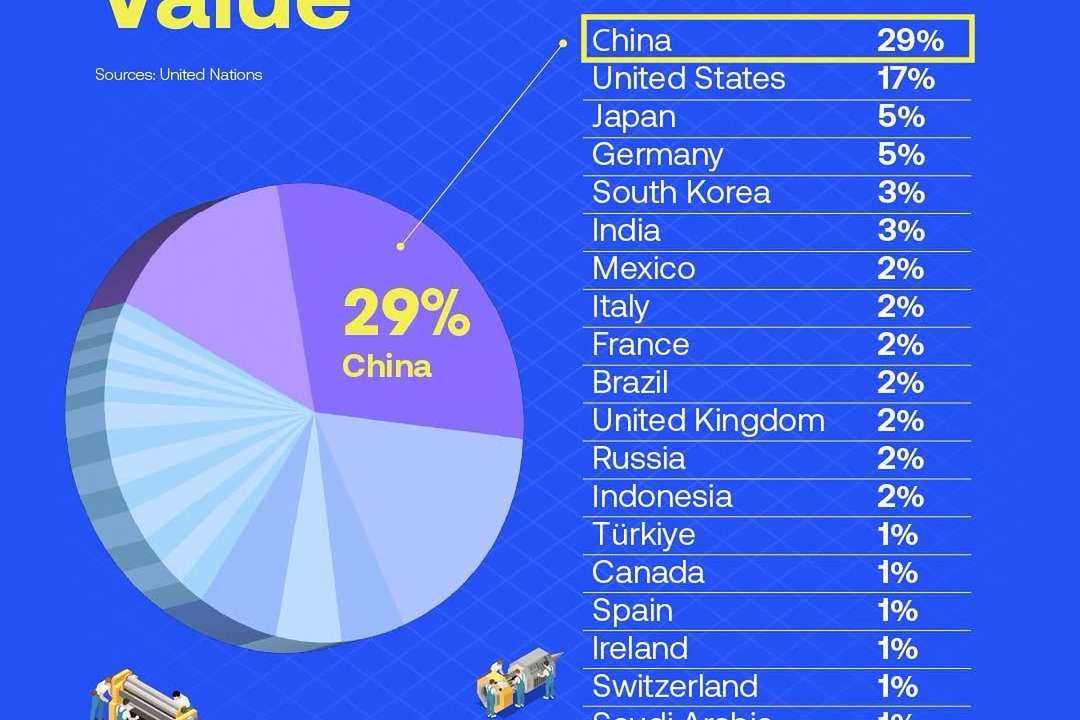
China continues to assert its dominance as the world’s manufacturing powerhouse, accounting for 29% of the global manufacturing value, according to the latest data from the United Nations. This figure places China significantly ahead of the United States (17%), Japan (5%), and Germany (5%).
In 2023, China’s manufacturing output soared to $4.8 trillion, accounting for 27% of the country’s GDP—a testament to its vast industrial capacity and deep supply chain integration.
China’s industrial power is anchored in heavy sectors such as metallurgy and machine-building, which together contribute nearly 40% of total industrial production. Meanwhile, consumer goods and synthetic textiles continue to fuel export growth, and products like fertilisers and plastics further cement China’s crucial role in global manufacturing networks.
Here are more reasons why the country continues to lead:
1. Scale and infrastructure
China boasts an unmatched industrial ecosystem—from raw material suppliers to component makers to end-product assemblers. Its robust infrastructure—ports, highways, and logistics networks—enables rapid and cost-effective production and distribution.
2. Labour force and efficiency
With a vast and increasingly skilled workforce, China maintains competitive labour costs while improving efficiency and quality. The shift toward automation and Industry 4.0 technologies further boosts productivity.
3. Global supply chain integration
China is deeply embedded in global supply chains. From electronics to textiles and heavy machinery, multinational corporations rely heavily on Chinese factories for both components and final products.
4. Government support
Strategic initiatives like “Made in China 2025” aim to transition the country from low-end manufacturing to high-tech industries, including robotics, aerospace, and electric vehicles. Substantial government incentives and subsidies bolster domestic innovation and global competitiveness.
The rest of the world: A mixed picture
While the United States remains a strong contender with 17%, much of its manufacturing value lies in high-end technology, aerospace, pharmaceuticals, and automotive industries. However, outsourcing to countries like Mexico and India has impacted its share.
Other countries contributing significantly include:
- Japan and Germany (5%): Known for advanced manufacturing and precision engineering.
- South Korea and India (3%): Rising players in electronics, automobiles, and pharmaceuticals.
- Mexico, Italy, France, Brazil, the UK, and Russia (2% each): Regional industrial hubs with specialised outputs.
- Emerging Economies: Indonesia, Turkey, and others contribute 1–2%, while the "Other" category collectively holds 15%, indicating diversified and growing manufacturing capacities worldwide.