Why the world is dotted with Santa Cruz, Sainte-Croix and Santa Croce
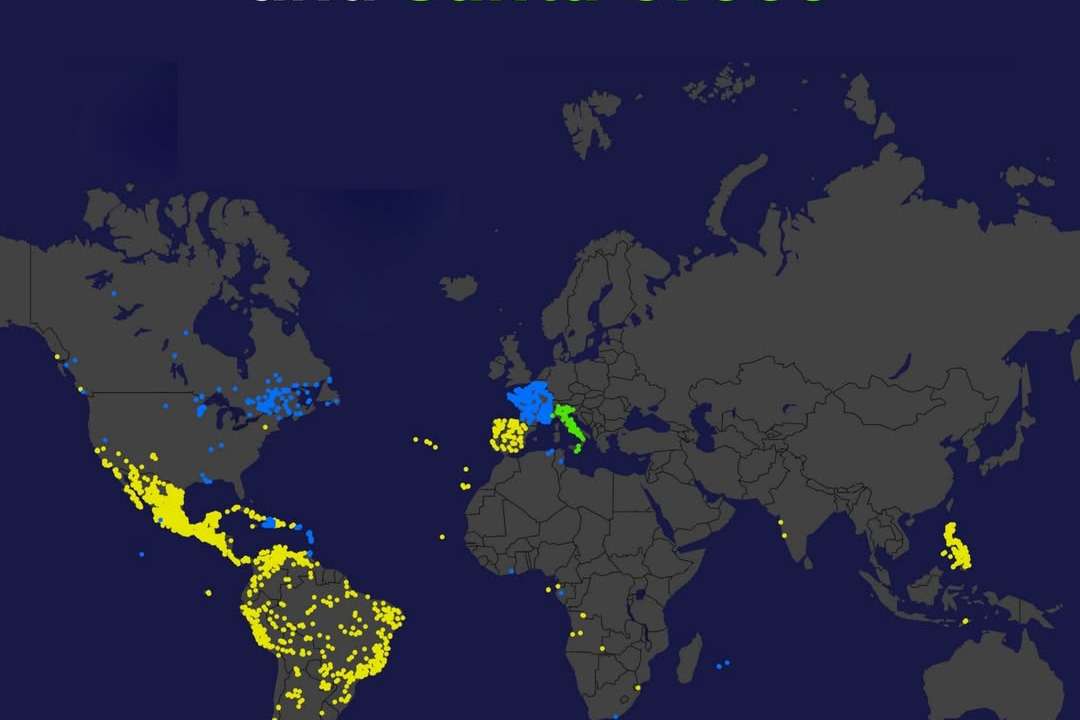
Across continents and oceans, the same place name appears again and again: Santa Cruz, Sainte-Croix, and Santa Croce. Whether in Latin America, the Caribbean, Europe, Africa, or parts of Asia, these names, translated from Spanish, French, and Italian, mean the same thing: “Holy Cross.”
Across continents and oceans, the same place name appears again and again: Santa Cruz, Sainte-Croix, and Santa Croce. Whether in Latin America, the Caribbean, Europe, Africa, or parts of Asia, these names, translated from Spanish, French, and Italian, mean the same thing: “Holy Cross.”
Their global spread is not a coincidence but the result of centuries of European exploration, colonisation, and Christian missionary activity that permanently reshaped the world’s maps.
From the 15th century onward, European empires used place-naming as both a religious expression and a political tool. Catholic explorers from Spain, Portugal, France, and Italy frequently named newly charted lands after Christian symbols, saints, or religious feast days. The cross, as the central symbol of Christianity, became one of the most common references.
According to Britannica, European colonial powers routinely imposed familiar religious names on foreign landscapes as a means of asserting ownership and spiritual authority over newly acquired territories. Naming was part of the broader colonial system that linked faith, empire, and governance.
RECOMMENDED FOR YOU

GTA V dominates global search interest as Grand Theft Auto VI nears release
The Spanish version, Santa Cruz, dominates the map largely because of Spain’s vast colonial reach. At its height in the 16th and 17th centuries, the Spanish Empire controlled most of Latin America, large parts of the Caribbean, and territories in Asia, including the Philippines.
Cities such as Santa Cruz de la Sierra (Bolivia), Santa Cruz (California), and Santa Cruz (Tenerife, Spain) were named during different waves of Spanish expansion and missionary settlement. Many of these places were established near missions, forts, or religious outposts where Catholic clergy played a central role in administration and education.
The French equivalent, Sainte-Croix, appears most prominently in the Caribbean and parts of Europe. The best-known example is Saint Croix in the U.S. Virgin Islands. Originally inhabited by Indigenous Taíno peoples, the island passed through Spanish, French, and Danish control before being sold to the United States in 1917.
The name reflects France’s Catholic heritage and its colonial presence in the Caribbean during the 17th century, when sugar plantations and transatlantic trade drove European settlement.
Santa Croce, the Italian form, is most closely associated with Europe, particularly Italy itself. The Basilica di Santa Croce in Florence, one of the most important Franciscan churches in the world, helped popularise the name.
While Italy did not establish overseas colonies on the same scale as Spain or France until much later, Italian missionaries and religious orders still carried Catholic naming traditions abroad.