Afghanistan and Myanmar are the world’s most authoritarian states
A cluster of countries across Asia, Africa and the Middle East continues to dominate the lower end of global democracy rankings, underscoring a persistent divide in governance standards worldwide, according to data compiled from the Economist Intelligence Unit (EIU) Democracy Index and World Population Review.
A cluster of countries across Asia, Africa and the Middle East continues to dominate the lower end of global democracy rankings, underscoring a persistent divide in governance standards worldwide, according to data compiled from the Economist Intelligence Unit (EIU) Democracy Index and World Population Review.
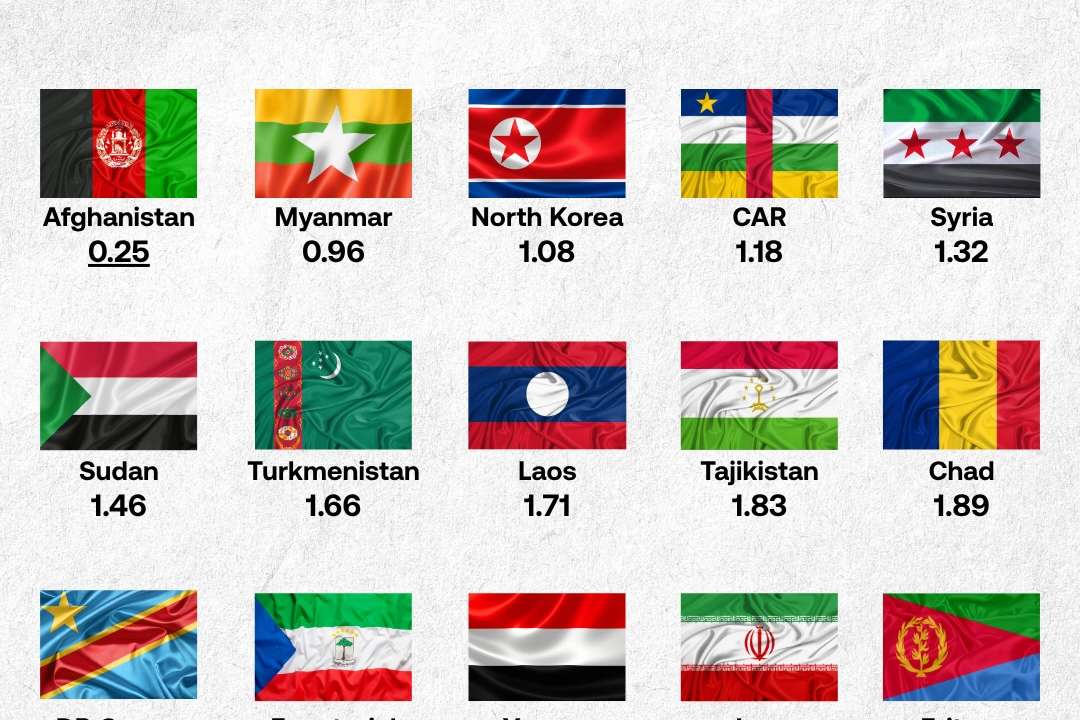
Afghanistan remains the most authoritarian country globally, with one of the lowest recorded democracy scores, followed closely by Myanmar and North Korea, based on recent index comparisons.
The EIU Democracy Index, which evaluates 167 countries on a scale from 0 to 10 across electoral processes, civil liberties, governance, political participation and political culture, classifies these nations firmly within the “authoritarian regime” category.
Visualised rankings show Afghanistan, Myanmar, North Korea, the Central African Republic and Syria among the countries with the weakest democratic performance, each scoring well below 2 out of 10.
RECOMMENDED FOR YOU

Houthis claim missile and drone attacks on Riyadh and Yanbu in Saudi Arabia
They are followed by Sudan, Turkmenistan, Laos, Tajikistan and Chad, nations where political power is highly centralised and electoral processes are either limited or tightly controlled.
Further down the list, countries such as the Democratic Republic of Congo, Equatorial Guinea, Yemen, Iran and Eritrea also register extremely low scores, reinforcing a pattern of restricted civil liberties and limited political pluralism.
World Population Review data confirms that Afghanistan has consistently ranked at the bottom of global democracy metrics in recent years, with little change in governance structures since 2021.
The EIU’s latest assessments indicate that roughly 60 countries worldwide fall into the authoritarian category, representing a significant portion of the global population.
In fact, more than one-third of people globally live under authoritarian rule, highlighting the scale of democratic decline.
Sub-Saharan Africa and the Middle East and North Africa remain the regions with the highest concentration of such regimes, according to comparative index data.
Despite years of decline, the EIU reported in its 2025 index that global democracy scores have begun to stabilise, with the average inching up slightly to 5.19 after hitting historic lows.
Persistently low scores in the most authoritarian countries are attributed to a mix of prolonged conflict, military control, weak institutions and restrictions on political freedoms.
RECOMMENDED FOR YOU
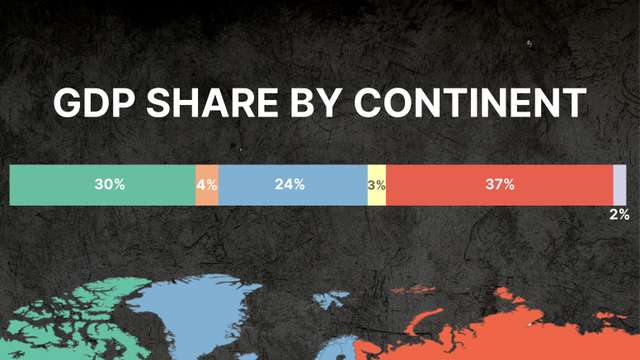
Asia produces the largest share of global GDP
In several cases, including Afghanistan, Syria and Yemen, ongoing instability and war have severely limited democratic processes. In others, such as North Korea and Turkmenistan, entrenched leadership structures and limited political competition continue to define governance.