AI-written articles now account for about half of online publishing
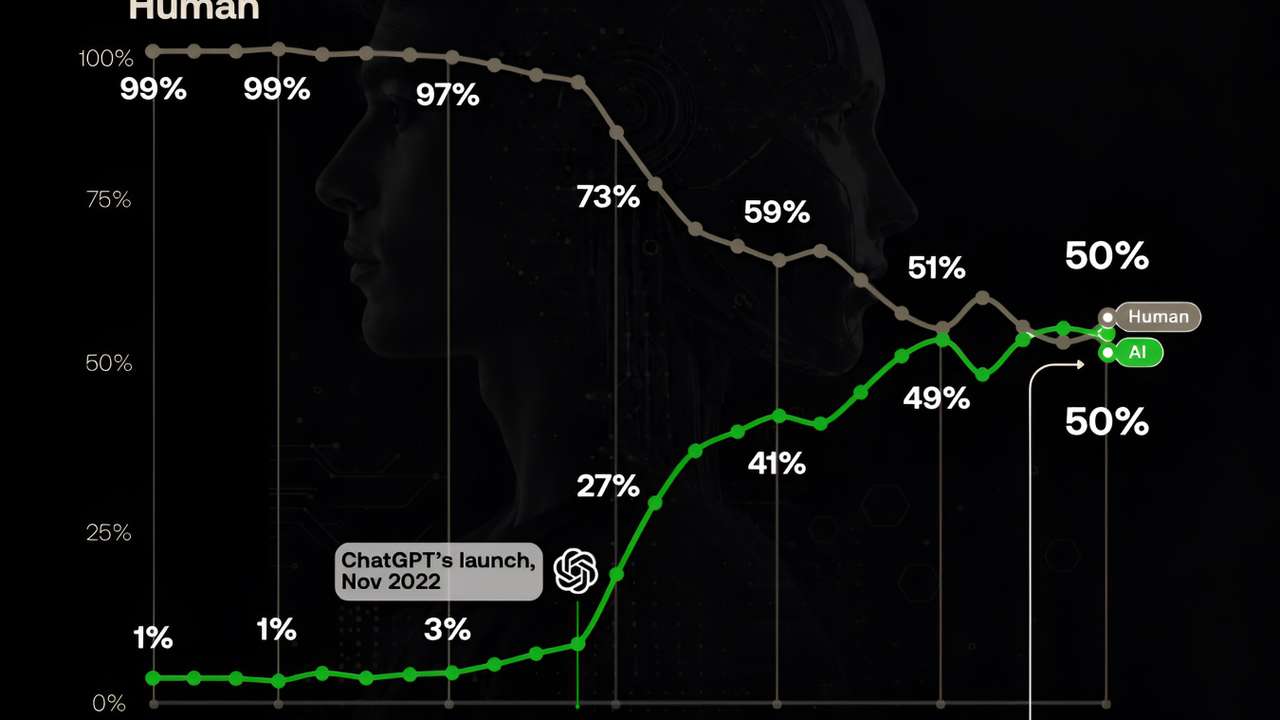
AI-generated articles rose sharply after ChatGPT’s launch, but their share has stayed close to 50% since early 2025
Main Points
- AI-generated articles reached 49.9% in early 2026.
- AI publishing surged after ChatGPT launched in 2022.
- AI-written content has stayed near 50% since early 2025.
Artificial intelligence now produces about half of newly published online articles, according to a study by digital growth company Graphite, showing how quickly AI has become part of web publishing.
Graphite found that 49.9% of articles published in the first quarter of 2026 were primarily AI-generated, while 50.1% were primarily human-written.
The study analysed 55,400 English-language articles collected through Common Crawl. The articles were published between January 2020 and March 2026, contained at least 100 words and were identified as articles or listicles.
Before ChatGPT was released in November 2022, Graphite found that almost all articles in its sample were classified as human-written.
RECOMMENDED FOR YOU

Asia and Europe dominated the world’s biggest cities in 1700
That changed rapidly after the chatbot became widely available. Within 12 months of ChatGPT’s launch, 35.9% of published articles were primarily AI-generated. After two years, the figure had risen to about 48%.
By the first quarter of 2025, AI-generated articles accounted for 49.6% of publishing, compared with 50.4% for human-written articles.
AI briefly moved ahead in the fourth quarter of 2025, reaching 50.9%, before falling slightly to 49.9% in the first quarter of 2026.
Despite the rapid rise, Graphite found that AI-generated publishing has stopped gaining significant ground.
The share has remained close to 50% for five consecutive quarters, suggesting that the sharp increase seen after ChatGPT’s launch has levelled off.
Graphite suggested that weaker performance in online search could be one reason for the slowdown, but it did not establish this as the cause.
A separate Graphite study found that human-written articles still dominate Google results. About 86% of articles appearing in Google Search were classified as human-written, compared with 14% generated by AI. Only 7% of articles ranking first on Google were classified as AI-generated.
Human-written articles also represented 82% of articles cited by ChatGPT and Perplexity, compared with 18% for AI-generated articles in Graphite’s study.
RECOMMENDED FOR YOU

Argentina equals Germany's record with fourth FIFA World Cup final defeat
Graphite used three AI-detection tools — Pangram, Copyleaks and GPTZero — to classify the articles. It calculated quarterly estimates from each detector and averaged the results.
The company reported false-positive and average false-negative rates below 2% in its tests. However, Graphite also acknowledged important limits to the research, including the difficulty of identifying articles initially generated by AI but later heavily rewritten by humans.
The findings therefore do not mean that exactly half of everything published on the internet is written entirely by AI. They show that, within Graphite’s sample and methodology, roughly half of newly published English-language articles were classified as primarily AI-generated.
This story is written and edited by the Global South World team, you can contact us here.