Analysis-Barring last-minute nuclear deal, US and Russia teeter on brink of new arms race
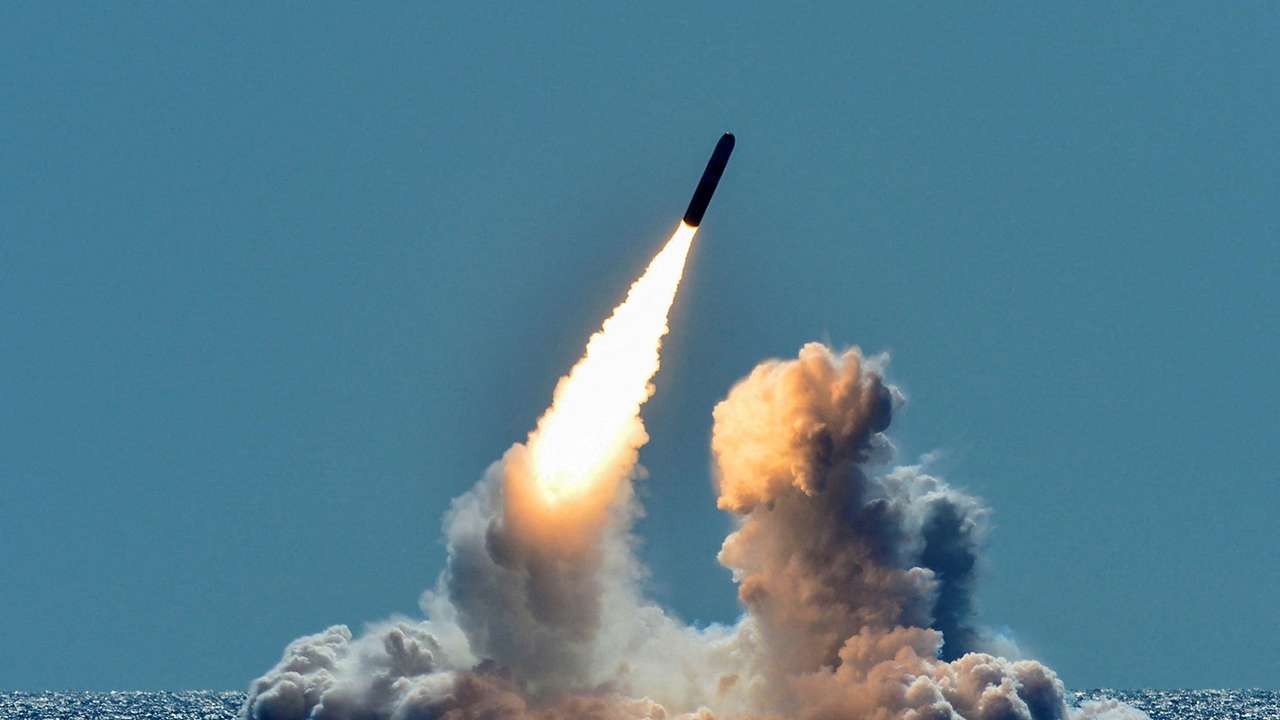
The United States and Russia could embark on an unrestrained nuclear arms race for the first time since the Cold War, unless they reach an eleventh-hour deal before their last remaining arms control treaty expires in less than a week.
The New START treaty is set to end on February 5. Without it, there would be no constraints on long-range nuclear arsenals for the first time since Richard Nixon and Soviet leader Leonid Brezhnev signed two historic agreements in 1972 on the first-ever trip by a U.S. president to Moscow.
Russian President Vladimir Putin has proposed the two sides should stick to existing missile and warhead limits for one more year to buy time to work out what comes next, but U.S. President Donald Trump has yet to formally respond.
Trump said this month that "if it expires, it expires", and that the treaty should be replaced with a better one.
RECOMMENDED FOR YOU
Explosions at Taiwan waste site injure 15, damage dozens of homes
Some U.S. politicians argue Trump should reject Putin's offer, freeing Washington to grow its arsenal to counter a rapid nuclear build-up by a third power: China.
Trump says he wants to pursue "denuclearisation" with both Russia and China. But Beijing says it is unreasonable to expect it to join disarmament talks with two countries whose arsenals are still far larger than its own.
WHY DO NUCLEAR TREATIES MATTER?
Since the darkest Cold War days when the United States and the Soviet Union threatened each other with "mutually assured destruction" in the event of nuclear war, both have seen arms limitation treaties as a way to prevent either a lethal misunderstanding or an economically ruinous arms race.
The treaties not only set numerical limits on missiles and warheads, they also require the sides to share information - a critical channel to "try to understand where the other side is coming from and what their concerns and drivers are", said Darya Dolzikova at the RUSI think-tank in London.
With no new treaty, each would be forced to act according to worst-case assumptions about the weapons the other is producing, testing and deploying, said Nikolai Sokov, a former Soviet and Russian arms negotiator.
"It's a self-sustaining kind of process. And of course, if you've got an unregulated arms race, things will get quite destabilising," he said.
NEW TREATY NO SIMPLE TASK
RECOMMENDED FOR YOU

Poland's wealth boom leaves old money behind
Since the fall of the Soviet Union, Russia and the United States have repeatedly replaced and updated the Cold War-era treaties that limited the so-called strategic weapons they point at each other's cities and bases.
The most recent, New START, was signed in 2010 by U.S. President Barack Obama and Dmitry Medvedev, a Putin ally who was then serving as Russian president for four years.
It caps the number of deployed strategic warheads at 1,550 on each side, with no more than 700 systems to deliver them from land, sea or air, by intercontinental ballistic missile, submarine-launched missile or heavy bomber.
Replacing it with a new treaty would be no simple task. Russia has developed new nuclear-capable systems - the Burevestnik cruise missile, the hypersonic Oreshnik and the Poseidon torpedo - that fall outside New START's framework. And Trump has announced plans for a space-based "Golden Dome" missile defence system that Moscow sees as an attempt to shift the strategic balance.
Meanwhile, China's arsenal is growing, unchecked by agreements between Washington and Moscow. Beijing now has an estimated 600 warheads and the Pentagon estimates it will have more than 1,000 by 2030.
A bipartisan Congressional commission in 2023 said the United States was now facing an "existential challenge" from not one but two nuclear peers, and needed to be prepared for simultaneous wars with Russia and China.
Its recommendations included preparing to bring out of storage some or all of the strategic nuclear warheads removed under New START and kept in a reserve stockpile.
That could involve restoring warheads removed from Minuteman III intercontinental ballistic missiles and submarine-fired Trident D5s, and returning to nuclear roles some 30 B-52 strategic bomber planes converted to conventional missions.
RECOMMENDED FOR YOU
Hungary's Magyar calls for stronger military amid European uncertainty
"The warheads are there. The missiles are there. You’re not buying anything new," said a former senior U.S. official involved in nuclear weapons policy who requested anonymity.
The former official expected only "modest" increases in warhead reloads should Trump order those options.
But Kingston Reif, a former Pentagon official now at the RAND research organization, told a recent webinar that at the high end the United States could "roughly double" its deployed warheads from the New START limit, while Russia would be in a position to add around 800. Both sides would take at least the best part of a year to make significant changes, he said.
PUTIN'S OFFER DIVIDES VIEWS IN THE U.S.
In policy circles in the United States, views are divided on whether Trump should agree to Putin's offer to keep existing limits in place for a year.
Trump should take steps "to reduce the risk of a wasteful nuclear arms race and to reduce the risk of a catastrophic misinterpretation (of the other side’s intent) that could spiral out of control during a crisis," said Paul Dean, a former arms control official now with the Nuclear Threat Initiative, an advocacy group.
Arms control advocates point out that the United States is already facing huge expenses from a nuclear force modernization program - including a new submarine, bomber and ICBM – that is suffering serious delays and massive cost overruns.
The nonpartisan Congressional Budget Office estimates that it will cost U.S. taxpayers nearly $1 trillion between 2025 and 2034 to modernize, sustain and operate the nuclear forces.
RECOMMENDED FOR YOU
Zelensky fires army commander-in-chief Syrsky as protests sweep Ukraine
"If the U.S. exceeds New START limits by uploading warheads, Russia will do the same, and China will use it as another excuse to build up their nuclear arsenal," Democratic Senator Ed Markey, a leading arms control proponent, told Reuters.
"Ultimately, Trump will have started a new arms race that we do not need, nor can we win. More weapons will not make use safer."
On the other side of the debate, experts and former officials say the U.S. shouldn't trust Putin, noting that he halted mutual inspections under New START in 2023 because of U.S. support for Ukraine in its war with Russia.
Franklin Miller, a member of the bipartisan Congressional commission, said the threats from Russia and China require an increase in deployed U.S. strategic nuclear warheads.
"We now have to be able to deter Russia and China simultaneously," said Miller. "The force that the treaty confined the U.S. to in 2010 is not sufficient to address Russia and China together."
U.S. weapons requirements should increase, although "not radically, not monumentally," he said, in a process that would probably take several years.
Asked about Trump's intentions, a White House official said: "The president will decide the path forward on nuclear arms control, which he will clarify on his own timeline."
Medvedev, the former Russian president who signed New START, told the Kommersant newspaper that Trump was unpredictable.
RECOMMENDED FOR YOU
Spain’s migration minister faces protests during Ceuta visit
"Russia is prepared for any development. New threats to our security will be promptly and firmly countered," he said.
This article was produced by Reuters news agency. It has not been edited by Global South World.