Asia dominates oil flows through Strait of Hormuz
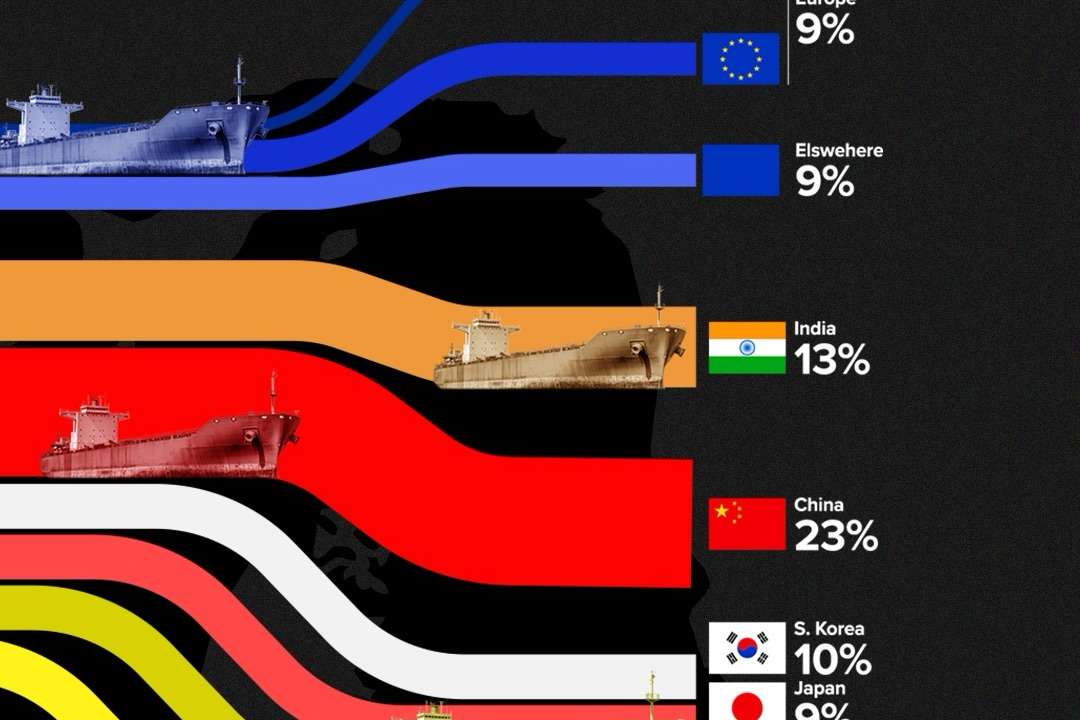
The bulk of oil and gas shipments passing through the Strait of Hormuz, one of the world’s most critical energy chokepoints, are heading overwhelmingly to Asia, underscoring the region’s dependence on Middle Eastern supplies.
The bulk of oil and gas shipments passing through the Strait of Hormuz, one of the world’s most critical energy chokepoints, are heading overwhelmingly to Asia, underscoring the region’s dependence on Middle Eastern supplies.
China is shown as the largest single destination, taking roughly 23% of flows, followed by India at 13%, with Japan, South Korea and Southeast Asia also accounting for significant shares.
According to the U.S. Energy Information Administration, around 84% of crude oil and condensate shipped through the Strait of Hormuz in 2024 was destined for Asian countries.
China, India, Japan and South Korea alone accounted for roughly 69% of total flows, making them the most exposed to any disruption.
RECOMMENDED FOR YOU

‘We will firmly defend our positions’ - Pezeshkian heads to UN
The International Energy Agency estimates that nearly a third of globally traded crude oil passes through the strait, with China and India together receiving about 44% of these exports.
The Strait of Hormuz handles around 20 million barrels of oil per day, roughly a fifth of global petroleum consumption, making it the most important oil transit chokepoint in the world.
It also carries a significant share of global liquefied natural gas, particularly exports from Qatar, one of the world’s largest LNG suppliers.
Despite its importance, alternatives remain limited. Pipelines in Saudi Arabia and the United Arab Emirates can bypass part of the route, but cannot fully replace their capacity in the event of a disruption.
By contrast to Asia, Western economies account for a much smaller share of direct imports.
The United States and Europe together receive less than 10% of oil flows through the strait, reflecting increased domestic production in the U.S. and diversified supply chains in Europe.
In 2024, the U.S. imported only about 7% of its crude oil from Persian Gulf countries via the strait, highlighting its reduced dependence compared with previous decades.
The Strait’s strategic importance has made it a recurring focal point of geopolitical tension.
RECOMMENDED FOR YOU

Explosions at Taiwan waste site injure 15, damage dozens of homes
Recent conflicts involving Iran, Israel, and the USA have once again highlighted the vulnerability of global energy supply chains, with shipping disruptions triggering price volatility and raising fears of broader economic fallout.