Australia and U.S. lead the world in home size as housing space reflects lifestyle trends
Homes in Australia and the United States are among the largest in the world, according to international housing data, highlighting how geography, urban planning and lifestyle preferences shape residential living space across countries.
Homes in Australia and the United States are among the largest in the world, according to international housing data, highlighting how geography, urban planning and lifestyle preferences shape residential living space across countries.
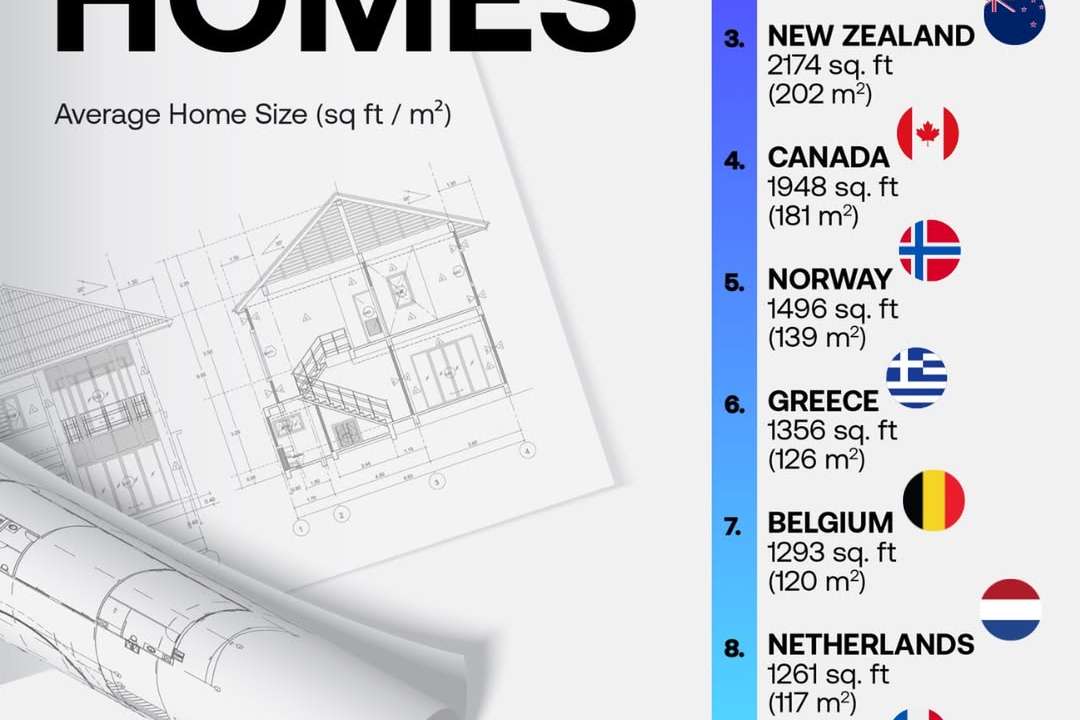
Figures compiled by World Population Review show that Australia ranks first globally for average home size, followed closely by the United States and New Zealand.
Australia's residential properties average about 2,303 square feet (214 square metres).
The large average reflects Australia’s suburban development patterns, relatively lower population density and a long-standing cultural preference for detached houses.
RECOMMENDED FOR YOU

More than 6 billion people are now online as global internet access reaches new high
Many Australian homes include large outdoor spaces, multiple bedrooms and expansive living areas, features common in suburban developments across cities such as Sydney, Melbourne and Brisbane.
The United States ranks second globally, with the average new single-family home measuring roughly 2,299 square feet, according to data from the U.S. Census Bureau.
American housing has historically grown larger over the decades, driven by suburban expansion and consumer demand for bigger living spaces.
U.S. housing statistics show that new homes often include features such as large kitchens, garages and open-plan layouts, contributing to the country’s high average residential floor area.
New Zealand follows closely with an average home size of about 2,174 square feet (202 square metres).
Canada ranks fourth, with average homes around 1,948 square feet (181 square metres), reflecting similar suburban development trends seen in North America and parts of Oceania.
Both countries have relatively low population densities compared with many European nations, allowing for larger residential developments.
European countries generally have smaller homes on average, largely due to higher population density, historic urban design and different housing traditions.
RECOMMENDED FOR YOU
Asia produces the largest share of global GDP
Norway ranks fifth globally with homes averaging 1,496 square feet, followed by Greece at 1,356 square feet and Belgium at 1,293 square feet.
The Netherlands and France also appear in the top ten, with average homes measuring around 1,261 square feet and 1,206 square feet, respectively.
Spain rounds out the list with an average home size of 1,044 square feet, reflecting the country’s high proportion of apartment living in urban areas.