Brazil election poll shows Lula at 40% and Flávio Bolsonaro at 36% in first round
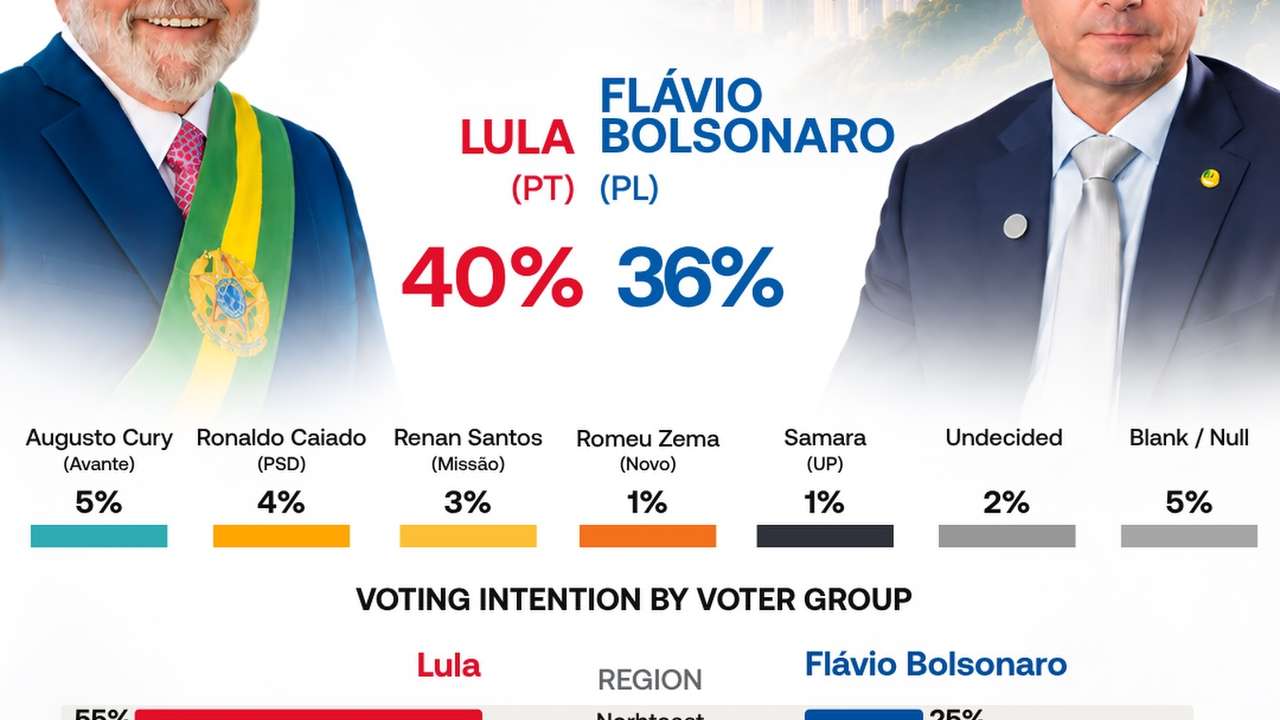
Brazilian President Luiz Inácio Lula da Silva has 40% support against 36% for Senator Flávio Bolsonaro in a first-round presidential election scenario, according to a Datafolha poll conducted on September 22 and 23.
Main points
- Lula has 40% to Flávio Bolsonaro’s 36%
- Support differs sharply by region and religion
- The poll has a two-point margin of error
Brazilian President Luiz Inácio Lula da Silva has 40% support against 36% for Senator Flávio Bolsonaro in a first-round presidential election scenario, according to a Datafolha poll conducted on September 22 and 23.
The four-point gap puts the two candidates at the limit of the poll’s overall margin of error of two percentage points in either direction. Datafolha said the figures indicate a narrow advantage for Lula rather than a clear-cut lead.
Other candidates remain well behind. Writer Augusto Cury of Avante has 5%, Ronaldo Caiado of PSD 4% and Renan Santos of Missão 3%. Romeu Zema of Novo and Samara of UP each have 1%. Another 5% would cast a blank or null vote, while 2% are undecided.
Lula performs strongest in the Northeast, where 55% back him compared with 25% for Flávio Bolsonaro. In the South, the pattern reverses, with Bolsonaro at 47% and Lula at 31%.
RECOMMENDED FOR YOU

Israel's Eisenkot begins coalition talks, calls for national emergency government
The race is closer in Brazil's other regions. Bolsonaro records 37% to Lula's 35% in the Southeast, while he has 41% against Lula's 33% across the combined Central-West and North. Given the larger margins of error for these regional samples, Datafolha describes both differences as statistical ties.
Voting intentions differ substantially between Brazil's two largest Christian groups.
Among Catholic voters, Lula has 45% support compared with Bolsonaro's 33%. Among evangelicals, Bolsonaro has 47%, while Lula receives 27%.
Other demographic divisions are also visible. Lula leads 42% to 33% among women and 49% to 29% among voters with only primary education. Bolsonaro records stronger numbers among higher-income voters, although the smaller samples mean some of those differences fall within the relevant margins of error.
The survey interviewed 2,002 voters aged 16 and over in 125 municipalities on September 22 and 23. It has an overall margin of error of two percentage points at a 95% confidence level and is registered with Brazil's electoral authorities as BR-00304/2026.
With the first round approaching, the poll provides a snapshot of voting intentions rather than an election forecast. It also shows that Brazil's presidential contest remains strongly divided by region, religion, income and education.
This story is written and edited by the Global South World team, you can contact us here.