China and Singapore lead world's top-performing education systems in PISA 2025 rankings
China and Singapore have emerged as the strongest performers in the latest global education assessment, even as students across many developed countries struggle with declining reading and mathematics skills.
Main points
- China leads in science and mathematics.
- Singapore tops reading and ranks highly in problem-solving.
- OECD reading and mathematics scores continue to fall.
China and Singapore have emerged as the strongest performers in the latest global education assessment, even as students across many developed countries struggle with declining reading and mathematics skills.
The Organisation for Economic Co-operation and Development (OECD) released its PISA 2025 Results (Volume I): Future-Ready Students report on September 8, 2026. It assessed more than 760,000 15-year-olds across 91 countries and economies in science, reading, mathematics and computational problem-solving.
China and Singapore dominate global rankings
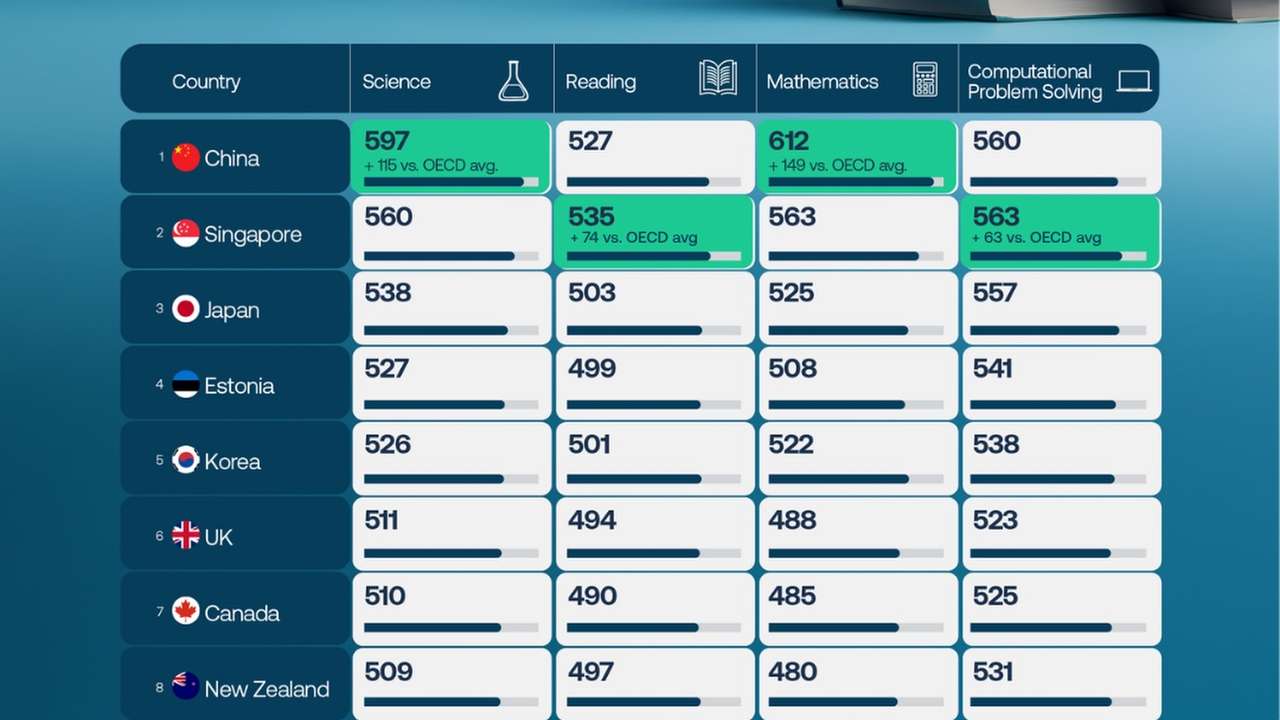
The Chinese regions of Beijing, Shanghai, Jiangsu and Zhejiang recorded the highest scores in science and mathematics, with 597 and 612 points respectively. Singapore followed with 560 in science and 563 in mathematics, while leading reading with 535 points.
Singapore also scored 563 in computational problem-solving, behind Macao's 572 points. The Chinese regions scored 560.
RECOMMENDED FOR YOU

Six countries account for three-quarters of Europe’s unicorn startups
Japan, Estonia and South Korea were among the other strong performers. Japan scored 538 in science, followed by Estonia with 527 and South Korea with 526. The United Kingdom, Canada, New Zealand, Australia and Finland also performed well in science.
The results, highlighted in a World Visualized infographic, show that Asian education systems remain among the strongest internationally. However, the OECD measures student performance rather than producing a single overall ranking of the world's most competitive education systems.
Reading and mathematics skills decline
Despite strong results in several countries, the OECD warned that learning outcomes are worsening across much of the developed world.
Between 2015 and 2025, average reading scores across OECD countries fell by 28 points, while mathematics scores dropped by 22 points. Science performance declined more modestly.
The report also found that about one in five students across OECD countries performed below the basic proficiency level in all three core subjects, up from 16% in 2022.
The OECD said the findings highlight the need to strengthen basic learning skills, improve teaching and reduce digital distractions in classrooms as schools prepare students for an increasingly technology-driven world.
This story is written and edited by the Global South World team, you can contact us here.