China records East Asia's highest youth unemployment
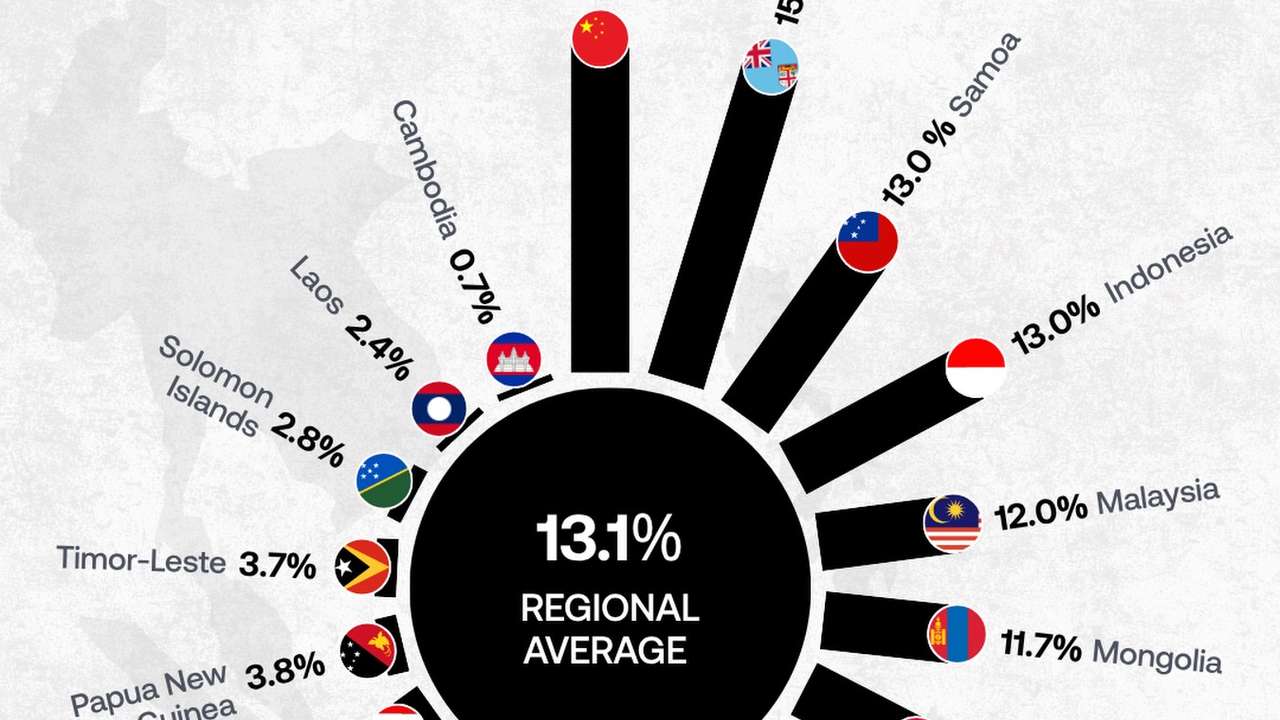
China recorded the highest youth unemployment rate in East Asia and the Pacific in 2025 at 15.8%, narrowly ahead of Fiji's 15.2%, while Cambodia reported the region's lowest rate at just 0.7%.
Main Points
- China records East Asia's highest youth unemployment
- Cambodia has the region's lowest youth unemployment
- One in eight young workers is unemployed across the region
China recorded the highest youth unemployment rate in East Asia and the Pacific in 2025 at 15.8%, narrowly ahead of Fiji's 15.2%, while Cambodia reported the region's lowest rate at just 0.7%.
The data, compiled by the World Bank using ILO-modeled estimates and referenced by the Asian Development Bank (ADB), measure the share of the labour force aged 15 to 24 who are unemployed but actively seeking work.
China topped the regional rankings with 15.8%, followed by Fiji (15.2%), Samoa (13.0%) and Indonesia (13.0%). Malaysia recorded 12.0%, Mongolia 11.7%, Vanuatu 11.3%, Myanmar 9.8%, South Korea 7.6%, the Philippines 7.0%, Vietnam 6.2% and Tonga 6.0%.
Lower youth unemployment rates were recorded in Thailand (4.5%), Papua New Guinea (3.8%), Timor-Leste (3.7%), Solomon Islands (2.8%), Laos (2.4%) and Cambodia (0.7%).
RECOMMENDED FOR YOU

More than 6 billion people are now online as global internet access reaches new high
Across the region, the average youth unemployment rate stood at 13.1%, meaning that roughly one in eight young people participating in the labour market was unable to find work.
The ILO defines unemployed young people as those without work, available to start employment and actively searching for a job. The estimates exclude people who are not participating in the labour force, such as students who are not seeking employment.
China's elevated youth unemployment has remained a major economic concern in recent years as slowing economic growth, a weak property sector and reduced hiring in technology, education and real estate have limited opportunities for new graduates. Chinese authorities have expanded vocational training programmes and introduced measures aimed at encouraging private-sector hiring, while continuing to promote entrepreneurship among young people.
In several Pacific island economies, including Fiji and Samoa, youth unemployment remains relatively high despite recovering tourism. Economists have linked the figures to limited formal employment opportunities, dependence on seasonal industries and the migration of skilled workers overseas.
By contrast, countries such as Cambodia, Laos and Thailand report much lower unemployment rates among young people. The World Bank and ILO caution, however, that low unemployment does not necessarily indicate strong labour markets. In many lower-income economies, young people often enter informal or low-paid work out of necessity rather than remaining unemployed while searching for formal jobs.
The Asian Development Bank has warned that improving the quality of education, strengthening technical and vocational training, and expanding access to higher-productivity jobs will be essential as East Asia and the Pacific continues to face demographic change, technological disruption, and evolving labour market demands.
This story is written and edited by the Global South World team, you can contact us here.