Dhaka set to overtake Jakarta as the world's largest urban agglomeration by 2050
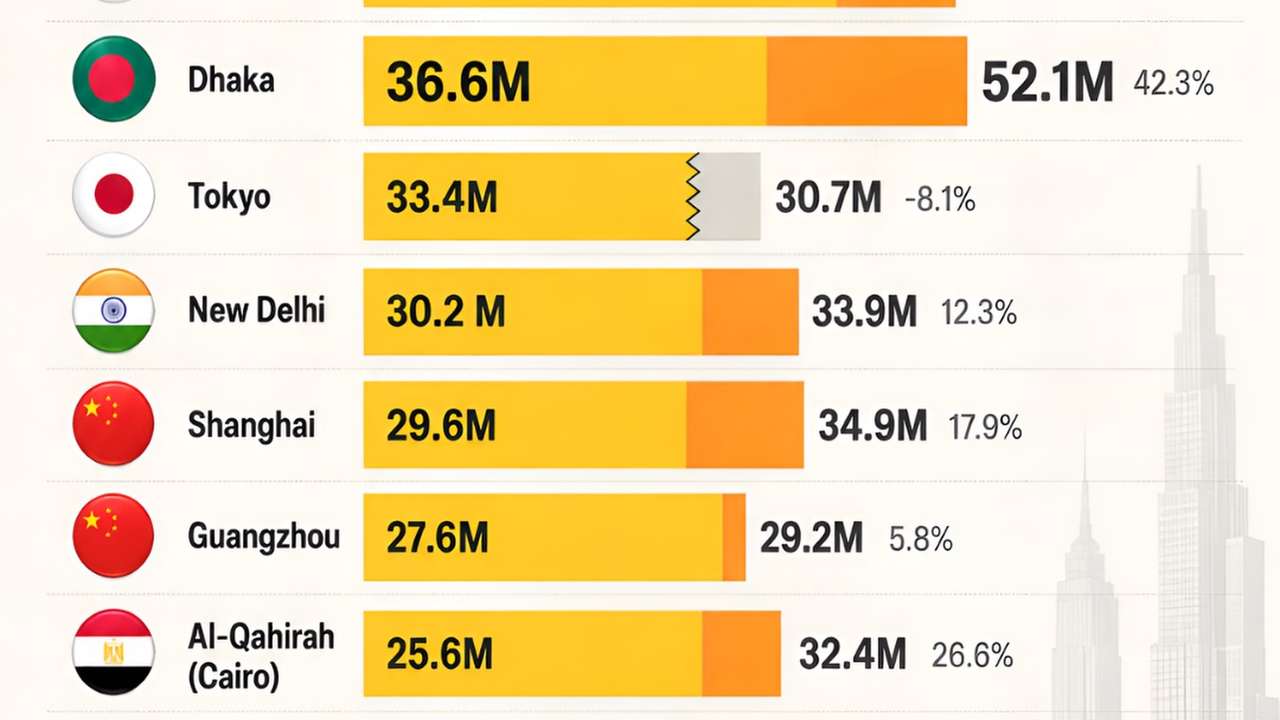
Dhaka is projected to become the world's largest urban agglomeration by 2050, surpassing Jakarta with an estimated population of 52.1 million, according to the United Nations' World Urbanisation Prospects 2025.
Main Points
- Dhaka is projected to become the world's largest megacity
- Tokyo and Seoul are expected to shrink by 2050
- Most future urban growth will occur in Asia and Africa
Dhaka is projected to become the world's largest urban agglomeration by 2050, surpassing Jakarta with an estimated population of 52.1 million, according to the United Nations' World Urbanisation Prospects 2025.
The UN projects Bangladesh's capital will grow from 36.6 million people in 2025 to 52.1 million by 2050, an increase of 42.3%. Jakarta, currently the world's largest urban agglomeration, is forecast to expand from 41.9 million to 51.8 million, representing 23.6% growth over the same period.
The projections define an urban agglomeration as the contiguous built-up area or densely populated settlement surrounding a city, regardless of administrative boundaries. This often includes central cities, suburbs and neighbouring municipalities that function as a single urban area.
India's New Delhi is expected to remain among the world's fastest-growing megacities, increasing from 30.2 million to 33.9 million residents by 2050, while Shanghai is projected to grow from 29.6 million to 34.9 million. Guangzhou is forecast to record more modest growth, rising from 27.6 million to 29.2 million.
RECOMMENDED FOR YOU

More than 6 billion people are now online as global internet access reaches new high
Africa's largest city, Cairo (Al-Qahirah), is projected to experience one of the strongest increases among the world's biggest urban areas. Its population is expected to rise from 25.6 million in 2025 to 32.4 million by 2050, a 26.6% increase driven by continued population growth and urban expansion.
The Philippines' capital region, Manila, is forecast to grow from 24.7 million to 27.1 million, while Kolkata is expected to increase from 22.6 million to 23.8 million.
Not all megacities are expected to expand. The United Nations projects Tokyo's urban agglomeration will decline from 33.4 million people in 2025 to 30.7 million by 2050, a fall of 8.1%, reflecting Japan's ageing population, low fertility and long-term population decline.
Similarly, Seoul is forecast to shrink from 22.5 million to 21.2 million, a 5.8% decline, as South Korea continues to record some of the world's lowest birth rates.
According to the UN, nearly 70% of the global population is expected to live in urban areas by 2050, up from about 57% today. Most future urban growth will be concentrated in Asia and Africa, where cities are expanding rapidly due to population growth, rural-to-urban migration and economic development.
The UN says governments will need to invest in housing, transport, water, sanitation, healthcare and climate resilience to accommodate growing urban populations while maintaining sustainable development.
This story is written and edited by the Global South World team, you can contact us here.