EU opens door to Canada becoming its first associate member
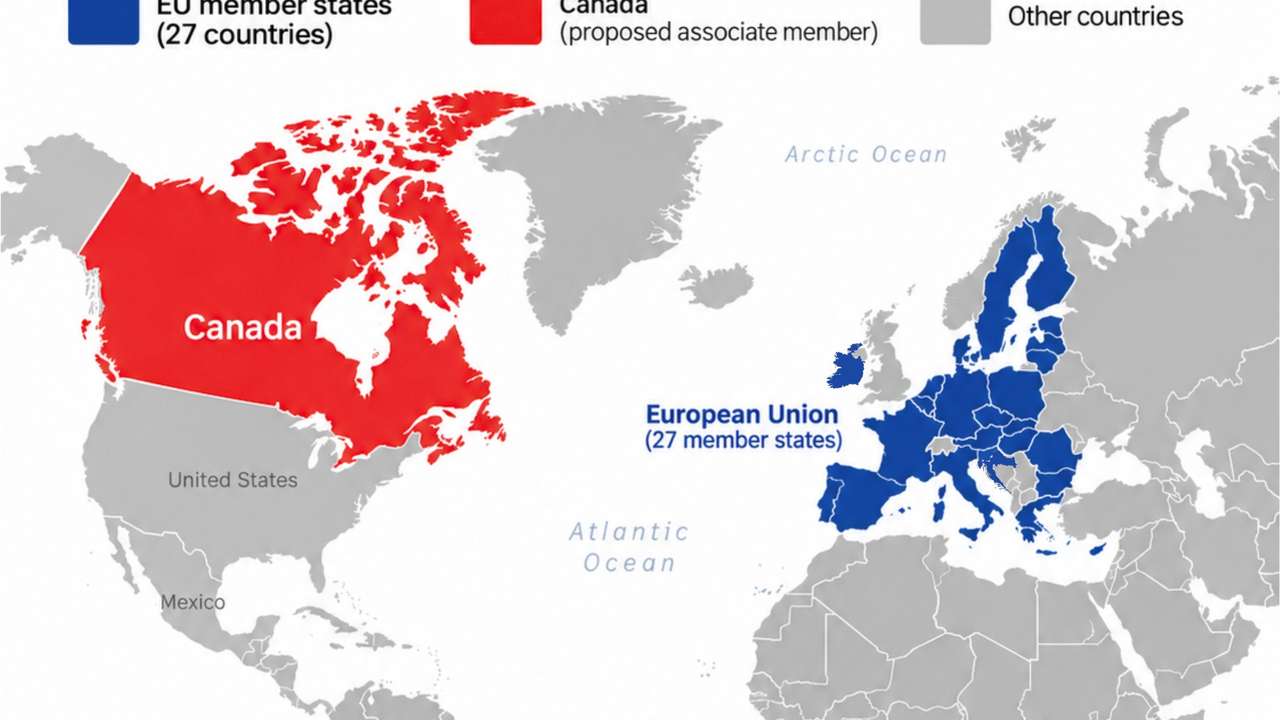
Canada could become the European Union’s first “associate member” under a proposal unveiled by European Commission President Ursula von der Leyen, potentially creating a new level of cooperation between the 27-member bloc and one of its closest non-European partners.
Key points
- EU chief proposes associate membership for Canada
- The new status has not yet been defined
- Canada says it is not seeking full EU membership
Canada could become the European Union’s first “associate member” under a proposal unveiled by European Commission President Ursula von der Leyen, potentially creating a new level of cooperation between the 27-member bloc and one of its closest non-European partners.
Von der Leyen raised the idea in her State of the Union address on September 16, 2026, attended by Canadian Prime Minister Mark Carney. She said the EU wanted to take relations with Canada to the “highest level possible” and proposed opening the door to Canada becoming the bloc’s first associate member.
The proposal does not mean Canada is joining the European Union. No formal associate membership structure currently exists, and von der Leyen did not set out what rights, obligations or access such a status would give Canada.
Carney has also said Canada is not seeking full EU membership, instead describing the goal as a “unique alliance” with Europe. Details are expected to be developed through further talks, with the next EU-Canada summit scheduled for October 29-30 in Montreal.
RECOMMENDED FOR YOU
Europe leads world in milk and dairy consumption at 221 kg per person
Canada and EU are already moving closer
The proposal comes after a series of agreements that have brought Canada deeper into European economic, research and security programmes.
Canada already has a comprehensive trade agreement with the EU through CETA and has been associated with part of the EU’s Horizon Europe research programme since 2024. The two sides have also expanded cooperation on digital trade, critical minerals, economic security and defence.
In June 2026, Canada became the first non-European country to formally participate in the EU’s SAFE defence procurement instrument, following an agreement signed in February. The programme allows greater participation by Canadian companies in joint European defence procurement.
Von der Leyen said the next stage could include closer cooperation in advanced manufacturing, technology, artificial intelligence, quantum computing, cybersecurity, critical minerals, batteries, defence and the Arctic.
What would associate membership mean?
For now, that is the biggest unanswered question.
The EU treaties allow a European state to apply for full membership, creating an obvious legal obstacle to Canada becoming an ordinary EU member. The proposed associate status could instead offer Canada a specially designed relationship without making it one of the bloc’s 27 member states.
Exactly how that would work, including whether Canada would gain additional access to the EU single market, institutions or programmes, has not yet been decided publicly.
RECOMMENDED FOR YOU
Mental health is the world’s biggest health concern - Ipsos survey finds
This story is written and edited by the Global South World team, you can contact us here.