Europe's rainfall divide: Norway's coast receives over 3,000 mm while parts of Spain remain dry
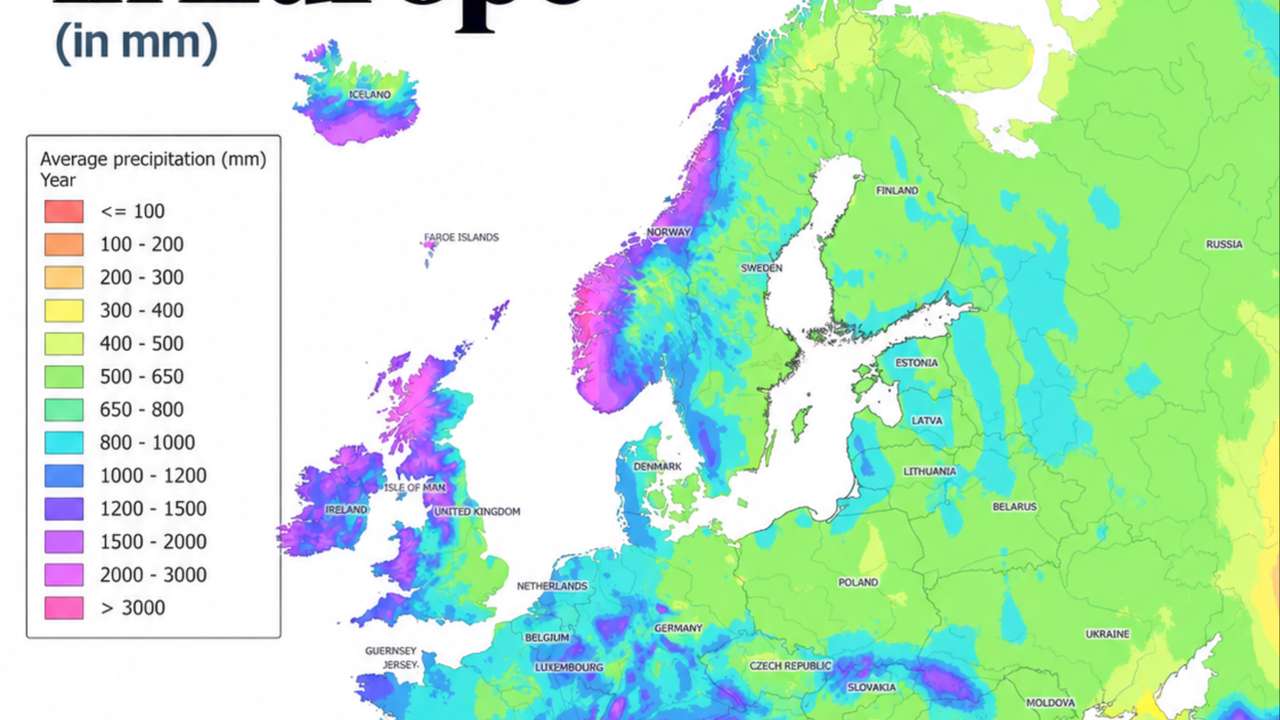
Rainfall across Europe varies dramatically, with some mountainous coastal areas receiving more than 3,000 millimetres of precipitation annually. In comparison, parts of southern Spain receive less than 300 millimetres.
Key points
- Western Norway receives some of Europe's heaviest rainfall.
- Mountain ranges create sharp differences in precipitation.
- Parts of Spain and southeastern Europe are much drier.
Rainfall across Europe varies dramatically, with some mountainous coastal areas receiving more than 3,000 millimetres of precipitation annually. In comparison, parts of southern Spain receive less than 300 millimetres.
Western Norway stands out as one of Europe's wettest regions, with parts of its mountainous coastline receiving more than 3,000 mm of precipitation each year.
Moist air from the Atlantic Ocean rises over Norway's mountains, cools and releases rain or snow. This helps explain why western coastal areas are much wetter than many inland regions.
Similar patterns appear in western Scotland, Ireland, the Alps and parts of the western Balkans, where mountainous terrain increases precipitation.
RECOMMENDED FOR YOU
Six countries account for three-quarters of Europe’s unicorn startups
The Alps also show sharp local differences, with wetter mountain slopes located close to much drier valleys.
Southern and eastern Europe are generally drier
Parts of southeastern Spain receive just 200–300 mm of precipitation annually, making them among the driest areas of mainland Europe.
The contrast is striking because northern Spain, particularly areas exposed to Atlantic winds, receives considerably more rainfall.
Much of eastern Europe also records lower annual precipitation than the Atlantic-facing west, although conditions vary across the region.
In countries such as Poland, Hungary and Ukraine, many lowland areas receive roughly 400–800 mm annually, according to the map.
Europe's precipitation patterns are shaped by several factors, including distance from the Atlantic Ocean, mountain ranges, wind direction and seasonal weather systems.
Western coastal regions generally receive more moisture from Atlantic weather systems. Mountains can intensify rainfall on windward slopes while leaving areas behind them relatively dry, a phenomenon known as the rain-shadow effect.
Mediterranean regions also experience long, dry summers, with much of their precipitation concentrated in autumn and winter.
RECOMMENDED FOR YOU

Madagascar Roundup: Child food poverty hits 77%, growth rebound forecast for 2027 and northern risk mapping begins
The map shows long-term average precipitation rather than rainfall recorded in a particular year. It also includes snowfall and other forms of precipitation, meaning the figures should not be interpreted as rainfall alone.