Germany, UK and France remain CERN's biggest backers
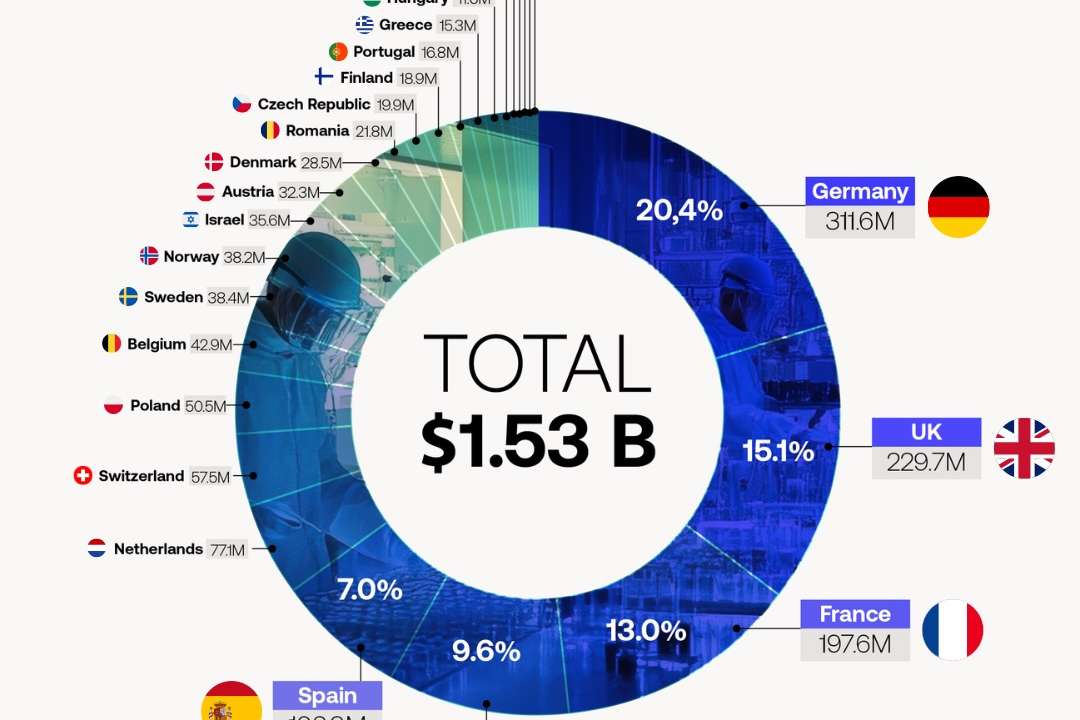
Germany remains the largest financial contributor to the European Organisation for Nuclear Research (CERN), providing 311.6 million Swiss francs (about $311.6 million) in annual member-state contributions for 2026, ahead of the United Kingdom and France, according to CERN's approved budget and contribution schedule.
Main Points
- Germany is CERN's largest financial contributor
- Five countries fund nearly two-thirds of CERN's budget
- India leads contributions among CERN associate members
Germany remains the largest financial contributor to the European Organisation for Nuclear Research (CERN), providing 311.6 million Swiss francs (about $311.6 million) in annual member-state contributions for 2026, ahead of the United Kingdom and France, according to CERN's approved budget and contribution schedule.
CERN's 2026 member-state budget totals approximately 1.53 billion Swiss francs, with the organisation's five largest contributors, Germany, the United Kingdom, France, Italy and Spain, providing around 65% of the total budget. The funding supports the operation of the laboratory's particle accelerators, scientific infrastructure, computing networks and international research programmes.
Germany accounts for 20.4% of the budget, followed by the United Kingdom with 229.7 million Swiss francs (15.1%), France with 197.6 million (13.0%), Italy with 146.9 million (9.6%), and Spain with 106.9 million (7.0%).
The Netherlands contributes 77.1 million Swiss francs, ahead of Switzerland at 57.5 million, Poland at 50.5 million, Belgium at 42.9 million, Sweden at 38.4 million, Norway at 38.2 million, and Israel at 35.6 million.
RECOMMENDED FOR YOU

From Suomi to Zhongguo, why some countries have completely different names at home
Other member states include Austria (32.3 million), Denmark (28.5 million), Romania (21.8 million), Czech Republic (19.9 million), Finland (18.9 million), Portugal (16.8 million), Greece (15.3 million), Hungary (11.6 million), Slovakia (8.1 million), Bulgaria (6.4 million), Serbia (4.8 million), Slovenia (4.2 million), Estonia (2.6 million) and Cyprus (1.4 million).
Unlike many international organisations, CERN calculates contributions using an agreed formula based largely on each member state's average net national income over several years, as approved annually by the CERN Council, the laboratory's governing body. The mechanism is intended to distribute costs according to countries' relative economic strength while providing stable long-term funding for scientific research.
Beyond its 24 full member states, CERN also works with associate member states, which participate in scientific programmes and contribute financially but do not hold the same voting rights as full members.
For 2026, India is the largest associate contributor at 23.4 million Swiss francs, followed by Brazil with 13.6 million, Türkiye with 6.7 million, Pakistan with 2.5 million, and Ireland with 2.2 million. Latvia and Ukraine each contribute 1.3 million, while Croatia and Lithuania each provide 1.2 million.
Founded in 1954 and headquartered near Geneva on the Franco-Swiss border, CERN is home to the Large Hadron Collider (LHC), the world's largest and most powerful particle accelerator. The laboratory became globally known after scientists announced the discovery of the Higgs boson in 2012, confirming a key prediction of the Standard Model of particle physics.
Today, CERN brings together more than 17,000 scientists, engineers and students from over 100 nationalities, representing hundreds of universities and research institutes worldwide. Its research has contributed not only to fundamental physics but also to advances in computing, medical imaging, superconducting technology and the creation of the World Wide Web, invented at CERN by British computer scientist Tim Berners-Lee in 1989.
According to CERN Stakeholder Relations, sustained contributions from member and associate states are essential for maintaining the laboratory's long-term scientific programme, including upgrades to the Large Hadron Collider and research that could shape the next generation of particle physics experiments.
Note: CERN’s official contributions are denominated in Swiss francs (CHF). All figures shown have been converted to U.S. dollars (USD) for consistency and easier comparison.
RECOMMENDED FOR YOU

Why Gaddafi once wanted Switzerland split between three countries
This story is written and edited by the Global South World team, you can contact us here.