Global confectionery giants hold firm as industry expands in 2026
The world’s largest confectionery companies have tightened their grip on a resilient global sweets market in 2026, with U.S.-based Mondelēz International retaining its position as the top candy producer by revenue, according to the latest Global Top 100 ranking from Candy Industry.
The world’s largest confectionery companies have tightened their grip on a resilient global sweets market in 2026, with US-based Mondelēz International retaining its position as the top candy producer by revenue, according to the latest Global Top 100 ranking from Candy Industry.
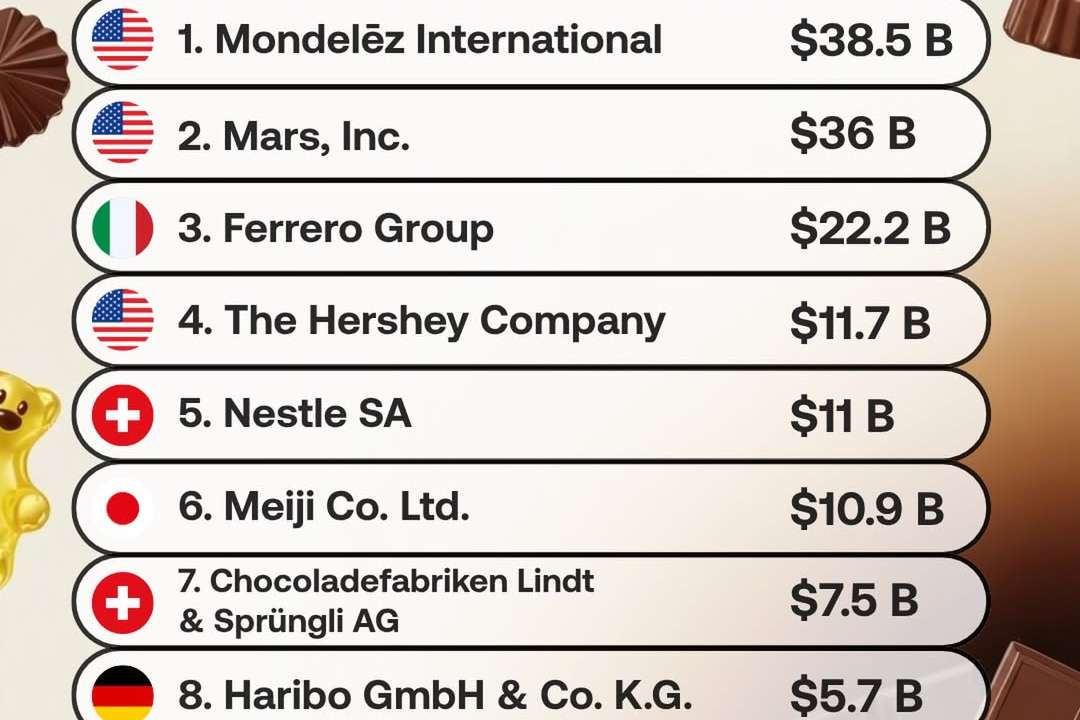
The Chicago-headquartered group reported confectionery sales of $38.5 billion, maintaining a clear lead over rival Mars Inc., which posted $36 billion in revenue from its sprawling snacks division.
Italian firm Ferrero Group secured third place with $22.2 billion, while The Hershey Company and Nestlé rounded out the top five with $11.7 billion and $11 billion respectively, underscoring continued dominance by a handful of multinational players.
The latest rankings highlight the enduring influence of a small cluster of global heavyweights often referred to as “Big Chocolate”, including Mondelēz, Mars, Ferrero, Hershey and Nestlé, which collectively command a significant share of global confectionery revenue.
RECOMMENDED FOR YOU
From Suomi to Zhongguo, why some countries have completely different names at home
These companies benefit from vast manufacturing networks, strong brand portfolios and global distribution systems, allowing them to maintain scale advantages even as consumer tastes evolve.
Beyond the top five, Japan’s Meiji Co., Switzerland’s Lindt & Sprüngli, Germany’s Haribo, Italy-based Perfetti Van Melle and UK-based Pladis complete the top 10 list, reflecting a mix of heritage European brands and Asian growth players.
The rankings come against a backdrop of steady growth in the global candy market, which is valued at approximately $78.8 billion in 2026 and projected to reach nearly $99 billion by 2031.
Manufacturers are increasingly responding to changing consumer preferences, including demand for premium products, reduced-sugar formulations and plant-based ingredients.
Digital commerce is also reshaping distribution, with online candy sales growing steadily as companies expand direct-to-consumer channels.
At the same time, emerging markets in Asia-Pacific are driving future growth, supported by rising incomes and urbanisation, even as Europe and North America remain the largest revenue centres.
This story is written and edited by the Global South World team, you can contact us here.