How Europe's time zones looked in 1938 before World War II changed the clocks
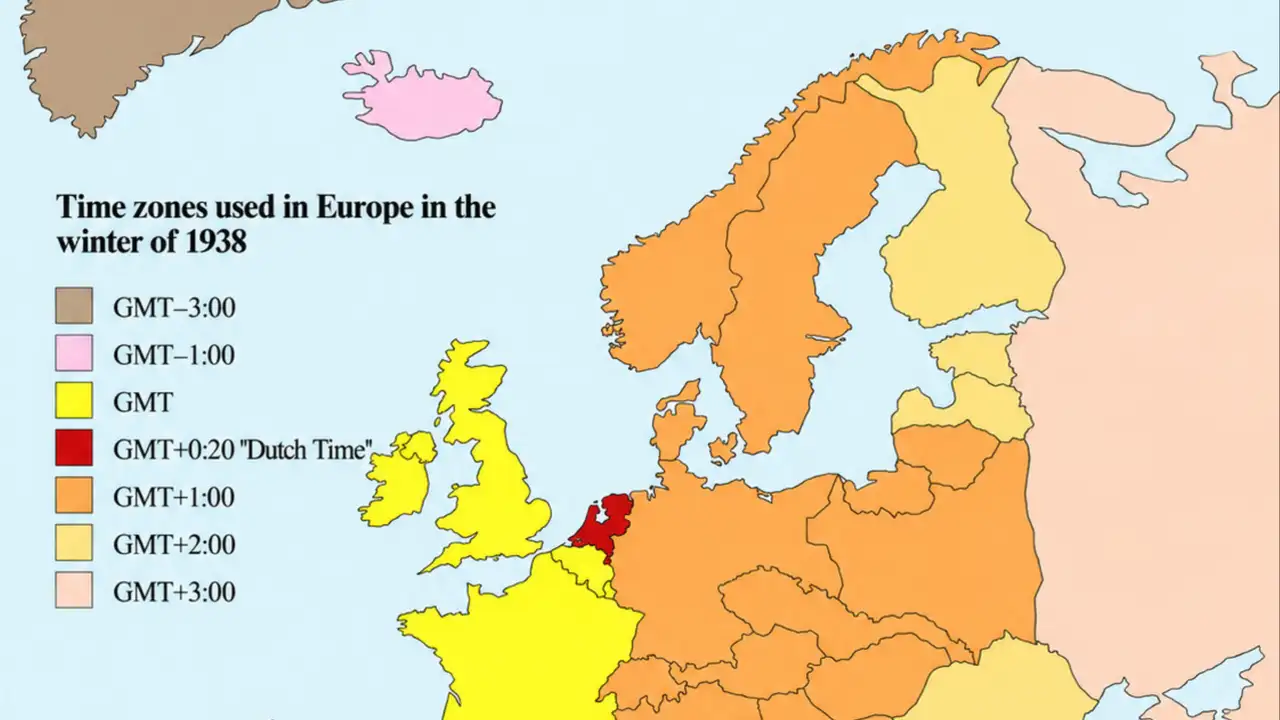
A historical map of Europe's time zones in the winter of 1938 shows a continent divided by national timekeeping rules, just months before World War II began in September 1939.
Key points
- Much of Western Europe used GMT in the winter of 1938.
- The Netherlands followed its own time, 20 minutes ahead of GMT.
- World War II helped establish the time zones used across much of Europe today
A historical map of Europe's time zones in the winter of 1938 shows a continent divided by national timekeeping rules, just months before World War II began in September 1939.
France, Spain, Portugal, the United Kingdom and Ireland were among the countries observing Greenwich Mean Time (GMT), while Germany, Italy, Poland and much of central Europe used GMT+1.
The Netherlands stood out. Instead of following either system, it observed a national time approximately 20 minutes ahead of GMT, a legacy of its earlier use of local astronomical time.
Farther east, Finland, Greece and Romania followed GMT+2, while parts of the Soviet Union used GMT+3 or other offsets.
RECOMMENDED FOR YOU

US tops Pakistan’s salt export markets by value
One of the biggest changes came during World War II. Following Germany's invasion of the Netherlands in May 1940, the occupying authorities ordered Dutch clocks to move forward by one hour and 40 minutes, bringing the country into line with German summer time.
Belgium and France also adopted Central European Time during the war, and the Netherlands retained the system after liberation.
Today, most of continental western and central Europe uses Central European Time (UTC+1) in winter, including France, Spain, Germany, Italy and the Netherlands. The United Kingdom, Ireland and Portugal remain on UTC+0, while much of eastern Europe uses UTC+2.
The 1938 map highlights how national decisions, geography and wartime events helped shape the time zones still used across Europe.
This story is written and edited by the Global South World team, you can contact us here.