How Indonesia is fighting forest fires from ground and sky
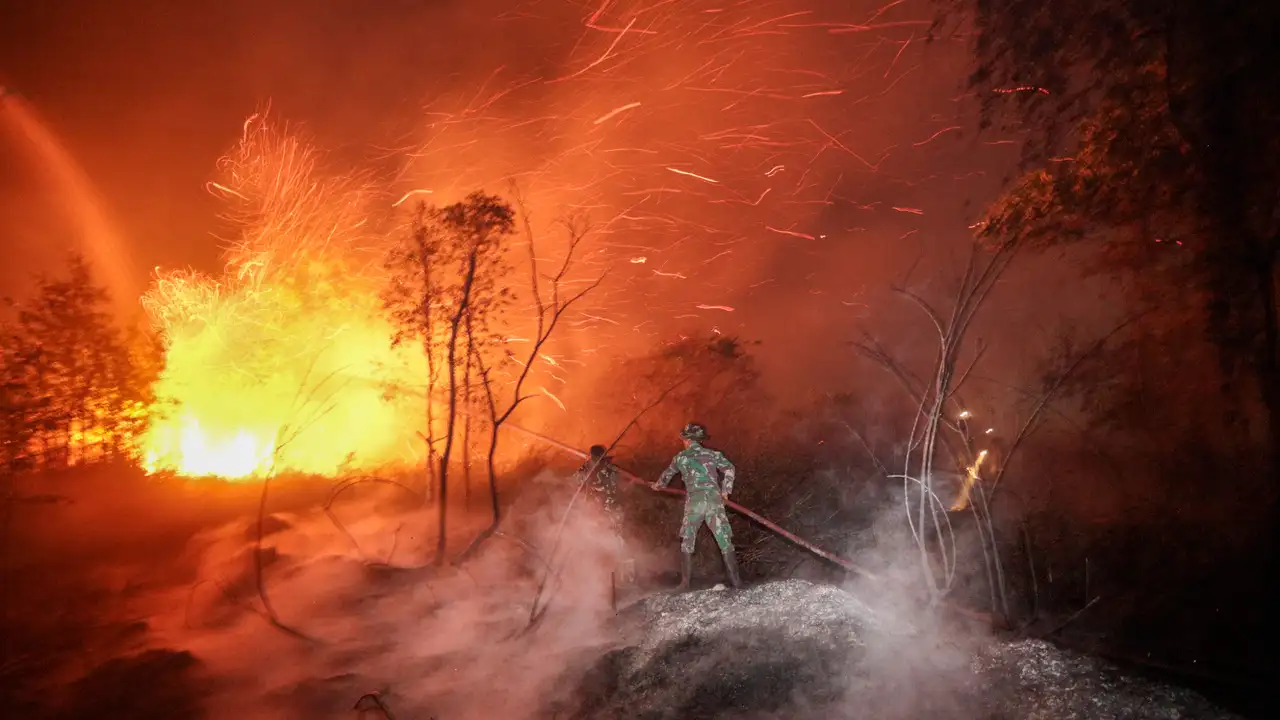
Indonesia is deploying ground crews, water-bombing helicopters and cloud-seeding aircraft to contain forest and land fires across Sumatra and Kalimantan, although thick smoke continues to restrict some aerial operations.
The response involves soldiers, police, specialist firefighters, company teams and volunteers across six priority provinces: Riau, Jambi, South Sumatra, West Kalimantan, Central Kalimantan and South Kalimantan.
BNPB, Indonesia’s disaster management agency, listed 53,848 personnel in its October 13 operational dashboard. For that reporting day, it recorded 12 water-bombing sorties delivering 1,135,000 litres of water and seven weather-modification sorties using 6,800 kilograms of seeding material.
A wider international fire season
Indonesia’s operations come during a year of extensive fires in several parts of the world.
In the United States, 64,393 fires had burned approximately 3.66 million hectares by October 14, according to the National Interagency Fire Centre. The burned area was 143% of the ten-year average for that point in the year.
RECOMMENDED FOR YOU
Six countries account for three-quarters of Europe’s unicorn startups
Across the European Union, Copernicus monitoring recorded 692,419 hectares burned by October 7—below the equivalent 2025 figure but above the long-term average. Its monitoring covers fires of approximately 30 hectares or larger, and its totals can differ from national statistics because of different methods and definitions.
Canada’s federal government reported 4.1 million hectares burned in its August update, illustrating the scale of the country’s fire season before the latest Indonesian operations.
Indonesia’s history of recurring fires
Indonesia’s burned area has fluctuated considerably between years. Forestry Ministry figures show approximately 1.65 million hectares burned in 2019, followed by lower totals before another increase in 2023.
Year | Forest and land area burned |
|---|---|
2019 | 1,649,261 hectares |
2020 | 296,943 hectares |
2021 | 358,864 hectares |
2022 | 203,686 hectares |
2023 | 1,161,193 hectares |
2024 | 376,806 hectares |
2025 | 343,432 hectares |
These figures appear in a Forestry Ministry document published in 2026. They measure forest and land fires, rather than forest loss alone.
For 2026, BNPB figures reported on October 13 put the cumulative burned area across the six priority provinces at approximately 129,899 hectares. That regional figure is distinct from a nationwide annual total.
Who is fighting the fires?
BNPB’s October 13 dashboard gives the following personnel breakdown across the six provinces:
Organisation or group | Personnel |
|---|---|
Indonesian armed forces | 12,285 |
Companies | 8,950 |
National police | 8,594 |
Volunteers | 8,201 |
Local governments | 4,767 |
Community fire-awareness groups | 4,749 |
Regional disaster management agencies | 3,472 |
Forest rangers | 1,434 |
Manggala Agni forest firefighters | 1,376 |
Central government | 20 |
Total | 53,848 |
The same dashboard recorded 570.09 hectares burned during the preceding 24 hours.
Fighting flames on the ground and from the air
Ground teams pump water into affected areas, wet deeper peat layers, cool burned land and inspect remaining smoke points. BNPB has described using hoses, portable pumps and temporary water-storage facilities where supplies are limited.
RECOMMENDED FOR YOU

Madagascar Roundup: Child food poverty hits 77%, growth rebound forecast for 2027 and northern risk mapping begins
Cloud-seeding aircraft support these operations by dispersing material into suitable existing clouds to encourage rainfall and wet wider areas of peatland. BNPB says the approach complements ground firefighting and reduces dependence on helicopters, whose operating costs and coverage limit their effectiveness.
Smoke remains an obstacle. In remarks reported on October 13, BNPB chief Suharyanto said poor visibility had prevented water-bombing helicopters in Central Kalimantan from operating for more than a week. Authorities were maintaining ground operations while preparing additional weather-modification aircraft for Central Kalimantan and South Sumatra.
Following an October 12 meeting, the Cabinet Secretariat said conditions had improved in the other four priority provinces. President Prabowo Subianto ordered authorities to deploy available resources to accelerate firefighting and prevent further spread.
This story is written and edited by the Global South World team, you can contact us here.
