India dominates global party membership as others struggle to keep up
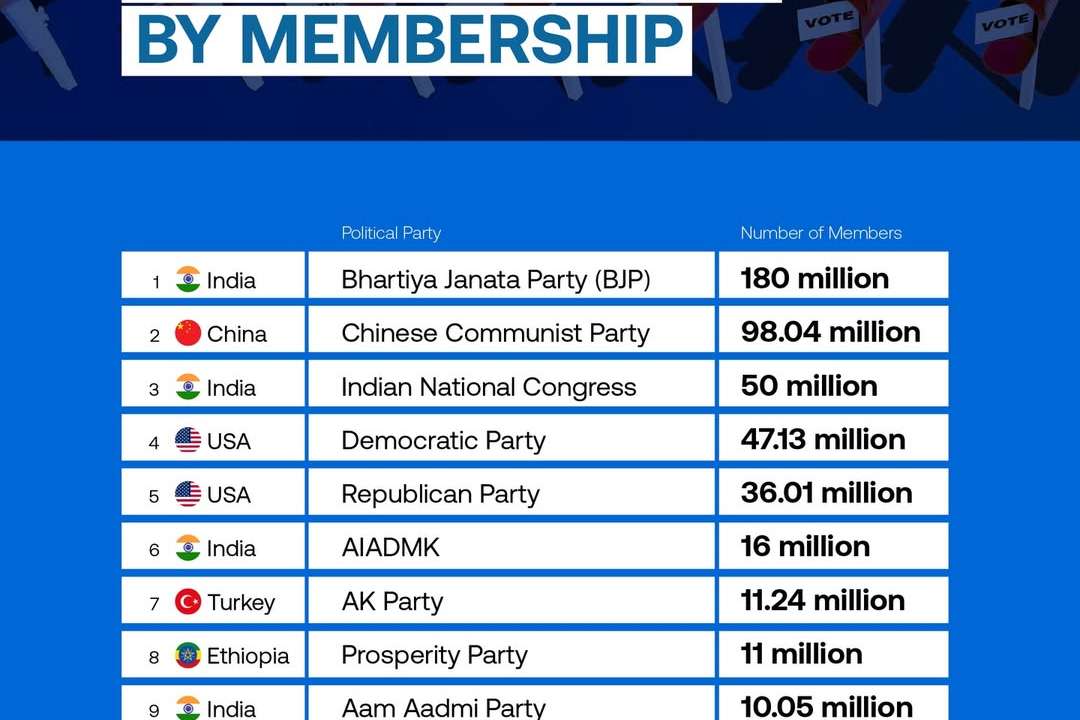
Political parties across the world are amassing unprecedented membership numbers, with India emerging as the clear centre of gravity in global party mobilisation.
Political parties across the world are amassing unprecedented membership numbers, with India emerging as the clear centre of gravity in global party mobilisation.
The Bharatiya Janata Party (BJP), India’s ruling party, stands as the largest political organisation globally by membership, with around 180 million registered members. The figure places it far ahead of its closest rival, China’s Communist Party, which reports roughly 98 million members.
The scale of these numbers reflects not just population size, but increasingly sophisticated political outreach strategies, digital enrolment systems, and grassroots expansion efforts.
India also accounts for four of the ten largest political parties worldwide. The Indian National Congress, once the dominant force in Indian politics, remains third globally with about 50 million members. Regional and newer parties are also prominent: the AIADMK is estimated at 16 million members, while the Aam Aadmi Party has crossed the 10 million mark.
RECOMMENDED FOR YOU

More than 6 billion people are now online as global internet access reaches new high
In the United States, where party membership is less formally structured, estimates place the Democratic Party at just over 47 million members and the Republican Party at around 36 million. These figures are typically derived from voter registration data rather than formal enrolment, making direct comparisons more complex.
Outside Asia and North America, Turkey’s AK Party holds approximately 11.24 million members, while Ethiopia’s Prosperity Party is close behind with 11 million. Pakistan’s Pakistan Tehreek-e-Insaf rounds out the top ten with roughly 10 million members.
In India, political membership drives have become highly organised operations, often linked to election cycles, welfare outreach, and ideological campaigns. Mobile technology and social media have further lowered the barrier to entry, enabling parties to scale rapidly.
The data also highlights the growing institutional strength of ruling or dominant parties in several countries, raising questions about political competition, internal party democracy, and the evolving nature of civic participation.
This story is written and edited by the Global South World team, you can contact us here.