Internet freedom divides the world as censorship tightens in some states
- #GazaHealthcare
- #CorneaTransplant
- #GazaEyeHospital
- #JusticeForVictims
- #UNPeacekeepers
- #AidWorkerAbuse
- #road blockades
- #health crisis
- #La Paz
- #ChildProtection
- #HumanitarianSafeguarding
- #AidSectorReform
- #GlobalSouthConversations
- #DNAJustice
- #IntersecAction
- #Haryana
- #chemical factory
- #explosions
- #Tomahawk
- #Amnesty International
- #Visualized
- #World Visualized
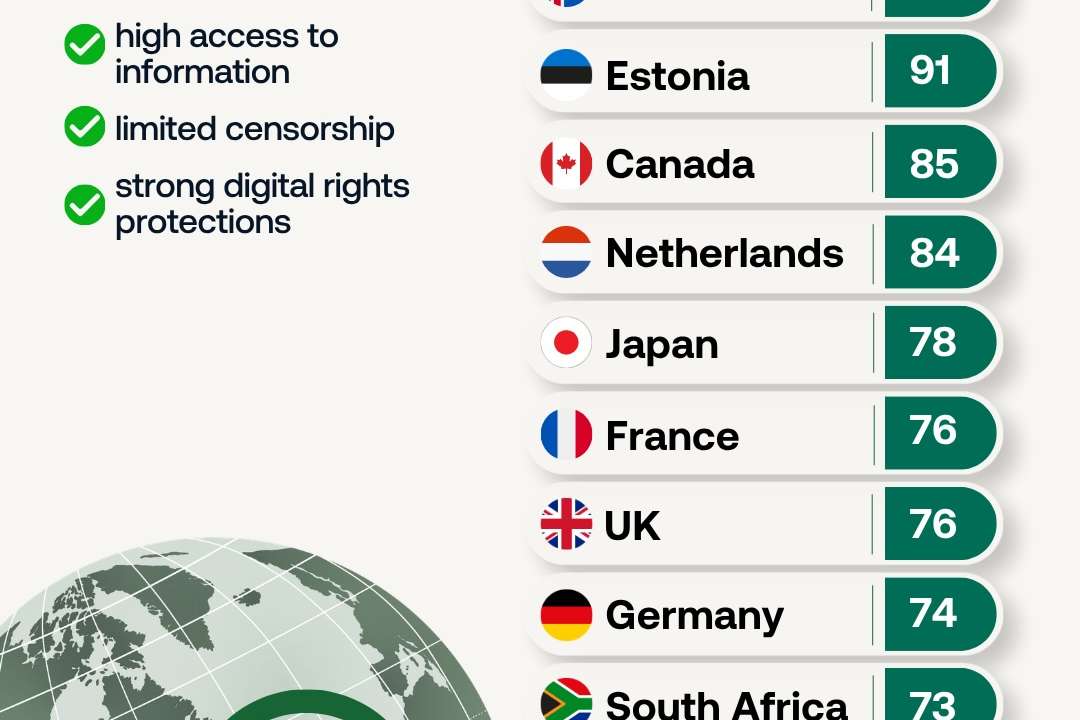
A widening global divide in internet freedom is reshaping how billions of people access information, communicate online and exercise digital rights, according to data compiled from Freedom House assessments and visualised in a recent World Visualized report.
A widening global divide in internet freedom is reshaping how billions of people access information, communicate online and exercise digital rights, according to data compiled from Freedom House assessments and visualised by World Visualized.
The rankings highlight stark contrasts between countries where citizens enjoy open access to information and those where governments maintain heavy censorship, surveillance and platform restrictions.
Thailand topped the list of countries with the most restricted internet environment, scoring just 39 points on Freedom House’s internet freedom scale. Turkey followed with 31, while Uzbekistan, Egypt and the United Arab Emirates also ranked among the world’s most digitally restrictive states.
Pakistan, Venezuela, Russia, Iran and China rounded out the bottom tier, reflecting ongoing concerns around state surveillance, content filtering, arrests linked to online activity and restrictions on foreign platforms.
RECOMMENDED FOR YOU
Asia produces the largest share of global GDP
Freedom House evaluates countries using factors including internet accessibility, limits on content, and violations of user rights. Lower scores indicate harsher restrictions and weaker digital freedoms.
China, despite having one of the world’s most advanced digital ecosystems, continues to maintain what analysts describe as the most sophisticated censorship apparatus globally. Authorities tightly control social media, search engines and online discourse through the country’s “Great Firewall,” blocking major Western platforms such as Google, Facebook, X and YouTube.
Russia and Iran have also intensified online controls in recent years, particularly during periods of political unrest and geopolitical tension. Both governments have expanded surveillance capabilities and introduced stricter regulations targeting journalists, activists and independent media operating online.
In Southeast Asia, Thailand and Vietnam have increasingly faced criticism from digital rights organisations over the use of lèse-majesté laws, cybercrime legislation and state monitoring tools to police online expression.
At the opposite end of the spectrum, Iceland ranked as the world’s freest internet environment with a score of 94. Estonia followed closely with 91, while Canada, the Netherlands and Japan also ranked highly for strong protections around free expression, digital privacy and open access to information.
European nations dominated the top positions, reflecting long-standing legal protections for civil liberties and stricter oversight of government surveillance practices.
The United Kingdom, France and Germany all remained within the “free internet” category, although watchdogs have raised concerns in recent years over expanding online safety legislation and data retention powers.
The United States scored 73, placing it below several European peers. Freedom House has previously cited concerns over misinformation, online harassment, political polarisation and the growing influence of private technology companies over public discourse.
RECOMMENDED FOR YOU
Argentina equals Germany's record with fourth FIFA World Cup final defeat
Several major emerging economies fell into a middle category described as “partly restricted.” Brazil and South Korea each scored 65, while Mexico, the Philippines and Ukraine followed closely behind.
India, the world’s largest democracy and one of the fastest-growing digital markets, scored 51. Freedom House has repeatedly pointed to internet shutdowns, particularly in Kashmir, alongside increasing pressure on technology platforms and journalists.
Singapore and Indonesia also appeared in the partially restricted category, reflecting what analysts say is a broader trend among governments seeking tighter control over digital narratives while maintaining relatively open internet infrastructure.
Digital rights advocates warn that internet freedom worldwide has declined for more than a decade as governments adopt increasingly sophisticated methods to monitor and influence online activity.
Freedom House researchers have also highlighted the growing use of artificial intelligence, biometric surveillance and state-backed disinformation campaigns as emerging threats to online freedom globally.
While highly connected societies continue to benefit from open digital ecosystems, the data suggests that access alone no longer defines internet freedom. Instead, the ability to communicate without censorship, surveillance or political intimidation has become the defining measure of digital liberty in the modern era.