More than 700 people are cryopreserved worldwide
Main points
- More than 700 people are cryopreserved worldwide
- The United States holds the largest known number
- No cryopreserved human has ever been revived
More than 700 legally dead people are being kept at extremely low temperatures by cryonics organisations around the world, in the hope that future technology might one day be able to repair their bodies and restore them to life.
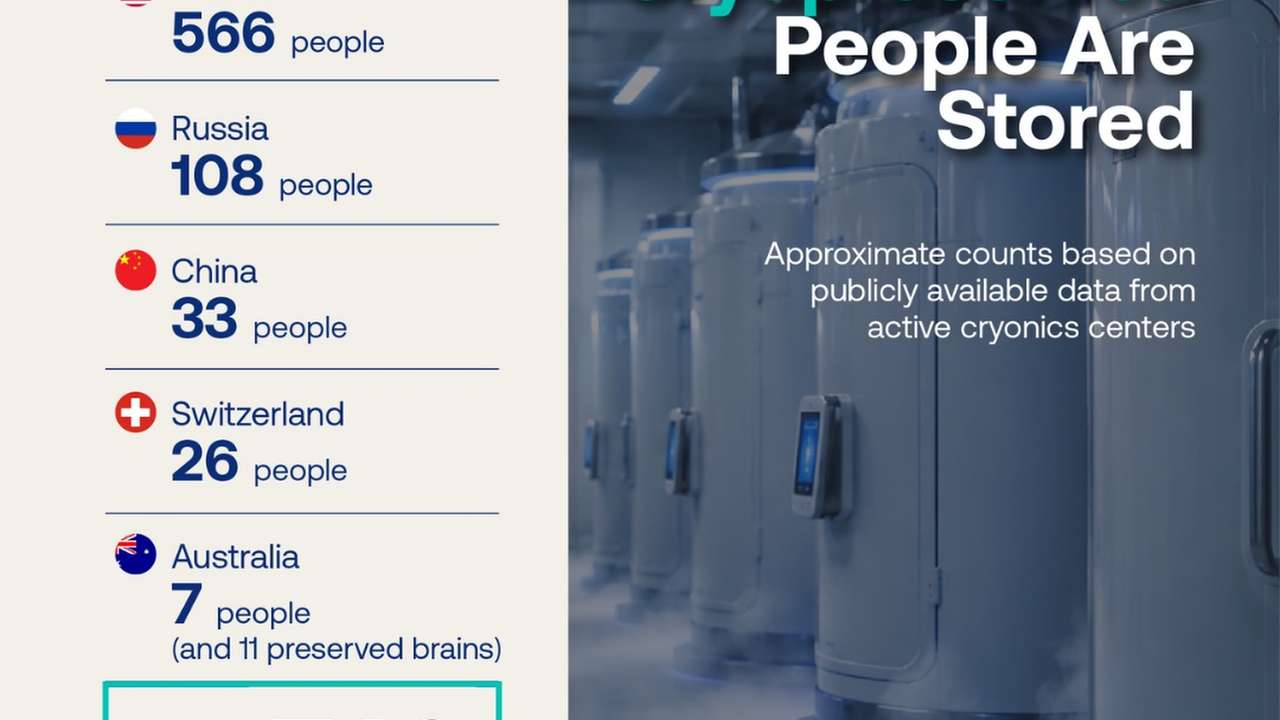
The United States is by far the largest centre for cryonics. The graphic estimates 566 people are stored there, mainly through two organisations, the Alcor Life Extension Foundation in Arizona and the Cryonics Institute in Michigan.
That figure is broadly consistent with current information, although exact totals change as new patients are added. Alcor currently reports 263 cryopreserved patients, while a 2025 comparison published by Alcor listed the Cryonics Institute with 270 patients. Together, those two organisations alone account for more than 530 people.
Russia is another major centre. KrioRus, founded in 2005 and describing itself as the first cryonics company in Eurasia, says it has cryopreserved 108 people.
RECOMMENDED FOR YOU

More than 6 billion people are now online as global internet access reaches new high
Its patient list shows that the total reached 108 in July 2026. The patients are not all Russian. KrioRus says 31 are foreign citizens, including people from Ukraine, Italy, Belarus, France, Japan, South Korea, India and several other countries.
Smaller cryonics operations also exist in Europe, China and Australia. The graphic estimates 33 cryopreserved people in China, 26 in Switzerland and seven people in Australia, alongside 11 preserved brains.
However, these figures are harder to verify independently because organisations publish their statistics differently and some do not maintain regularly updated public patient totals. That makes the graphic's global total of 740 people a reasonable estimate rather than a precise worldwide count.
Cryonics begins after a person has been legally declared dead. Organisations cool the body and use cryoprotective chemicals designed to reduce damage caused by ice formation before storing the patient at extremely low temperatures.
Alcor describes its purpose as preserving people after legal death in the hope that future medical advances might eventually make restoration possible.
There is an important limit to that idea. No human being cryopreserved after legal death has ever been revived, and there is currently no proven technology capable of restoring a cryonics patient to life.
This makes cryonics fundamentally different from established medical cryopreservation, which is routinely used for smaller biological materials such as sperm, eggs and embryos.
The practice remains extremely small globally, but patient numbers are growing. Alcor, founded in 1972, now has more than 1,500 living members signed up and 263 patients already in storage.
RECOMMENDED FOR YOU
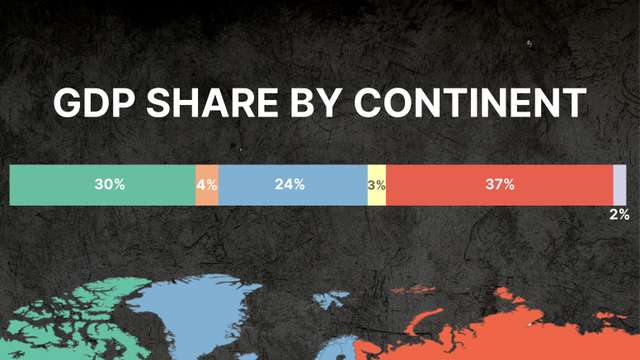
Asia produces the largest share of global GDP
KrioRus says it has around 600 contracts for future cryopreservation, while its stored patient count has risen to 108.
The figures show that cryonics remains concentrated in only a handful of countries, with the United States accounting for most known patients.
This story is written and edited by the Global South World team, you can contact us here.