NATO's Stoltenberg concerned by secessionist rhetoric in Bosnia
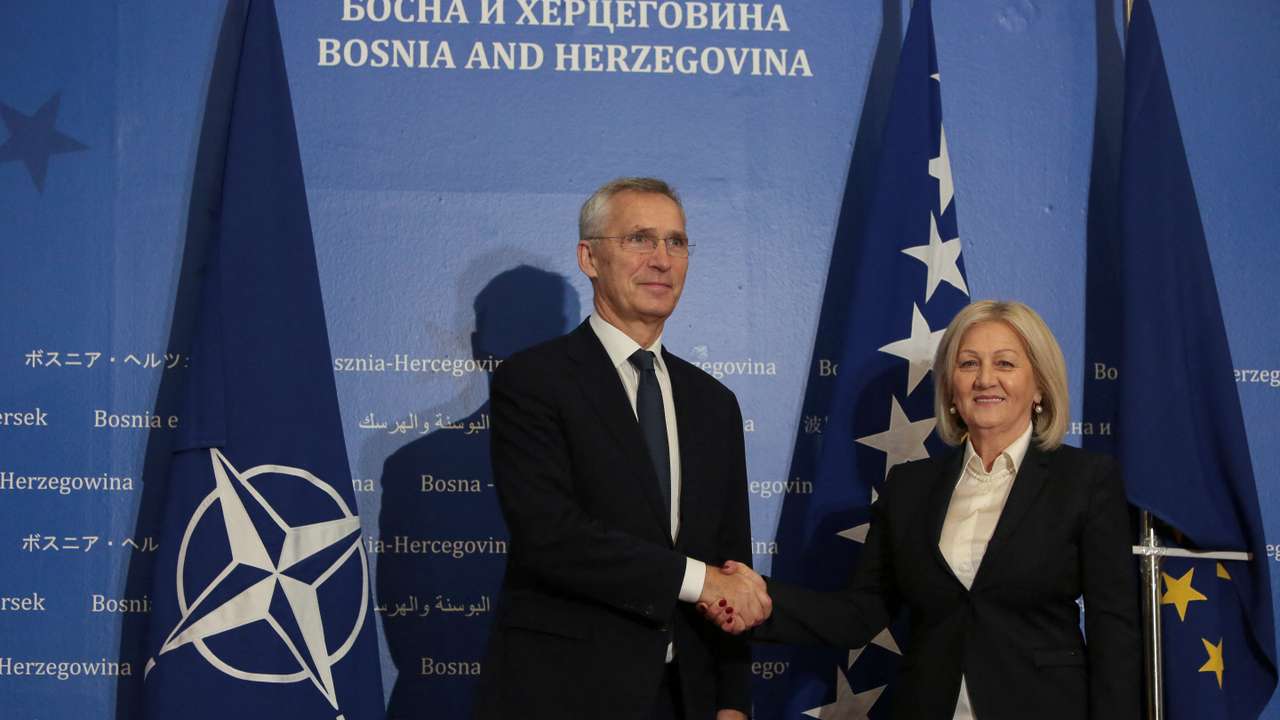
NATO's Stoltenberg concerned by secessionist rhetoric in Bosnia
By Daria Sito-Sucic
SARAJEVO (Reuters) -NATO Secretary General Jens Stoltenberg said on Monday the alliance was concerned by secessionist rhetoric in Bosnia, as well as by Russian influence in the country, after months of Serb leaders increasingly saying they want to split away.
Bosnia emerged from a 1992-1995 war with a federal structure uniting a Serb-dominated republic with a federation of Croats and Bosniak Muslims. The leader of Serbian entity, Milorad Dodik, has increasingly said in recent months that he aims to secede and join neighbouring Serbia.
RECOMMENDED FOR YOU
New Asia Forum: Indonesia to set out progress on sustainable AI data centres
"We are concerned by secessionist and divisive rhetoric as well as .. foreign interference including Russia," Stoltenberg told reporters in Sarajevo, his first stop during a tour of the Western Balkans region.
"This undermines the stability and hampers reform," Stoltenberg said, adding that all political leaders must work to preserve unity, build national institutions and achieve reconciliation.
Nearly three decades after the war that claimed 100,000 lives, the deadliest of the wars that followed the breakup of Yugoslavia in the 1990s, Bosnia remains divided, its economy stagnating and people leaving en masse.
NATO had deployed about 60,000 troops in Bosnia after the war, which were replaced by an EU peacekeeping force, EUFOR, in 2004. Last year, the EU almost doubled the EUFOR size to 1,100 troops, concerned that instability from the Ukraine war could spill over to the Western Balkans.
Stoltenberg said that NATO strongly supported and worked with the EUFOR mission.
"We cannot and will not allow a security vacuum in Bosnia and Herzegovina," he said after meeting Christian Schmidt, the international High Representative in Bosnia, who has not been recognised in that role by the Bosnian Serbs who say that his appointment was not endorsed by the UN Security Council.
"Any attack undermining your position takes Bosnia-Herzegovina backwards, not forward," Stoltenberg said.
NATO has warned about risks for Bosnia from foreign interference, particularly from Russia, and agreed to help to shore up its ability to defend itself.
RECOMMENDED FOR YOU

Are universities failing us? Global South Thinkers LIVE
"NATO remains committed to support Bosnia's Euro-Atlantic path. Every country has the right to choose its security arrangements without foreign interference," Stoltenberg said after meeting the chairwoman of Bosnia's Council of Ministers, Borjana Kristo.
Although the country's leaders had pledged to embrace NATO integration, the pro-Russian Bosnian Serbs have withdrawn their support for joining the alliance, effectively halting Bosnia's Atlantic integration ambitions.
This article was produced by Reuters news agency. It has not been edited by Global South World.