Nine great powers that once shaped the world and why they disappeared
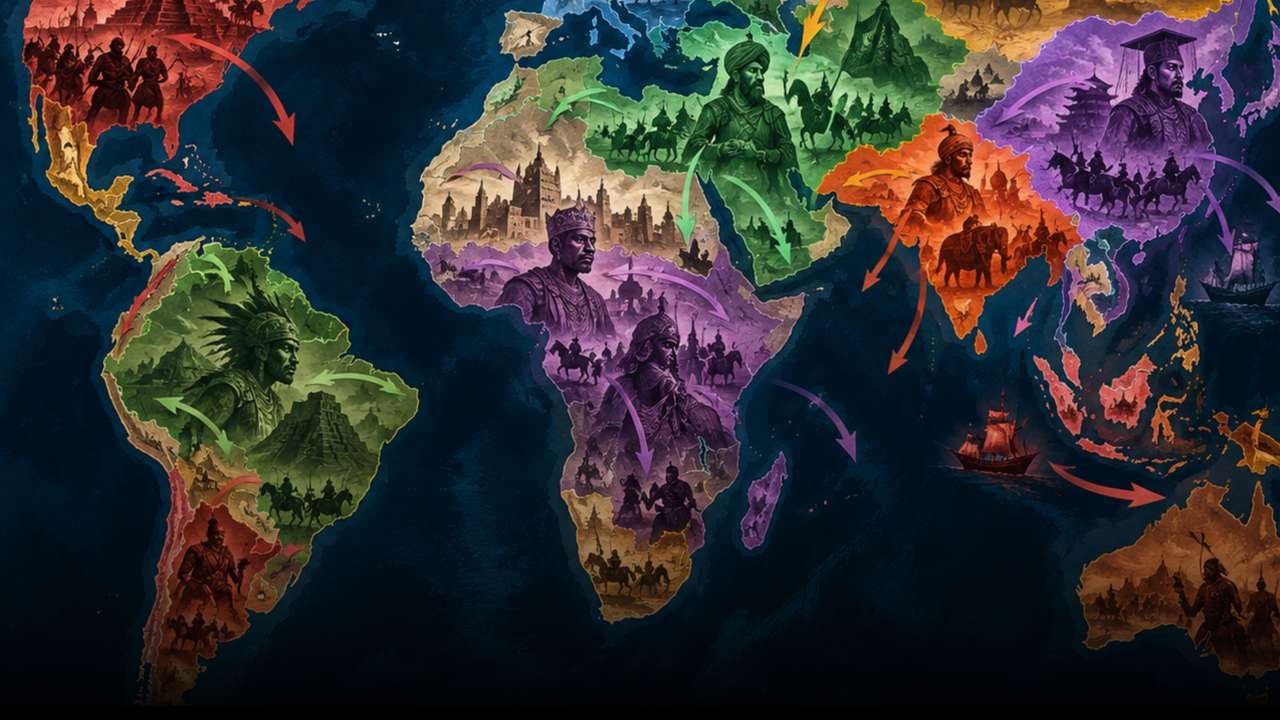
Empires and political unions that once controlled vast territories across Europe, Asia, Africa and the Americas have disappeared, but many continue to influence modern borders, languages and political institutions centuries after their decline.
Key points
- The Holy Roman Empire lasted until 1806
- The Crown of Aragon ended under Bourbon centralisation
- Former powers left borders and institutions still visible today
Empires and political unions that once controlled vast territories across Europe, Asia, Africa and the Americas have disappeared, but many continue to influence modern borders, languages and political institutions centuries after their decline.
A historical series highlighting nine major powers that no longer exist includes the Holy Roman Empire and the Crown of Aragon, two European political systems whose territories once stretched across areas now divided among several modern states.
Holy Roman Empire survived for more than eight centuries
The Holy Roman Empire developed in medieval Europe and is conventionally dated from 962, when Otto I was crowned emperor. At various points, it included territories covering much of present-day Germany, Austria, the Czech Republic, Switzerland, the Netherlands, Belgium, Luxembourg and parts of Italy, France, Poland and Slovenia.
But it was not a single centralised country. It consisted of hundreds of kingdoms, principalities, duchies, bishoprics and free cities whose rulers enjoyed varying degrees of autonomy.
RECOMMENDED FOR YOU

Elon Musk leads 2026 US midterm election donors with $446 million
The empire came to an end on August 6, 1806, when Emperor Francis II relinquished the imperial crown following Napoleon's military victories and the formation of the Confederation of the Rhine by German states that had left the empire.
That makes the 962–1806 dates shown in the graphic broadly accurate, though historians debate exactly when the entity later called the Holy Roman Empire should be considered to have begun.
Crown of Aragon became a Mediterranean power
The Crown of Aragon emerged in the 12th century from the dynastic union of Aragon and Barcelona. Over the following centuries, its rulers expanded their influence across the western Mediterranean, eventually controlling territories that included Aragon, Catalonia, Valencia, Mallorca, Sicily and Sardinia, as well as, at different times, other Mediterranean possessions.
Its union with Castile became much closer after the 1469 marriage of Ferdinand of Aragon and Isabella of Castile, but their realms initially retained separate laws and institutions.
The graphic gives the Crown of Aragon a lifespan of 1164 to 1715/16. That is a reasonable shorthand, but its ending was a process rather than a single event.
Following the War of the Spanish Succession, Philip V's Nueva Planta decrees abolished or reorganised many of the Crown's separate institutions and imposed a more centralised Bourbon administration. The first decrees affecting Aragon and Valencia came in 1707, while the decree for Catalonia was issued on January 16, 1716.
The Archive of the Crown of Aragon says the 1716 decree ended institutions including Catalonia's Courts and Generalitat and introduced a more centralised system modelled on Castilian government.
RECOMMENDED FOR YOU

Argentina takes Britain to International Court, demands halt to Falklands oil project
This story is written and edited by the Global South World team, you can contact us here.