North America uses 13 times more energy per person than Africa
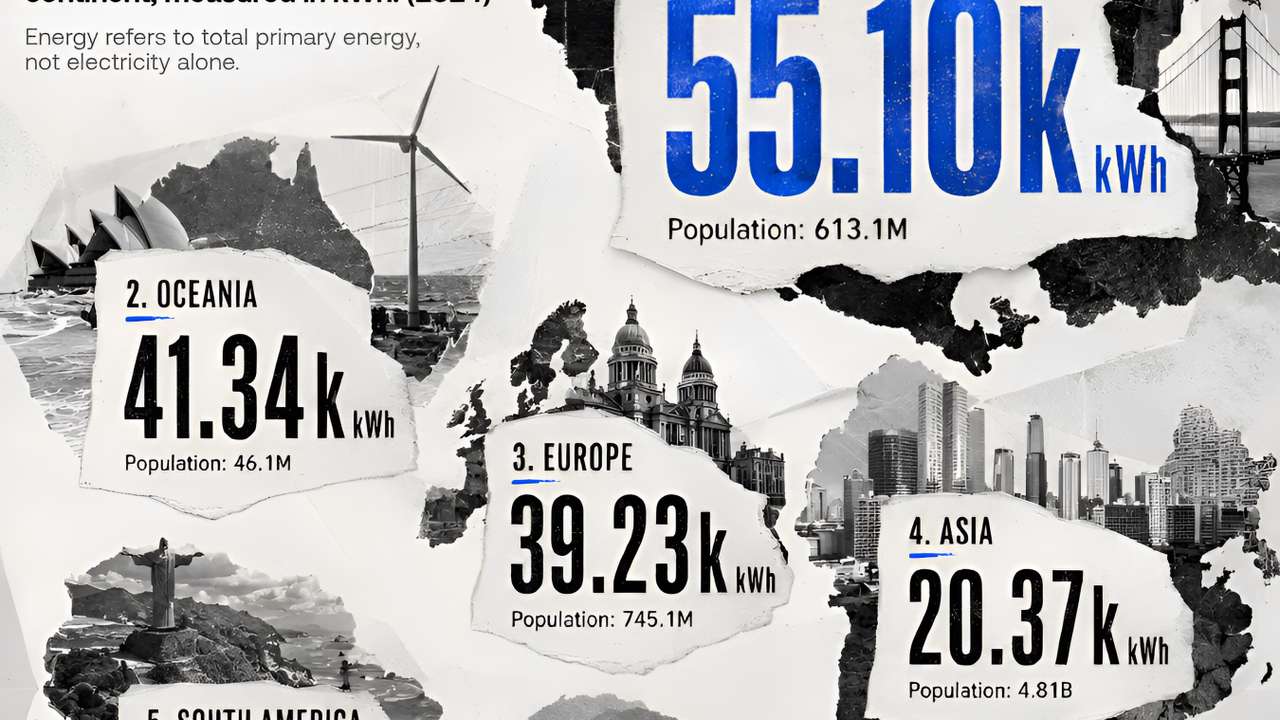
North America consumed about 55,100 kilowatt-hours of primary energy per person in 2024, more than 13 times the level shown for Africa, exposing a wide divide in energy use between the world's regions, according to data compiled by Our World in Data.
Main Points
- North America leads global energy use per person
- Africa uses 13 times less energy than North America
- Asia leads total energy demand despite lower per-person use
North America consumed about 55,100 kWh of primary energy per person in 2024, more than 13 times Africa's level, highlighting a wide divide in energy use across continents, according to data compiled by Our World in Data.
The regional comparison places North America first, followed by Oceania and Europe, while Africa records by far the lowest per-person consumption. The figures measure primary energy, rather than electricity use alone, and include energy from oil, coal, natural gas, nuclear power and modern renewables.
Our World in Data's latest dataset draws on the U.S. Energy Information Administration's 2026 international energy data and the Energy Institute's Statistical Review of World Energy 2025, combined with population estimates.
North America's 55,100 kWh per-person consumption in 2024 was the highest among the continents shown.
RECOMMENDED FOR YOU

France split into three nearly equal populations shows how unevenly the country is settled
Within the region, the disparity is even clearer at the country level. The United States consumed about 76,800 kWh per person, while Canada reached 97,780 kWh, according to Our World in Data.
The infographic places Oceania second at about 41,340 kWh per person, followed by Europe at 39,230 kWh.
Those figures mean the average North American consumed roughly 33% more energy than a person in Oceania and about 40% more than the European average.
The figures should not be interpreted as household electricity bills or direct residential consumption. Primary energy captures energy across the economy, including transport, industry, electricity generation and other uses. Our World in Data calculates the indicator using the substitution method, which adjusts nuclear and renewable electricity to make them more comparable with fossil-fuel primary energy.
Asia ranks fourth in the infographic at approximately 20,370 kWh per person, less than half North America's level.
Yet Asia's much larger population makes it the world's dominant region in absolute energy consumption. Our World in Data puts Asian primary energy use at about 97,910 terawatt-hours in 2024, compared with 33,780 TWh in North America and 29,280 TWh in Europe.
Large differences also exist within Asia.
China consumed about 34,510 kWh per person in 2024, while India used around 7,810 kWh. South Korea, by contrast, reached approximately 69,920 kWh per person, exceeding the North American regional average.
RECOMMENDED FOR YOU
Asia produces the largest share of global GDP
Africa sits at the opposite end of the ranking.
The infographic puts average African primary energy consumption at only 4,060 kWh per person in 2024, around 7% of North America's level.
That means the average North American used roughly as much primary energy as 13.6 people in Africa, based on the figures shown.
Africa's total primary energy consumption was about 6,140 TWh in 2024, according to Our World in Data. That remained well below other major regions despite the continent's population exceeding 1.5 billion.
Some individual African countries sit considerably below even that continental average. Guinea-Bissau, for example, recorded primary energy consumption of only about 693 kWh per person in 2024.
This story is written and edited by the Global South World team, you can contact us here.