North Korea’s Mount Paektu rises nearly 800 metres above South Korea’s highest peak
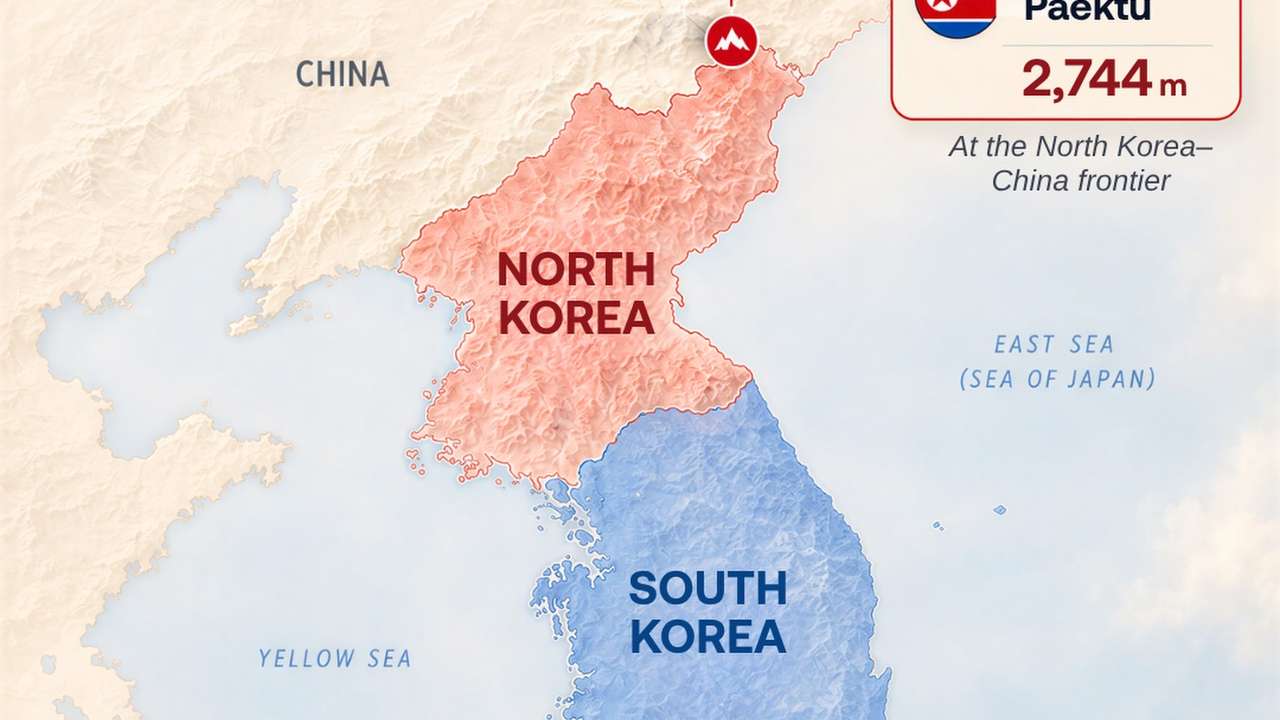
North Korea has the higher of the two Koreas’ tallest mountains, with Mount Paektu rising significantly above South Korea’s Hallasan.
Main points
- Mount Paektu is the Korean Peninsula’s highest mountain
- Hallasan is South Korea’s highest peak
- Both mountains were formed by volcanic activity
North Korea has the higher of the two Koreas’ tallest mountains, with Mount Paektu rising significantly above South Korea’s Hallasan.
Mount Paektu, also known as Changbai Mountain in China, stands on the North Korea-China border. Its highest point reaches about 2,744 metres above sea level, making it the highest mountain on the Korean Peninsula.
Hallasan, a shield volcano in the centre of South Korea’s Jeju Island, reaches about 1,950 metres, according to UNESCO. That puts Mount Paektu roughly 794 metres higher.
Mount Paektu is a volcanic mountain whose summit area straddles North Korea and China. Its most striking feature is a large caldera containing Lake Chon, known as Tianchi or Heaven Lake on the Chinese side.
RECOMMENDED FOR YOU

More than 6 billion people are now online as global internet access reaches new high
The volcano produced the enormous Millennium Eruption around 946 CE, one of the largest eruptions of the past several thousand years. Volcanic ash from the eruption travelled as far as Japan.
UNESCO designated Mt Paektu as a Global Geopark in 2025, making it North Korea’s first UNESCO Global Geopark. The wider area has also been a UNESCO Biosphere Reserve since 1989.
Hallasan forms the centre of Jeju Island, South Korea’s largest island. UNESCO describes Jeju as a volcanic island formed over roughly the past two million years, with Hallasan surrounded by hundreds of smaller volcanic cones.
Hallasan is part of the Jeju Volcanic Island and Lava Tubes UNESCO World Heritage Site, which was inscribed in 2007. Its summit includes a lake-filled crater, while the wider protected area contains volcanic rock formations, cliffs and distinctive ecosystems.
This story is written and edited by the Global South World team, you can contact us here.