Orphans of Gaza war left with no close relatives to care for them
Orphans of Gaza war left with no close relatives to care for them
By Doaa Rouqa
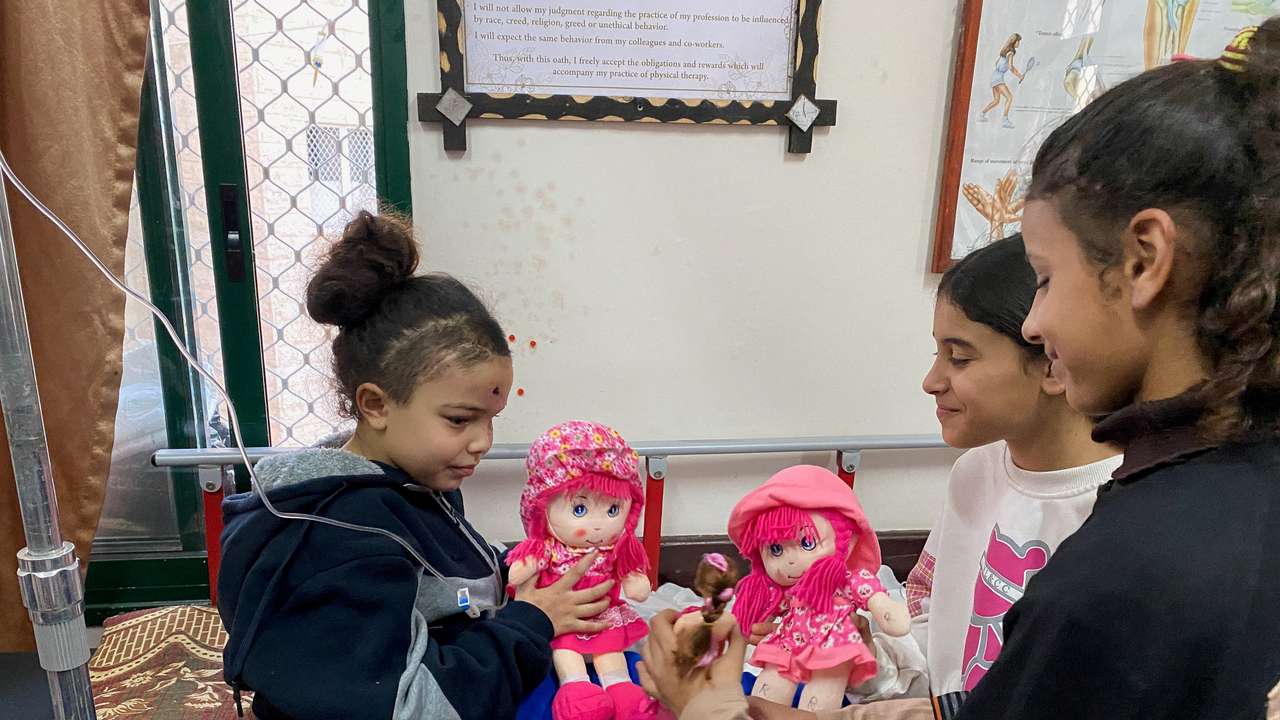
Playing with dolls on a Gaza hospital bed where she sits with her leg in a plaster cast and scars on her face, 10-year-old Razan Shabat does not know that her mother, father and siblings were killed in the strike that wounded her.
The little girl is one of a growing number of children in Gaza who have lost both parents, and in some cases their entire families, in the war between Israel and Hamas, and who are being cared for by distant relatives, friends or even strangers.
RECOMMENDED FOR YOU
New Asia Forum: Indonesia to set out progress on sustainable AI data centres
"This girl doesn't know that she lost her family, and we're responsible for her now," said Rajaa al-Jarou, who is married to an uncle of Razan and is now caring for the girl at the Al Aqsa Martyrs Hospital in Deir al-Balah, central Gaza.
Despite the large scab on her forehead and thinner scars running from her brow to her cheek, Razan's face lit up with a big smile as she played with two pink rag dolls, cooing at them as a mother would with a baby.
Her smile disappeared when she was asked what she was missing the most in hospital.
"I miss my family. I miss seeing them," she said, suddenly sad and serious.
Her left leg lay flat on the bed, encased from top to bottom in a cast.
"I had an operation on my leg, it was broken. And as you can see in my forehead there's a wound, and I had four operations in my skull, but thank God, I’m good and thank God, I’m getting better," she said.
Younis al-Ajla, a doctor involved in caring for Razan, said she and many other children had been brought to the hospital alone.
"Many children who come to Al Aqsa Martyrs Hospital, we don’t know their names. We write ‘unknown’ on their entry files until one of their relatives comes and recognises them," he said, adding that this had been Razan's case for many days.
RECOMMENDED FOR YOU
‘Meta, don't meddle’ - Lula supporters protest alleged election bias in Brazil
'THEY'VE LOST EVERYONE'
James Elder, chief spokesperson for UNICEF, the U.N. agency for children, said it was hard to determine how many Gaza children were now orphans due to the sheer number of people being killed and the desperate conditions on the ground.
"There are so, so many children who have lost both parents, but worse than that, they've lost entire families," he said.
Relatives or neighbours usually step forward to care for orphaned children, although there were cases so extreme that no one was alive to do so, he said.
"I've met children, usually in hospitals because they'd been injured when their home was hit, they lost their mother and their father and grandparents, aunts and uncles, siblings, everyone.
"When a child is the last surviving family member, then you have a real problem."
The war was triggered by Hamas militants who rampaged through southern Israel on Oct. 7, killing 1,200 people including babies and children and kidnapping 240 people of all ages to hold as hostages in Gaza, according to Israel.
Vowing to destroy Hamas, Israel has responded with a military onslaught and total siege of the densely populated strip that have killed more than 18,000 people, most of them women and children, according to the Gaza health ministry.
RECOMMENDED FOR YOU
‘Why would you need courage to speak the truth?’ Nobel Peace Prize winner Navi Pillay asks
Gemma Connell, a U.N. aid worker visiting the hospital in Deir al-Balah, crouched down to talk to a young girl sitting on the floor with bandaged feet, holding a partially inflated blue balloon in one hand and a packet of sweets in the other. The girl appeared dazed and did not respond.
Connell said she had met many traumatised children who were injured, hungry, scared and in many cases bereaved.
"Many of them have seen their siblings die, their parents die," she said, speaking in a telephone interview on Monday separate from her hospital visit.
"Yesterday I met a young girl about four years old who couldn't speak because of what she had seen. She couldn't even say her name. Her eyes were as wide as a deer's in the headlights ... That is what children in Gaza look like."
This article was produced by Reuters news agency. It has not been edited by Global South World.