Europe’s political crises are exposing vulnerabilities its leaders have acknowledged for years: Opinion
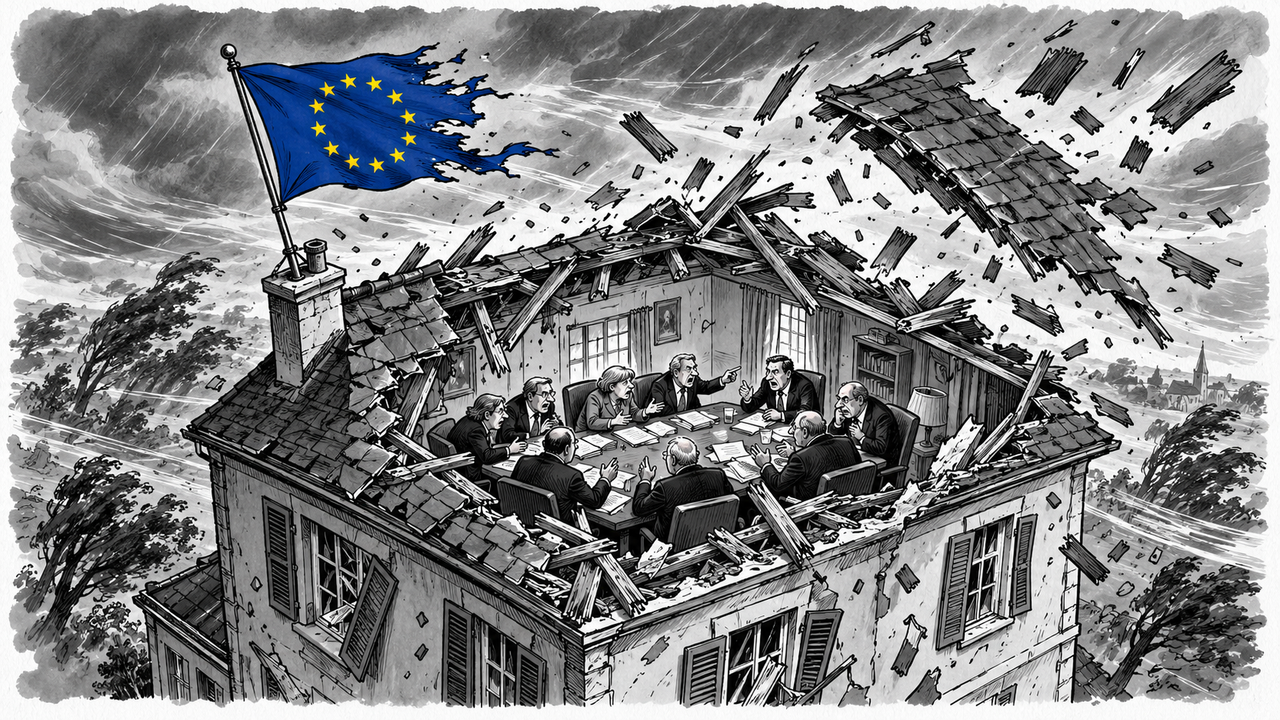
The European Union seeks to explain the difficulties it faces today by pointing to external threats, surprising shifts in Washington’s positions, and unexpected election results in its member states. Far less often does it discuss the responsibility of those who have left it so exposed.
Every shock is presented as a surprise: an election result, a faltering coalition, a statement from across the Atlantic, a decision in Beijing. Taken separately, they seem like a succession of misfortunes. Viewed together and examined without pulling any punches, they reveal the same vulnerabilities, known for years yet blithely ignored in the hope that they would resolve themselves.
The phrase “perfect political storm”, frequently used in European analysis, is convenient. It shifts attention away from the quality and accountability of political leadership and towards the hostility of circumstances. Yes, a storm can take us by surprise with its intensity. But the structural weakness of the shelter is the builder’s responsibility, and whoever miscalculated its ability to withstand the storm must be held accountable.
The diagnosis was already there
Elections in member states, struggles for power, and public discontent, even when expressed more aggressively, are part of democracy. A European strategy that works only as long as no government changes was poorly designed from the outset. If a change of government threatens to block projects essential to a country, the merits and durability of the agreements underpinning those projects must be re-examined. Voters cannot be expected to keep voting for the same parties simply to safeguard European negotiations.
RECOMMENDED FOR YOU
Six countries account for three-quarters of Europe’s unicorn startups
It is true that no one could have anticipated every event. But it was possible to identify the dependencies that turn a shock into a prolonged crisis. In March 2022, at Versailles, EU leaders pledged to strengthen defence, reduce energy dependencies, and reinforce the economic base. Then, in 2024, the Draghi report documented the structural vulnerabilities of the European economy, including problems with productivity and energy costs. Neither EU leaders nor those of its member states can claim that they lacked warning.
One example predates even the full-scale invasion of Ukraine, which is cited as responsible for many of the difficulties we face today. In 2015, the Commission launched its Capital Markets Union action plan, intended to make it easier for European companies to obtain financing. In 2020, the European Court of Auditors found that the measures adopted had produced only small steps, without delivering substantial progress. It highlighted vague objectives that were difficult to measure and a lack of explicit priorities in the original plan. A significant vulnerability affecting investment and competitiveness had thus already been identified before the shocks invoked today. Responsibility lies, according to their respective remits, with both the Commission and the governments that negotiated and implemented the reforms. A serious discussion begins by identifying the decisions that were delayed and, above all, those who blocked them and the reasons they gave. It does not begin with the consequences, as though these had been inevitable. How many comparable commitments came with identified resources, realistic deadlines, and specific, verifiable responsibilities?
Adversaries can explain the pressure, not the decisions
The Russian military threat and China’s economic pressure are real and require serious assessment. But while an adversary’s actions may explain the pressure you face, they cannot justify every decision you have made in response. Political leadership requires vision and foresight. Its very purpose is to prepare responses to external interests that do not align with its own. Invoking an adversary cannot provide a permanent exemption from accountability.
Washington’s role must be assessed just as realistically. The transatlantic alliance does not erase the differences between American and European interests, nor does a change from a Democratic to a Republican president reset them to zero. During the Biden administration, the subsidies and conditions attached to the Inflation Reduction Act were already raising European concerns about competition and where investment would flow. The Commission explicitly recorded those concerns in 2023. American policy alone does not explain Europe’s difficulties. But an ally’s interests must be assessed with the same clear-eyed judgement as those of any other actor. European autonomy should also have been built to address situations in which American priorities impose costs on us or narrow our options. Waiting for a more accommodating administration in Washington is no substitute for accountability, nor can it be considered a responsible foreign policy.
The same applies to relations with countries outside the Western circle, including those brought together in BRICS. Cooperation must be built around concrete interests, from energy to market access. Europe weakens its negotiating position when it treats interlocutors with differing interests as a homogeneous bloc. Positions of principle must be accompanied by an understanding of each partner and an assessment of the outcomes being sought.
Resilience requires a strategy
Ukraine is the issue on which the need for an independent European assessment is most pressing. Russia bears responsibility for the invasion. This does not exempt European leaders from assessing the policies adopted both before and after it began. Support for Kyiv must be judged in terms of objectives, means, results, and the prospects for a sustainable end to the conflict. The phrase “for as long as it takes” expresses solidarity. It does not, however, say what political outcome Europe seeks, what it can sustain militarily and financially, or what diplomatic initiative it is prepared to undertake. Above all, it does not explain what Europe will do if Washington’s priorities change, as we are now seeing.
RECOMMENDED FOR YOU
Burkina Faso to stop importing armoured vehicles, Traore says
European citizens, who are being asked to make additional and far from easy sacrifices, deserve answers to all these questions. Asking them does not mean that they question Ukraine’s right to defend itself. It means they want to understand how long this will last, how much it will cost them, and what else is being done to end the conflict beyond supplying it with weapons and ammunition.
Opposition does not cancel accountability
Within Europe, the rise of radical parties can become a source of instability. But the analysis remains incomplete if it begins only at the ballot box and ignores the experiences that led people to vote as they did. The quality of the alternative and the accountability of those already in power must be examined separately. The shortcomings of one do not automatically absolve the other. Labelling those who challenge the established order does not explain the loss of trust. We must also examine the gap between promises and results, the unequal distribution of costs, and the difficulty citizens face in identifying who is responsible for a decision. When leaders claim credit for success while attributing failure exclusively to circumstances, the mechanism of political accountability ceases to function.
Stepping back
Adaptation requires more than solemnly acknowledging a changing world. It requires revising priorities, abandoning assumptions that have proved wrong and, above all, taking responsibility for mistakes. Sometimes, it also requires those who can no longer lead the necessary correction, or no longer have the credibility to sustain it, to step aside. Stepping back becomes an act of responsibility when remaining in office blocks a change that the public interest demands.
Replacing one set of leaders with another means nothing, however, unless it is accompanied by a different policy, with objectives and evaluation criteria established, accepted, and stated in advance. Otherwise, we are merely changing the names of those who explain the failure. Membership of the European Union does not relieve any member of the duty to assess costs continually and properly defend its own interests. Taking part in a decision requires reasoned arguments and negotiation.
Europe has difficult decisions to make. The first condition for avoiding a repetition of past mistakes is an honest discussion of yesterday’s decisions and the motives of those who made them. Otherwise, an EU that confuses effects with causes is doing nothing more than setting itself up for its next crisis.
RECOMMENDED FOR YOU
Norway has Europe’s highest petrol prices, Russia and Belarus remain cheapest
This article exclusively represents the opinions of its author, Silviu Predoiu, and not those of Global South World.
