Overcoming differences through music: opinion
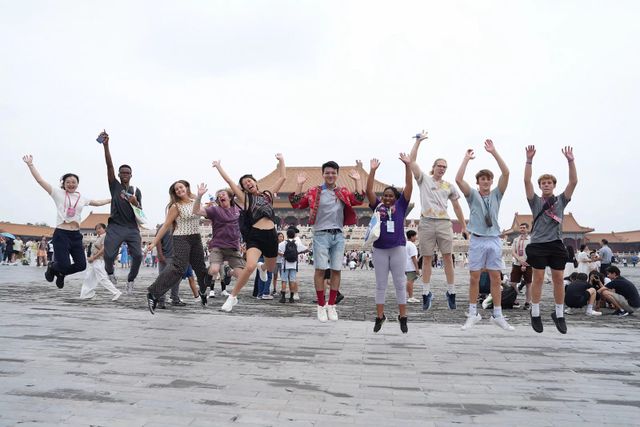
Not long ago, a delegation of 23 young Americans from the US-China Youth Music and Culture Exchange Camp arrived in Beijing, the final stop of their journey across China. They climbed the Great Wall, immersed themselves in the deep history of the Forbidden City, sang a chorus of "You Raise Me Up" outside the Temple of Heaven, and danced late into the night in a traditional Beijing courtyard.
The day coincided with the birthday of Dominic, an American eighth-grader in the group. Their Chinese hosts threw him a party and presented every child - including Dominic’s twin brother who couldn't attend - with a symbolically crafted travel passport (tongguan wudie), wishing them safe passage and lifelong friendship.
Beyond experiencing China’s deep cultural heritage and the genuine hospitality of its people, the teenagers were captivated by the country's modern, hyper-convenient lifestyle. Faced with an overpacked suitcase bursting with souvenirs that refused to zip shut, one American family used an on-demand delivery app. Within hours, a brand-new, high-quality suitcase was delivered straight to their hotel lobby—a firsthand taste of "China speed."
One American parent’s reflection captured the prevailing sentiment: "My child doesn't want to come home—he just wants to stay in China." A group teacher observed on WeChat: "The anxiety and hesitation our parents felt when signing up have completely transformed into joy, excitement, and gratitude."iTranscending language
RECOMMENDED FOR YOU
Can Indonesia be Asia’s next EV powerhouse?
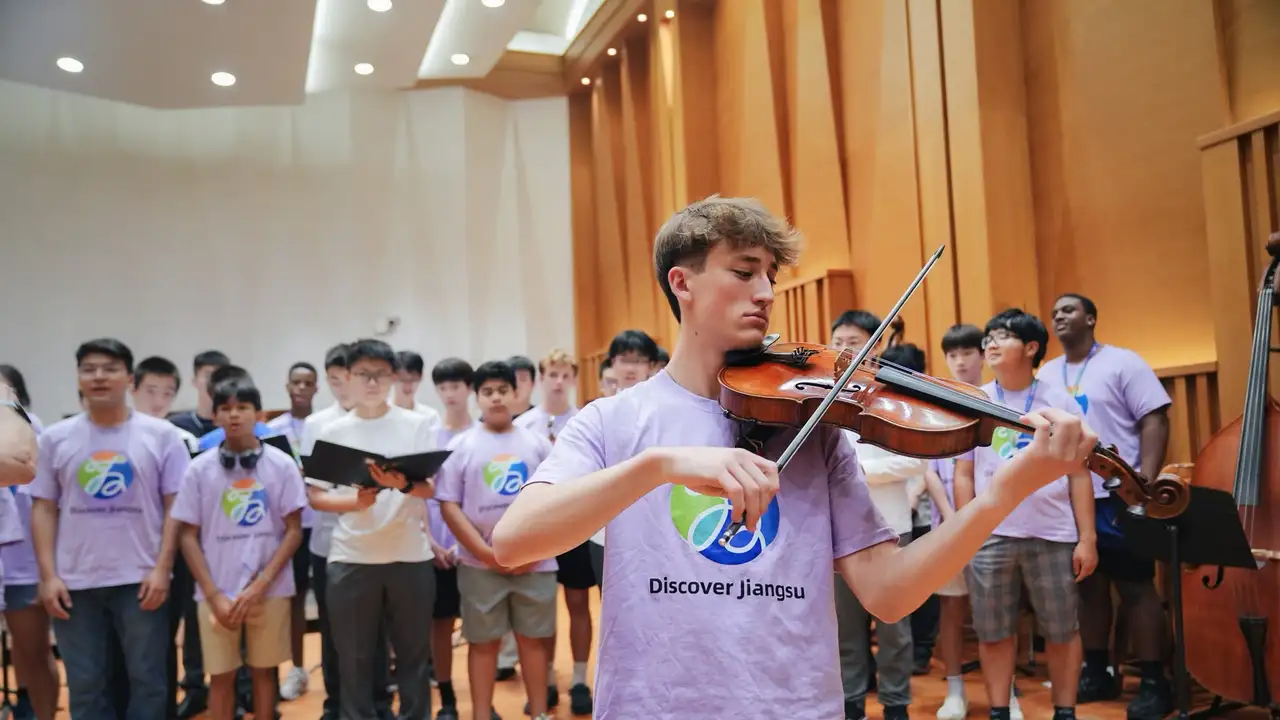
On July 12, Typhoon Bavi swept past the city of Changzhou in Jiangsu Province, leaving fresh rains in its wake. In a local high school rehearsal hall, Marian Poulin, an American conductor with over 40 years of experience and the camp’s delegation leader, was visibly moved by Chinese students performing "From Jasmine to Turandot."
She immediately invited the American and Chinese students to form a joint ensemble, stepping up to improvise a rehearsal with an orchestra blending Western classical and traditional Chinese instruments. There was no shared native language and zero prior practice. Yet as the erhu harmonised with the violin and the pipa echoed the trombone, cultural barriers melted away in seconds. As Poulin put it: "Differences don't need to be erased for harmony to exist. That is perhaps what the Chinese mean by 'harmony in diversity' (he er bu tong)."
Music connected not only the performers on stage but also the local communities they met along the way. From impromptu street performances in Nanjing to beating hand drums alongside locals dancing and practising Tai Chi in Changzhou’s Hongmei Park, these young Americans experienced the warm, vibrant rhythm of daily Chinese life.
Benjamin, an 18-year-old violinist from Maryland, was one of the older members of the delegation. Having just graduated high school with an offer from a top California music conservatory, his expressive playing made him a crowd favourite throughout the tour. Offstage, he took care of the younger kids like a big brother. On his final day in Beijing, he was seen patiently holding hands and dancing with an eight-year-old Chinese camper half his height, treating him like family.
"When you face a language barrier, the moment you realise everyone is expressing the same emotion through music, communication suddenly becomes effortless," Benjamin noted.
In another memorable event - a "500-RMB Grocery Challenge" at a Changzhou wet market - mixed teams of American and Chinese students bought ingredients, negotiated cooking fees, and even busked on the spot to cover expenses, forging quick friendships through shared laughter. Recalling how he and his Chinese teammates used espresso instead of vanilla extract to bake chocolate cookies, Benjamin smiled: "Seeing the big grins on their faces made every second worth it."
This authentic grassroots interaction resonated widely across social media. Recognizing the surging interest in youth exchanges this summer, China Global Television Network (CGTN) - where I work - launched the "Gen Cool Challenge," encouraging youth worldwide to share their exchange experiences. Young people across cities like Chengdu, Xiamen, Chongqing, Zhoushan, and Shanghai joined in, generating significant online traction, with posts shared by the Chinese Embassy in the US and Ambassador Xie Feng.
The "Zhiyin" initiative
RECOMMENDED FOR YOU

LIVE: Lula stays in power, beats Bolsonaro in stunning comeback
This transpacific reunion traces its roots back to June 28 at Shanyuan Garden in Washington, D.C.
Over 30 students and parents gathered at the venue, including more than 20 young artists set to depart for China on July 12. Hailing from Maryland, New Jersey, Pennsylvania, and Washington, D.C., these middle and high school students possessed formal training across classical instruments, vocal performance, jazz, and rap. After breaking the ice, they began rehearsals under expert guidance—first forming their own ensemble, then preparing to collaborate with Chinese peers on traditional Chinese songs across Changzhou, Nanjing, Shanghai, and Beijing.
The initiative was organised by veteran media executive and civic diplomat Zhou Zhixing and his wife, Yu Shan. Their twin Shanyuan Garden spaces in Washington and Beijing serve as crucial platforms for fostering US-China people-to-people exchanges.
Last year, they organised a visit to China for a youth pickleball delegation from Montgomery County, Maryland. The students wrote a letter to Chinese President Xi Jinping, expressing gratitude for his "50,000 youth in five years" invitation initiative and sharing memories of the friendships they formed. President Xi sent a reply message, encouraging them to be young ambassadors of friendship between the two nations.
This summer, several students from that pickleball trip returned to China at their own expense, staying in the homes of the Chinese friends they met last year. Zhou noted that seeing these young Americans develop a genuine love for China has been deeply encouraging: "Polls show American public perception of China is gradually recovering, and these grassroots youth interactions are undeniably playing a vital role."
The next twenty years
Throughout the history of US-China relations, cultural exchange has repeatedly acted as a breaker of ice. From "Ping-Pong Diplomacy" over half a century ago to the Philadelphia Orchestra’s historic 1973 tour, art and culture have consistently opened doors when political channels chilled. Unlike competitive sports, musical collaboration involves intricate emotional and artistic nuances, giving it a unique power to connect and heal.
For many of the American students, this was their first time setting foot in China. Before departure, some parents harboured doubts and anxieties. Yet the moment the music swelled and hands were shaken, preconceptions dissolved. The true value of civic exchange cannot be measured by a few weeks of excitement, but by what endures over time.
RECOMMENDED FOR YOU

‘Who will take responsibility?’ - October 7 families confront Netanyahu on Israel election day
History teaches us that the trajectory of international relations depends not only on high-level strategic calculations, but on the depth of public goodwill. Many of the young Americans and Chinese participating in the "Zhiyin" (Soulmate/Musical Kinship) Initiative are bound for world-class universities like Yale and the University of Chicago. As Zhou pointed out: "When these young people understand China firsthand and make Chinese friends, they will carry that goodwill into mainstream society ten or twenty years from now. That warmth will influence their families and, ultimately, broader society."
Delegation leader Marian Poulin shared a similar vision: "Our youth are our future. Once you truly get to know someone, you realise our similarities vastly outweigh our differences. I hope this experience isn't limited to these 23 children, but becomes a sustained, two-way street that brings more Chinese youth to the US as well."
The world may be flat, but it still requires dedicated bridge-builders.
As the vessel of big-power relations navigates turbulent waters, these grassroots bridges - built from musical notes, shared laughter, exchanged gifts, and footsteps on the Great Wall - are quietly assembling the foundational resilience both nations need. The future and hope of US-China relations have already been quietly planted in the hearts of these young people.
Du Yubin is a journalist, producer, and chief editor at China Global Television Network. He was stationed in Washington, D.C. and London for six years each, focusing on China-US and China-EU relations. He has worked in China's international communication and new media sectors for over 16 years. The views expressed in this article are solely those of the author
