Poland leads NATO defence spending
NATO members are increasing defence spending, with Poland emerging as the alliance’s top spender relative to economic output, as European countries accelerate military investment in response to heightened security concerns.
NATO members are increasing defence spending, with Poland emerging as the alliance’s top spender relative to economic output, as European countries accelerate military investment in response to heightened security concerns.
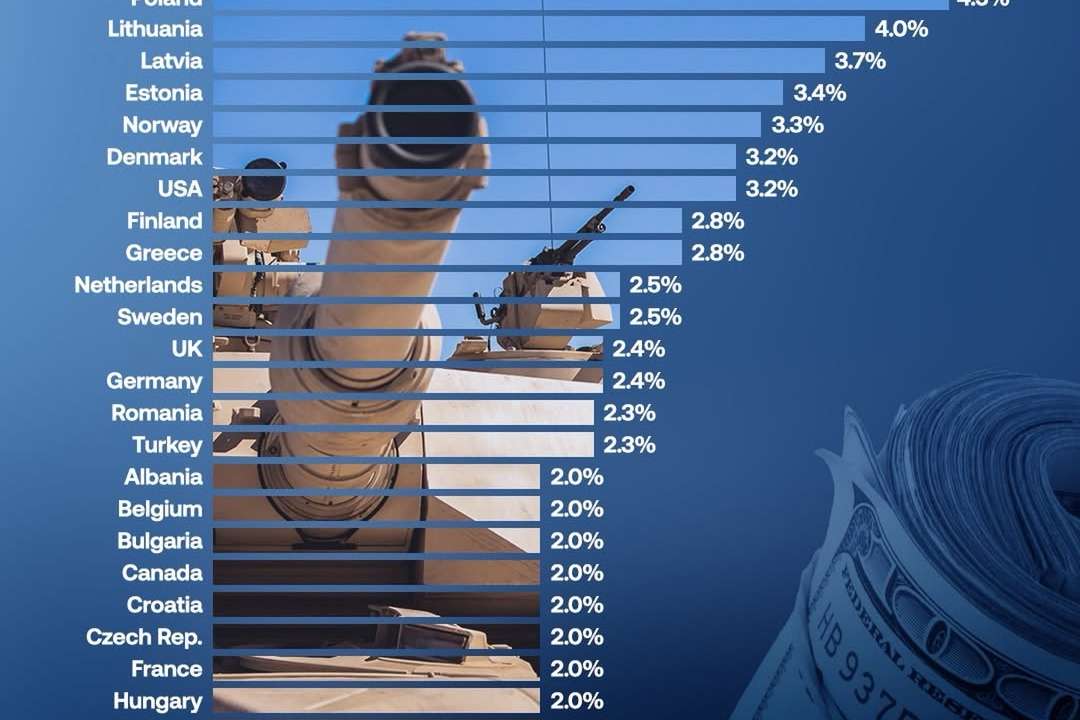
Poland is expected to allocate around 4.5% of its gross domestic product (GDP) to defence in 2025, the highest share among NATO allies, according to recent estimates compiled by defence analysts and data platforms, including Atlas Institute and reported by Euronews.
The surge reflects a broader shift across the alliance, where governments are under growing pressure to meet or exceed NATO’s benchmark of spending at least 2% of GDP on defence.
Countries on NATO’s eastern flank, closest to Russia, dominate the top of the spending rankings. Lithuania (4.0%), Latvia (3.7%) and Estonia (3.4%) are all projected to significantly exceed the alliance’s 2% target.
RECOMMENDED FOR YOU
From Suomi to Zhongguo, why some countries have completely different names at home
What this signals is a strategic recalibration. Since Russia’s full-scale invasion of Ukraine in 2022, frontline states have moved rapidly to strengthen military readiness, expand troop numbers and modernise equipment.
Euronews reports that defence budgets across Europe have seen sustained increases, with many governments committing to multi-year spending plans focused on air defence systems, artillery and ammunition stockpiles.
The United States, NATO’s largest military power, is expected to spend about 3.2% of GDP on defence in 2025—lower than several Eastern European allies in proportional terms but still far higher in absolute spending.
Northern European countries are also stepping up. Norway (3.3%) and Denmark (3.2%) are among the top contributors, reflecting growing concerns over Arctic security and regional stability.
Meanwhile, major Western European economies such as the United Kingdom and Germany are projected to spend around 2.4% of GDP, signalling progress after years of criticism for underinvestment.
Germany, in particular, has pledged a long-term shift in defence policy following its €100 billion special fund announced after the Ukraine invasion, a move widely covered by Euronews as a turning point in European security policy.
A notable development is that nearly all NATO members reached the 2% GDP benchmark in 2025. Countries including France, Italy, Canada and Spain hit that threshold, marking a significant change from just a few years ago when many allies fell short.
RECOMMENDED FOR YOU
Hungary's Magyar calls for stronger military amid European uncertainty