RSF index reveals that press freedom gaps widened globally in 2025
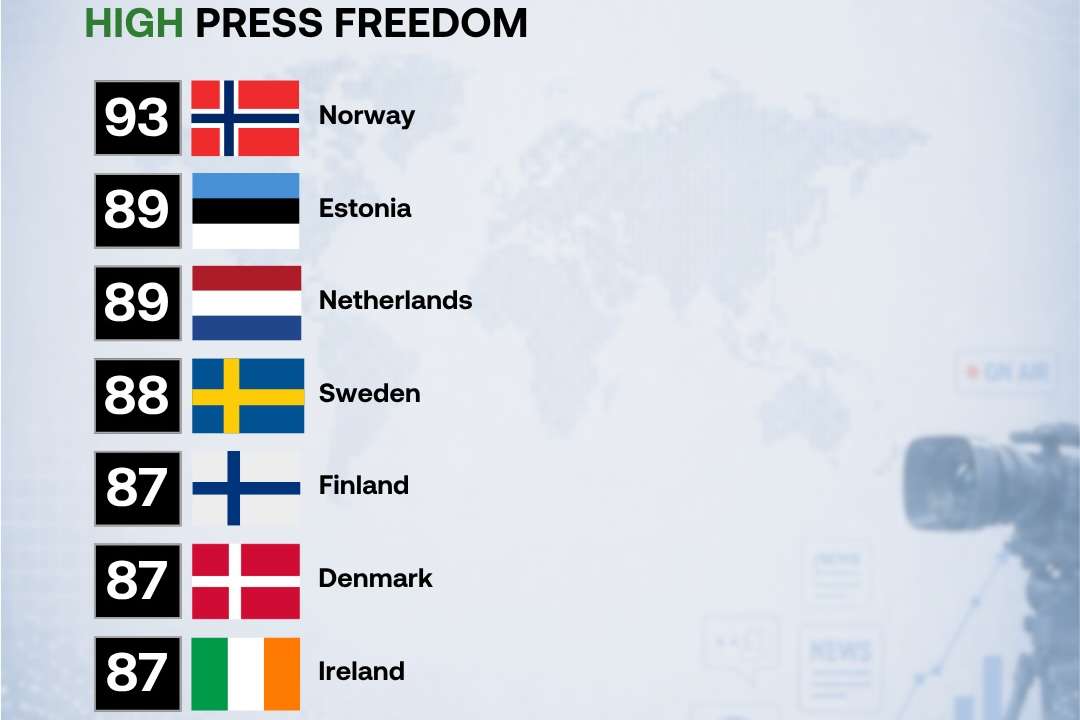
Press freedom remains sharply uneven worldwide in 2025, with Nordic countries maintaining their dominance at the top of global rankings, while dozens of nations continue to operate under constrained or reduced media conditions, according to the 2025 World Press Freedom Index published by Reporters Without Borders (RSF).
Main Points
- 4.25 billion people live in a country where press freedom is in a “very serious” situation
- Europe and Central Asia make up 43 of the world’s top 100 countries
- Global press freedom is becoming more fragile and fragmented
Press freedom remains sharply uneven worldwide in 2025, with Nordic countries maintaining their dominance at the top of global rankings, while dozens of nations continue to operate under constrained or reduced media conditions, according to the 2025 World Press Freedom Index published by Reporters Without Borders (RSF).
The index, which scores countries on a scale from 0 to 100, shows Norway once again leading globally with a score of 93, followed closely by Estonia and the Netherlands at 89, and Sweden at 88. Finland, Denmark and Ireland also rank among the highest performers, each scoring 87, reinforcing Northern Europe’s longstanding position as a stronghold for independent journalism.
European countries dominate the upper tier of the index, with several nations, including Portugal, Switzerland, Germany, and Czechia, scoring in the mid-80s, indicating a broadly stable media environment. The United Kingdom and Canada sit slightly lower at 79, reflecting what RSF describes as “moderate but notable pressures” on press independence.
Despite Europe’s overall strength, the index highlights variations within the region. Countries such as Hungary (63) and Greece (55) fall into lower categories, underscoring concerns about political influence, media concentration and journalist safety.
RECOMMENDED FOR YOU

Sadio Mane invests $20 million in hometown agro project
A large group of countries falls into what RSF classifies as “moderate” or “constrained” press freedom. These include major economies such as the United States (65), Japan (63), and South Korea (64), where structural and political challenges continue to affect journalistic work.
In Africa, the picture is mixed. Ghana (67) and Namibia (75) perform relatively well, while others, such as Zambia (57) and Niger (57), face tighter constraints. Similarly, Latin American countries show divergence, with Uruguay (65) and Costa Rica (73) outperforming regional peers like Bolivia (54) and Ecuador (54).
Asia-Pacific nations also display a broad spectrum. Australia and New Zealand remain in the moderate category, while countries such as Papua New Guinea (58) and Malaysia (56) highlight ongoing struggles with regulatory and political pressures.
At the lower end of the index, countries including Benin, Bolivia, Ecuador and Tanzania all score 54, placing them in the “reduced press freedom” category. Serbia, Brunei, Eswatini, Kosovo and Angola follow closely with scores of 53.
These rankings point to systemic issues such as censorship, legal intimidation, limited access to information and threats to journalists’ safety, factors RSF identifies as key barriers to a free press.