Russia and Soviet Union account for 163 UN Security Council vetoes since 1946
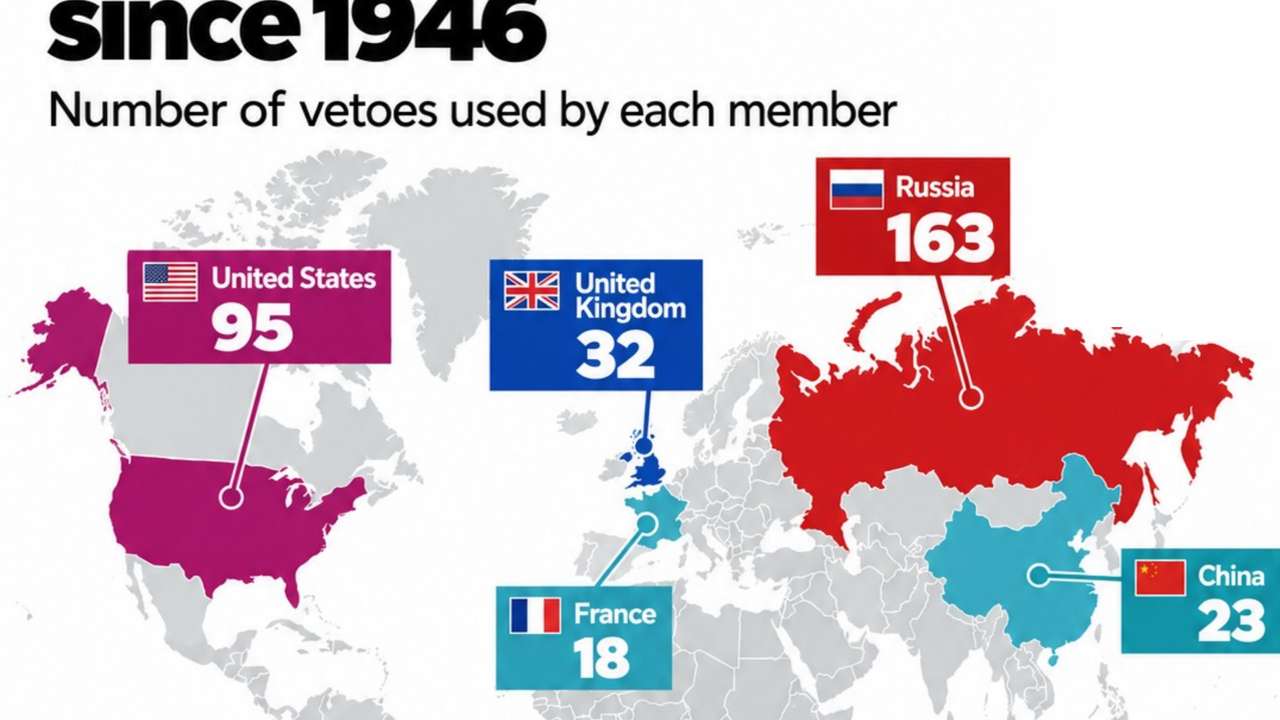
The five permanent members of the UN Security Council have used their veto power hundreds of times since 1946, with the Soviet Union and Russia accounting for the largest number, UN records show.
Key points
- Soviet Union and Russia have cast 163 vetoes
- The United States has used 95 vetoes
- China and Russia vetoed an Iran sanctions measure in September
The five permanent members of the UN Security Council have used their veto power hundreds of times since 1946, with the Soviet Union and Russia accounting for the largest number, UN records show.
The Security Council has 15 members, but only China, France, Russia, the United Kingdom and the United States are permanent members with veto power over substantive decisions. A negative vote by any one of them can block a draft even when it has enough support from other Council members.
The veto dates to the creation of the United Nations after World War Two and remains one of the most powerful and debated features of the Security Council.
Using the UN's historical series, the Soviet Union and Russia have cast 163 vetoes combined — 120 by the Soviet Union and 43 by Russia. The United States follows with 95, while the United Kingdom has 32 and France 18. China has 23, when the historical veto cast while the Republic of China held China's UN seat is included.
RECOMMENDED FOR YOU

Big Tech spending could top $1 trillion by 2027 as AI investment accelerates
The pattern has changed substantially over time. The Soviet Union used the veto frequently during the UN's early decades, including over applications for UN membership. The United States later became a frequent user, particularly on resolutions concerning Israel and the Palestinian territories.
Britain and France, by contrast, have not exercised their veto since 1989.
Latest veto centred on Iran sanctions monitoring
The latest veto came on September 17, 2026, when China and Russia blocked a US-backed draft resolution that would have extended the mandate of a panel of UN experts monitoring sanctions on Iran for one year. The proposal received 11 votes in favour, while China and Russia voted against it and Pakistan and Somalia abstained.
Russia and China argued that the sanctions framework lacked a valid legal basis after Security Council Resolution 2231 expired in October 2025. The United States and several European governments disputed that interpretation and said the expert panel was needed to monitor sanctions connected to Iran's nuclear and ballistic missile programmes.
The veto triggered a UN General Assembly debate on October 1 under a 2022 rule requiring the Assembly to meet after a permanent Security Council member casts a veto. The measure does not overturn the veto but allows the wider UN membership to debate it.
This story is written and edited by the Global South World team, you can contact us here.