Some animals can live for centuries — and one may not age at all
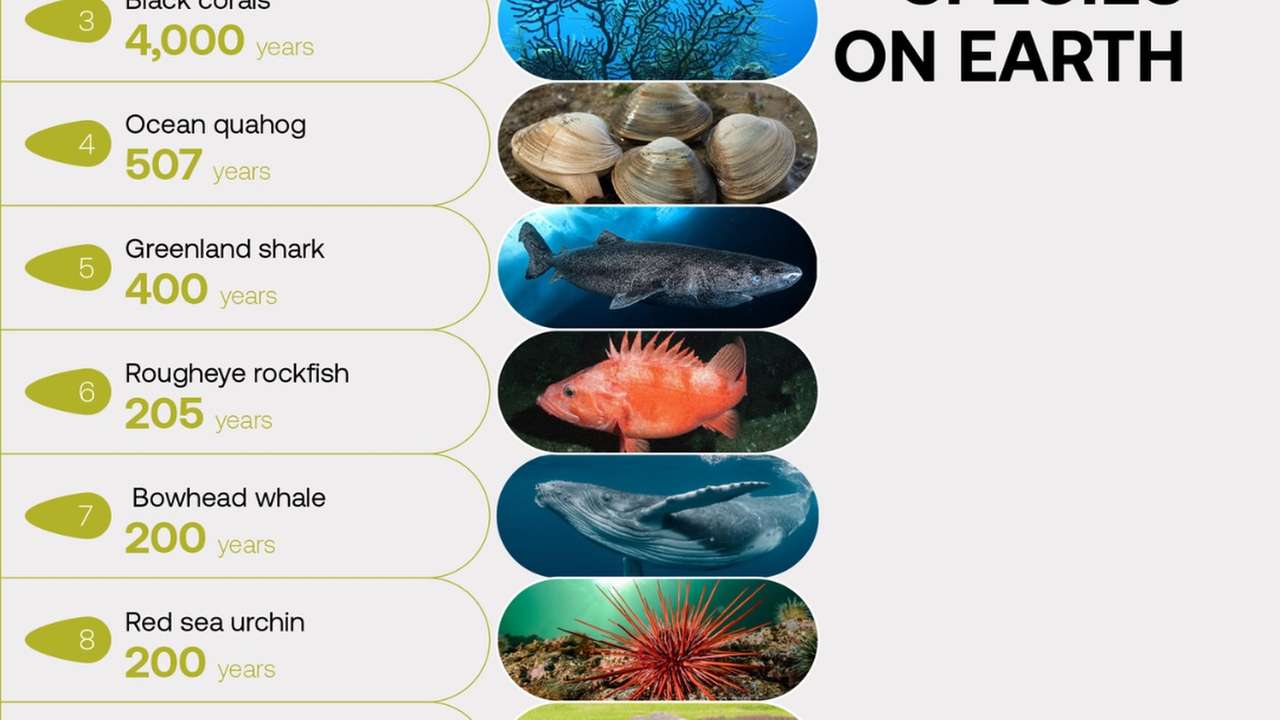
Some of Earth's longest-lived animals survive for centuries or even thousands of years, with many of the most extreme examples found in the ocean. But the figures are not all directly comparable: some are verified ages of individual animals, while others are scientific estimates or maximum lifespans.
Main points
- Some deep-sea animals can live for thousands of years
- Greenland sharks may survive for centuries
- Humans have a verified record of 122 years
Some of Earth's longest-lived animals survive for centuries or even thousands of years, with many of the most extreme examples found in the ocean. But the figures are not all directly comparable: some are verified ages of individual animals, while others are scientific estimates or maximum lifespans.
Deep-sea sponges are among the most remarkable. Research on the glass sponge Monorhaphis chuni estimated that one specimen had lived for about 11,000 years, with a margin of uncertainty of roughly 3,000 years. That makes the infographic's rounded 10,000-year figure reasonable, although it is an estimate rather than a precisely measured age.
Black corals can also survive for thousands of years, making extreme longevity particularly common among some slow-growing marine organisms.
A clam that lived for more than 500 years
One of the strongest individual records belongs to an ocean quahog, Arctica islandica. Researchers at Bangor University determined that a specimen collected from Icelandic waters had lived for 507 years.
RECOMMENDED FOR YOU

Global oil chokepoints under scrutiny as tensions expose fragile energy lifelines
Nicknamed “Ming”, the clam's age could be determined from annual growth bands in its shell, much like counting tree rings.
Greenland sharks are another extraordinary case. A 2016 study published in Science used radiocarbon dating of proteins in the eye lenses of 28 female sharks. The largest was estimated to be 392 years old, with an uncertainty of 120 years in either direction. The researchers concluded that Greenland sharks live at least 272 years, making them the longest-lived vertebrates known.
So the graphic's 400-year figure is a useful approximation, but it should not be read as an exact maximum lifespan.
Other fish can also live far longer than humans. NOAA records a 205-year maximum age for rougheye rockfish from a specimen collected in southeast Alaska.
Bowhead whales can reach similarly remarkable ages. NOAA Fisheries says evidence from old harpoon tips recovered from whales, together with newer ageing techniques, indicates that bowheads can live more than 200 years.
Red sea urchins may also reach 200 years or more, according to research reported by Oregon State University. Unlike humans, the animals appear to show remarkably few signs of age-related decline even when they are more than a century old.
Jonathan is still going at 194
On land, the numbers are much smaller, but one living animal has witnessed almost two centuries of human history.
Jonathan, a Seychelles giant tortoise living on the island of St Helena, is estimated to have been born around 1832, making him at least 194 years old in 2026. Guinness World Records recognises him as the world's oldest known living land animal and the oldest known turtle or tortoise on record.
RECOMMENDED FOR YOU

3,000 athletes are in Kyrgyzstan for the World Nomad Games — But this sport could steal the show
Humans sit well below many of these animals. The oldest fully authenticated person was France's Jeanne Calment, who lived for 122 years and 164 days before dying in 1997. Her record has still not been surpassed.
Is the “immortal jellyfish” really immortal?
The biggest qualification concerns the animal at the top of the graphic.
The immortal jellyfish, Turritopsis dohrnii, is not known to live forever in the wild. It gets its name from an unusual ability to reverse its life cycle. Under certain conditions, an adult jellyfish can return to an earlier developmental stage and begin growing again.
That means it could theoretically repeat its life cycle rather than inevitably dying from biological ageing. But it can still be killed by disease, predators or environmental conditions. Calling its lifespan “potentially indefinite” is therefore more accurate than saying an individual jellyfish has actually lived forever.
This story is written and edited by the Global South World team, you can contact us here.