Global oil chokepoints under scrutiny as tensions expose fragile energy lifelines
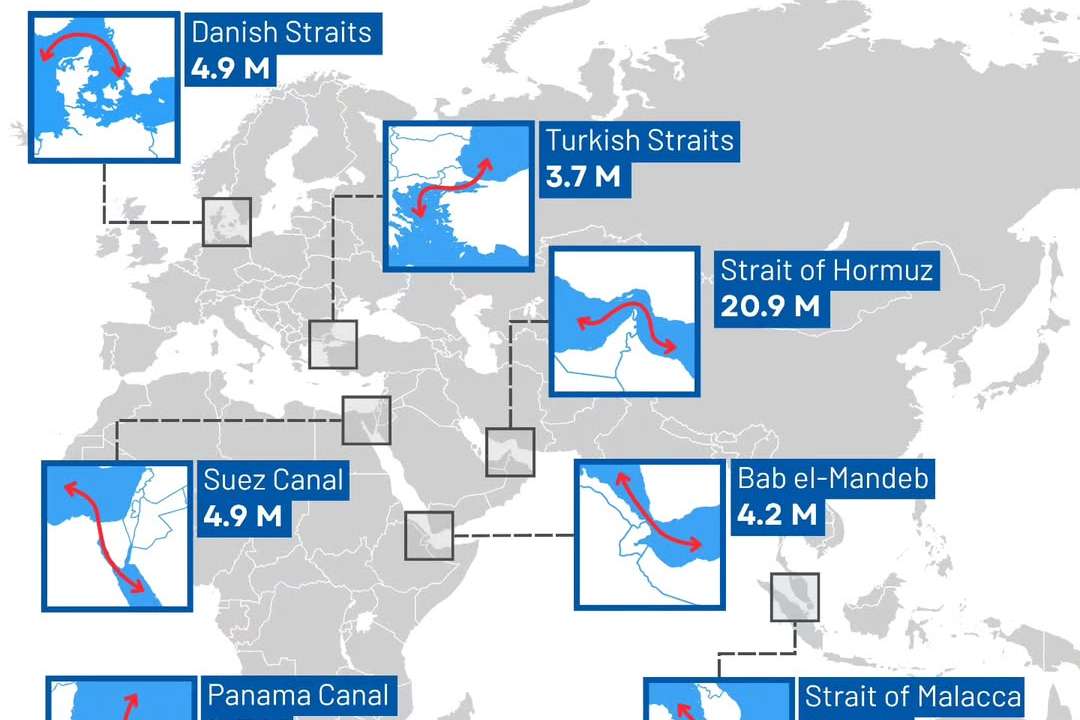
Long before oil prices spike or tankers are rerouted, the real pressure points of the global energy system lie in a handful of narrow sea passages. These maritime chokepoints, often just a few kilometres wide, quietly carry the bulk of the world’s oil.
Long before oil prices spike or tankers are rerouted, the real pressure points of the global energy system lie in a handful of narrow sea passages. These maritime chokepoints, often just a few kilometres wide, quietly carry the bulk of the world’s oil.
From the Strait of Hormuz in the Middle East to the Strait of Malacca in Southeast Asia, these routes form the backbone of international energy trade, handling the vast majority of seaborne crude flows.
Eight routes that power the global economy
According to the U.S. Energy Information Administration (EIA), roughly 80 million barrels of oil move through global maritime trade daily, with a large share funnelled through just a small number of chokepoints.
The Strait of Malacca, linking the Indian and Pacific oceans, is the busiest oil transit route in the world, carrying more than 23 million barrels per day, nearly a third of total maritime oil flows.
RECOMMENDED FOR YOU

We can't 'build a wall' around Ceuta and throw migrants over it - Sanchez blasts EU
Close behind is the Strait of Hormuz, one of the most strategically sensitive waterways on the planet. Around 20 million barrels per day pass through this narrow corridor between Iran and Oman, accounting for roughly a quarter of global seaborne oil trade.
Other critical routes include the Suez Canal and SUMED pipeline system, the Bab el-Mandeb strait near the Red Sea, the Danish and Turkish straits in Europe, the Panama Canal, and the Cape of Good Hope, each carrying millions of barrels daily and linking key producers to major consuming regions.
What makes these chokepoints so important is not just volume, but lack of alternatives.
Many oil-exporting countries in the Gulf rely heavily on the Strait of Hormuz, with limited pipeline capacity to bypass it.
Similarly, Asian economies including China, Japan and South Korea depend heavily on the Strait of Malacca for energy imports, making it a strategic vulnerability in times of geopolitical tension.
This story is written and edited by the Global South World team, you can contact us here.