South Africa returns to top of Africa’s largest economies in 2026
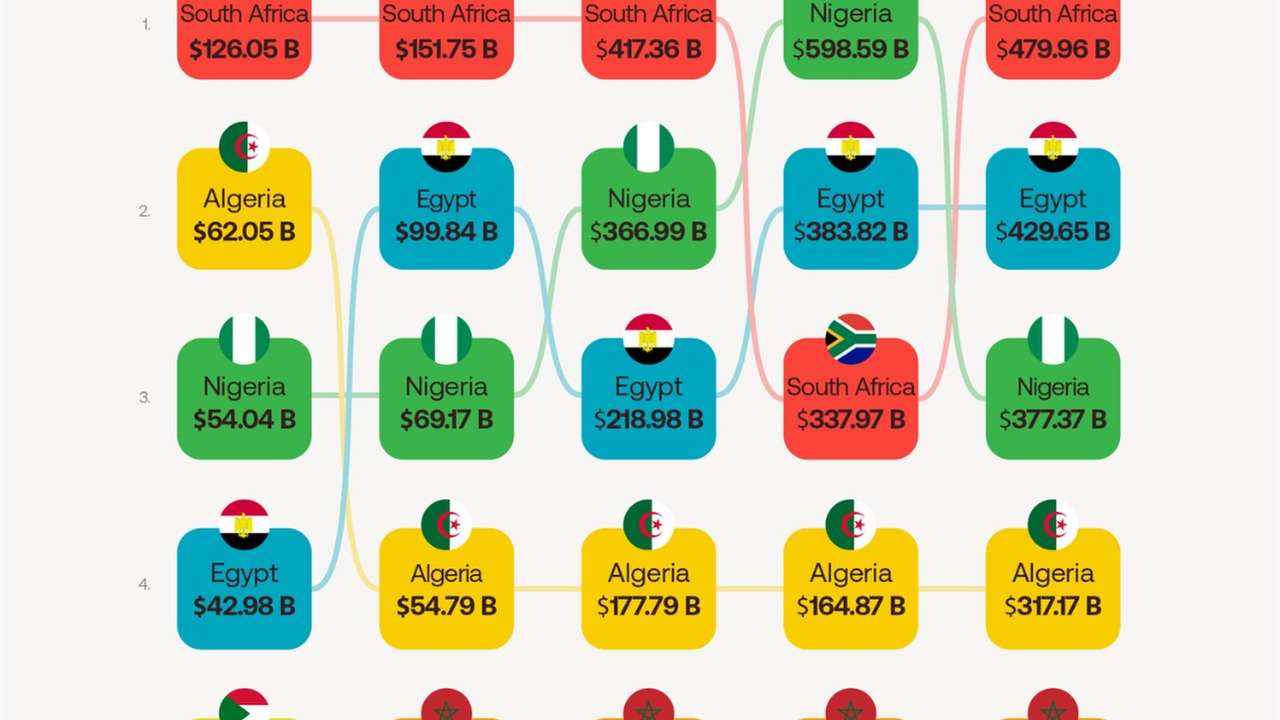
South Africa is projected to have Africa’s largest economy in 2026, reclaiming a position that has shifted between the continent’s biggest economies over the past three decades.
Main points
- South Africa is projected at nearly $480 billion
- Egypt and Nigeria rank second and third
- Currency swings have repeatedly reshaped the rankings
South Africa is projected to have Africa’s largest economy in 2026, reclaiming a position that has shifted between the continent’s biggest economies over the past three decades.
The IMF’s April 2026 World Economic Outlook puts South Africa’s nominal GDP at about $480 billion, ahead of Egypt at roughly $430 billion and Nigeria at $377 billion. Algeria follows at about $317 billion, with Morocco fifth at $194 billion.
The figures measure nominal GDP in current US dollars, meaning exchange-rate movements can significantly change the rankings even when an economy is still growing in local currency terms.
South Africa returns to first place
The historical data show how often the top positions have changed.
RECOMMENDED FOR YOU
Countries strengthen crisis plans as Europe steps up disaster readiness
South Africa was Africa’s largest economy in 1990, 2000 and 2010, according to World Bank figures. Its GDP increased from about $126 billion in 1990 to $417 billion in 2010.
Nigeria moved into first place by 2020, when its GDP reached nearly $599 billion, compared with Egypt’s $384 billion and South Africa’s $338 billion.
By 2026, the order has changed again. The infographic, using IMF projections, puts South Africa back on top, followed by Egypt, Nigeria, Algeria and Morocco.
Nigeria’s ranking reflects a weaker currency
Nigeria provides one of the clearest examples of why dollar-based GDP rankings can change quickly.
World Bank data show Nigeria’s nominal GDP at about $647 billion in 2022, before falling to $487 billion in 2023 and $252 billion in 2024. The sharp decline in its dollar value came during major depreciation of the naira. World Bank data put the economy back at about $291 billion in 2025.
That does not mean Nigeria suddenly lost the same proportion of its actual economic activity. Converting GDP into US dollars makes the figure highly sensitive to exchange rates.
Africa’s top five have changed over time
The longer history also shows some consistency. Algeria has remained among the five largest economies throughout each year highlighted in the graphic, while Morocco has held fifth place since 2000.
Egypt has risen from fourth in 1990 to second in the 2026 projection. Nigeria moved from third in 1990 to first in 2020 before dropping back, while Sudan, fifth in 1990, is the only country shown to have fallen out of this group. World Bank figures support the historical values shown for the major economies.
RECOMMENDED FOR YOU

Russia warns Europe of swift military response if war breaks out
The 2026 numbers should be read as IMF projections rather than final results. They also measure the overall size of each economy, not income or living standards per person. The IMF’s April outlook projects global growth of 3.1% in 2026 amid significant economic and geopolitical uncertainty.
Taken together, the figures show that South Africa, Egypt and Nigeria have increasingly traded places near the top, while exchange rates have become an important part of the story behind Africa’s changing economic rankings.
This story is written and edited by the Global South World team, you can contact us here.