Southern Europe embraces air conditioning while the north holds back
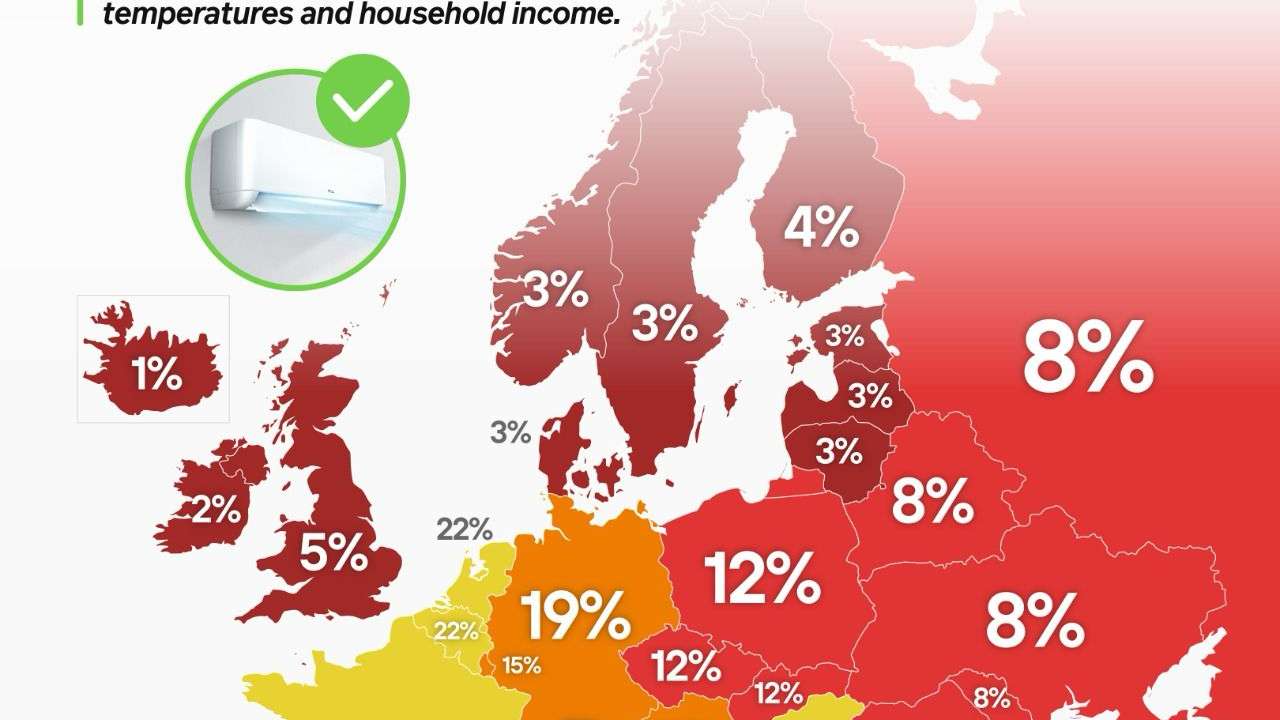
Air conditioning remains uncommon across much of Europe despite increasingly frequent summer heatwaves, with ownership concentrated in the continent's warmer southern countries, according to data from the International Energy Agency (IEA) and Eurostat.
Key Points
- Southern Europe has Europe's highest air conditioning ownership
- Northern Europe has the lowest household air conditioning rates
- Climate and income largely determine air conditioning adoption
Air conditioning remains uncommon across much of Europe despite increasingly frequent summer heatwaves, with ownership concentrated in the continent's warmer southern countries, according to data from the International Energy Agency (IEA) and Eurostat.
The map highlights wide differences in household air conditioning ownership across Europe, reflecting long-term variations in climate, income, housing design and energy demand.
Greece has the highest rate among European countries, with 99% of households equipped with air conditioning. It is followed by Italy (55%), Spain (55%), Türkiye (35%), Portugal (35%) and Bulgaria (30%). France records 25%, while Romania has 26%. Several Balkan countries range between 25% and 35%.
Ownership is considerably lower across much of northern and western Europe. Germany records 19%, the Netherlands 22%, Belgium 22%, the United Kingdom 5%, Finland 4%, Norway 3%, Sweden 3%, Denmark 3%, Estonia 3%, Latvia 3%, Lithuania 3%, Ireland 2% and Iceland just 1%.
RECOMMENDED FOR YOU
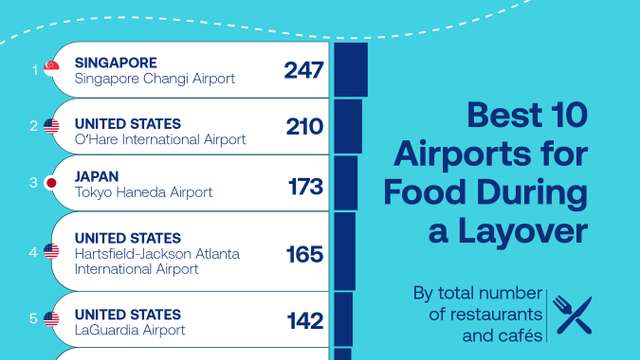
Singapore Changi tops world’s best airports for food during a layover
The International Energy Agency says Europe has historically had lower demand for residential cooling than many parts of Asia, the Middle East and North America because much of the continent has traditionally experienced milder summers. Instead, homes have generally been designed to retain heat during winter rather than dissipate it during hot weather.
However, climate change is increasing demand for cooling. The Copernicus Climate Change Service says Europe is the world's fastest-warming continent, with heatwaves becoming more frequent, longer-lasting and more intense. Southern Europe has experienced repeated summers with temperatures exceeding 40°C, while countries farther north have also recorded unprecedented heat extremes.
The IEA estimates that air conditioner ownership is strongly influenced by average summer temperatures, household income and electricity access. Countries with hotter climates and higher disposable incomes typically have higher adoption rates, although energy costs and building regulations also affect installation.
The European Commission has encouraged member states to improve building insulation, passive cooling techniques, tree cover and energy-efficient construction to reduce dependence on mechanical cooling while adapting to rising temperatures.
Energy experts note that although air conditioning protects public health during extreme heat, rapid growth in cooling demand can place significant pressure on electricity grids during summer peak periods unless accompanied by greater energy efficiency and renewable generation.