Spain leads global male baldness rankings as Indonesia records lowest rate
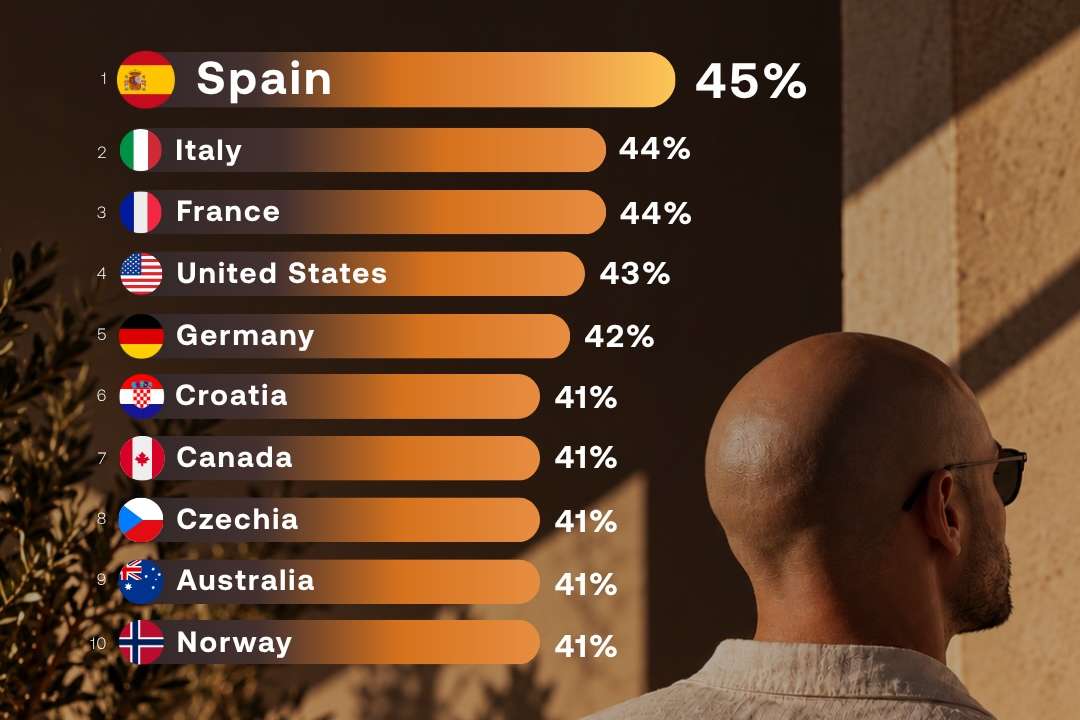
Spain has the highest reported rate of male pattern baldness among 46 countries surveyed, while Indonesia has the lowest, according to figures published by World Population Review.
Main points
- Spain tops the ranking with 44.5% of men affected.
- Indonesia records the lowest rate at 26.96%.
- European countries dominate the highest baldness rankings.
Spain has the highest reported rate of male pattern baldness among 46 countries surveyed, while Indonesia has the lowest, according to figures published by World Population Review.
The figures, based on 2024 data and included in World Population Review's 2026 country rankings, show that 44.5% of men in Spain are bald or experiencing male pattern hair loss. Italy follows at 44.37%, with France close behind at 44.25%.
The United States ranks fourth at 42.68%, followed by Germany at 41.51% and Croatia at 41.32%. Canada, Czechia, Australia and Norway complete the top 10, each recording rates of about 41%.
Indonesia and Colombia record the lowest rates
At the other end of the ranking, Indonesia has the lowest reported rate at 26.96%, followed closely by Colombia at 27.04%.
RECOMMENDED FOR YOU

‘Victory is within reach’ - Ahmad Tibi vows to bring down Netanyahu's government
The Philippines ranks third-lowest at 28%, while Malaysia and Argentina record 29.24% and 29.35%, respectively.
China, Ukraine and Thailand each have rates of around 31%, while Denmark and Poland are slightly higher at about 32%.
The figures show a clear regional difference among the countries covered, with European nations dominating the highest rates and several Asian and South American countries appearing near the bottom.
Why are some men more likely to go bald?
Male pattern baldness, also known as androgenetic alopecia, is a common form of hair loss linked mainly to genetics and sensitivity to hormones.
World Population Review notes that inherited traits help explain why baldness rates differ between populations. Age also plays an important role, as male pattern hair loss generally becomes more common as men grow older.
The rankings cover 46 countries, and the figures do not establish whether differences in age, genetics or survey methods explain each country's position.
Also note that although the rankings are published on World Population Review's 2026 pages, the underlying figures are from 2024 rather than a new 2026 survey.
This story is written and edited by the Global South World team, you can contact us here.