Spain’s foreign-born population passes 10 million after three decades of migration
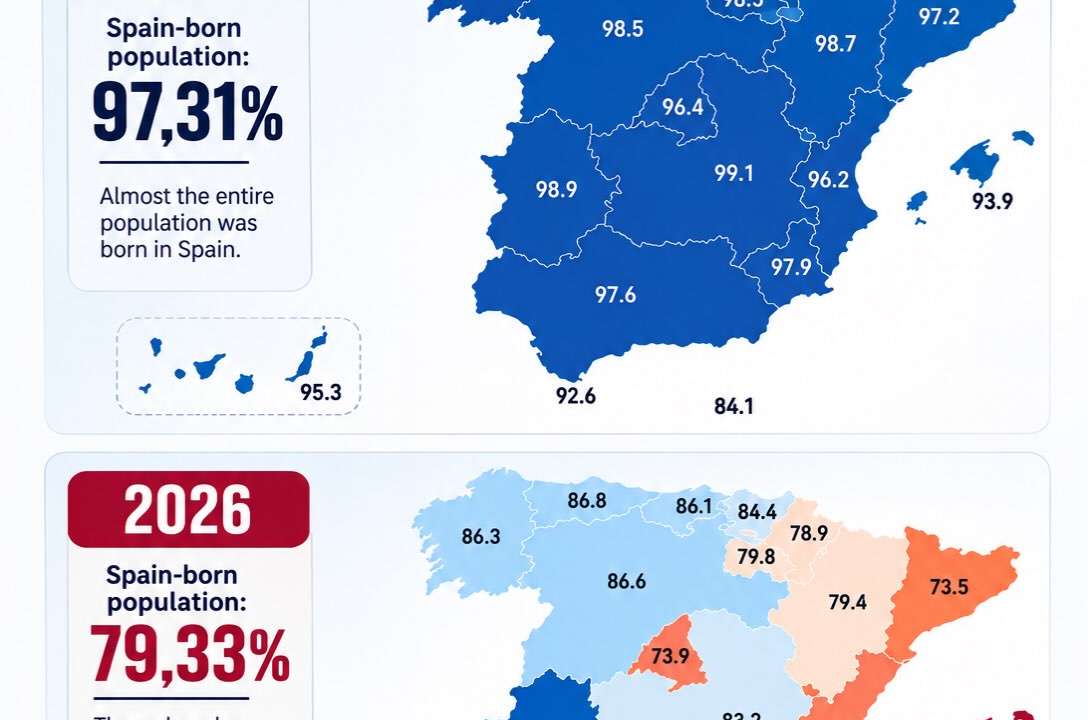
Spain has undergone a major demographic shift over the past three decades, with roughly one in five residents now born outside the country, compared with only a small fraction in the mid-1990s.
Key points
- Spain-born residents fell from about 97% in 1996 to around 80% in 2026
- More than 10 million residents were born outside Spain
- Migration is driving Spain’s recent population growth
Spain has undergone a major demographic shift over the past three decades, with roughly one in five residents now born outside the country, compared with only a small fraction in the mid-1990s.
Spain had 49.57 million residents on January 1, 2026, according to provisional data from the National Statistics Institute (INE). Of those, 10 million were born abroad, crossing the 10-million mark for the first time. That leaves about 39.57 million people born in Spain, or roughly 79.8% of the population.
The graphic puts the Spain-born share at 97.31% in 1996 and 79.33% in 2026. The 2026 figure is close to the official INE data, although the latest January figures imply a share of about 79.8%, rather than exactly 79.33%. Differences can result from the reference date or dataset used.
Spain was overwhelmingly a country of Spanish-born residents in the mid-1990s. Since then, large-scale immigration from Latin America, other parts of Europe, Africa and elsewhere has changed the country's population.
RECOMMENDED FOR YOU

France split into three nearly equal populations shows how unevenly the country is settled
The shift has continued in 2026. By July 1, Spain's population had risen further to 49.80 million, while the number of foreign-born residents reached 10.29 million. That means around 20.7% of Spain's residents were born abroad, leaving roughly 79.3% born in Spain.
That July figure is important because it means the graphic's 79.33% national figure is broadly accurate for mid-2026, rather than for January 1.
INE also makes an important distinction between foreign-born residents and foreign nationals. Spain had 10.29 million foreign-born residents in July, but only 7.44 million residents with foreign nationality. Many people born abroad have acquired Spanish citizenship.
The map shows some of the lowest Spain-born shares in the Balearic Islands, Catalonia, Madrid and parts of the Mediterranean coast, while several inland and western regions remain much more heavily Spain-born.
This reflects decades of immigration concentrating around large cities, tourism centres, agricultural areas and regions with strong labour demand. The geographical difference is now large enough that the demographic profile of Madrid or the Balearic Islands looks very different from that of Extremadura.
Spain's overall population is still growing despite fewer Spain-born residents. INE said the country's recent population increase came from growth in the foreign-born population, while the number of residents born in Spain declined.
By July 2026, Spain had 444,205 more residents than a year earlier, an annual increase of about 0.9%.
This story is written and edited by the Global South World team, you can contact us here.