Sweden election leaves opposition with narrow lead as final count continues
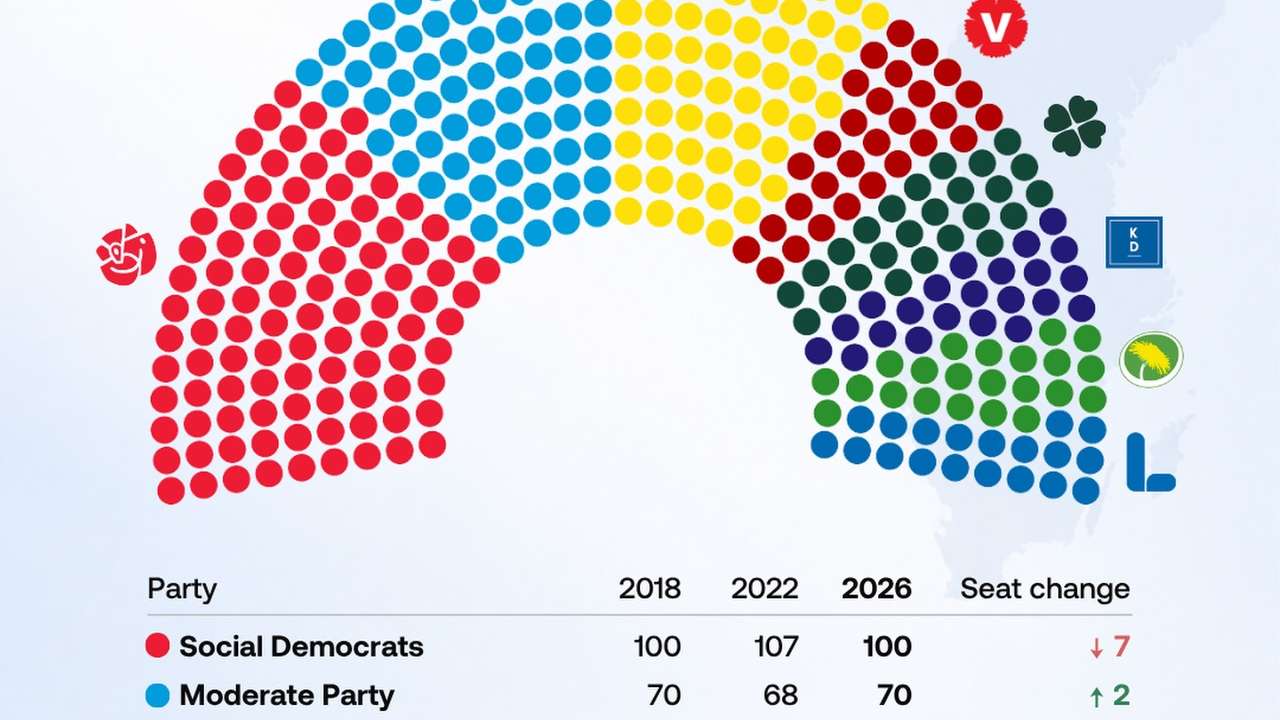
Sweden's opposition held a razor-thin lead after Sunday's general election, setting the country up for difficult coalition talks as officials continued counting late and overseas ballots.
Main points
- Opposition parties are projected to win 176 seats
- Social Democrats remain the largest party
- Final results could change the balance
Sweden's opposition held a razor-thin lead after Sunday's general election, setting the country up for difficult coalition talks as officials continued counting late and overseas ballots.
Preliminary results from the Swedish Election Authority put the four opposition parties on course for 176 of the Riksdag's 349 seats, against 173 for the parties that form or support Prime Minister Ulf Kristersson's outgoing government.
The Social Democrats, led by former prime minister Magdalena Andersson, remained Sweden's largest party despite losing support compared with 2022. Andersson is seeking to return to the job she lost four years ago, but the narrow result means neither side can claim a clear victory yet.
The election also brought a setback for the Sweden Democrats, the anti-immigration party that supported Kristersson's minority government from outside the cabinet. Its vote share fell to just under 18%, about three percentage points lower than in 2022, pushing it from second to third place behind Kristersson's Moderate Party.
RECOMMENDED FOR YOU
Argentina takes Britain to International Court, demands halt to Falklands oil project
Forming a government could be difficult
Even if the opposition's lead survives the final count, Andersson would still face a difficult task in putting together a government.
Her potential parliamentary majority includes the Social Democrats, Left Party, Greens and Centre Party. But the Centre Party does not want to govern with the Left Party, while the Left has said it will oppose a government in which it is not represented. Those disagreements could complicate negotiations despite the bloc's apparent majority.
Kristersson's right-leaning bloc faces its own challenges. Since 2022, his government has consisted of the Moderates, Christian Democrats and Liberals, with parliamentary support from the Sweden Democrats. Before the election, Kristersson had opened the door to the Sweden Democrats entering government for the first time if his side retained power.
Sweden uses proportional representation, with 349 seats in parliament. Parties normally need at least 4% of the national vote to enter the Riksdag, and forming a government depends on whether a proposed prime minister can avoid being rejected by a majority of lawmakers.
Healthcare, schools, household finances, crime and migration were among the major domestic issues during the campaign. On foreign policy, the main parties broadly agree on continued support for Ukraine and Sweden's membership of NATO, although differences remain over defence and other foreign-policy questions.
Why the result is not final
The Swedish Election Authority says the election-night count is preliminary. Late advance votes and ballots from Swedes living abroad are counted separately, while the formal final count is carried out by county administrative boards.
More than 8.04 million people were eligible to vote in the parliamentary election, including about 227,000 Swedes living abroad.
The final result will determine whether Andersson gets a chance to return as prime minister or Kristersson can find another route to remain in office.
RECOMMENDED FOR YOU

Niger accuses Chad of deadly drone strike with French backing
This story is written and edited by the Global South World team, you can contact us here.