US time zones in 1924: How railways shaped America's clocks more than a century ago
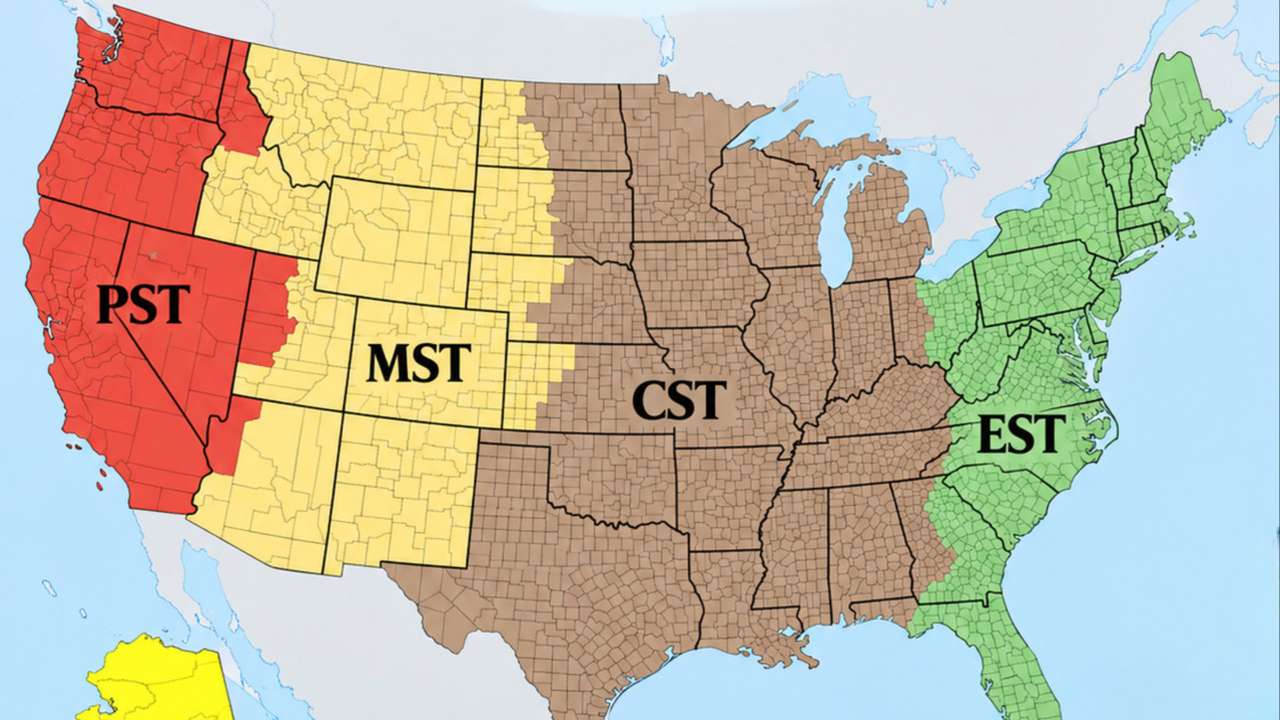
More than 100 years ago, the United States was already divided into major time zones, a system introduced to make railway travel easier and bring order to a country where towns once set their clocks by the Sun.
Key points
- The mainland US had four main time zones in 1924.
- American railways introduced standard time in 1883 to simplify travel.
- The 1918 Standard Time Act brought time zones under federal oversight.
More than 100 years ago, the United States was already divided into major time zones, a system introduced to make railway travel easier and bring order to a country where towns once set their clocks by the Sun.
A historical map dated January 1, 1924, shows how the United States organised its time zones long before modern air travel, digital clocks and smartphones.
The mainland was divided into four main zones: Eastern, Central, Mountain and Pacific Standard Time. Each was one hour behind the next, reflecting the country's vast geographical size.
Eastern Standard Time was five hours behind Greenwich Mean Time (GMT), while Central, Mountain and Pacific Standard Time were six, seven and eight hours behind, respectively.
RECOMMENDED FOR YOU

‘We refuse to be scapegoats’ - Chad rejects Niger's deadly drone strike accusations
The system emerged from the rapid expansion of American railways during the 19th century. Before standardisation, towns kept their own local time based on the Sun's position, creating confusion for railway operators and passengers.
On November 18, 1883, American and Canadian railways introduced four standard time zones to simplify timetables and improve coordination.
The US government formally adopted standard time under the Standard Time Act of 1918, giving the Interstate Commerce Commission authority to establish and adjust time-zone boundaries.
By 1924, the system was firmly established, although boundaries did not always follow state lines. Some states were divided between two zones, reflecting transport connections and local economic needs.
The historical map also shows Alaska and Hawaii using separate time standards. However, Hawaii was not yet a US state, and the territories' time arrangements differed from those used today.
The boundaries continued to change over the following decades. The Uniform Time Act of 1966 established a more consistent national approach to daylight saving time, while responsibility for time-zone boundaries eventually passed to the US Department of Transportation.
Today, the department oversees nine official US time zones, including those covering territories outside the mainland.
The 1924 map illustrates how a system originally designed to solve railway scheduling problems became a lasting part of American life.
RECOMMENDED FOR YOU

Europe recruits migrant workers. So why doesn't it tell them how to see a doctor?
This story is written and edited by the Global South World team, you can contact us here.