Where American forces are stationed in 2026
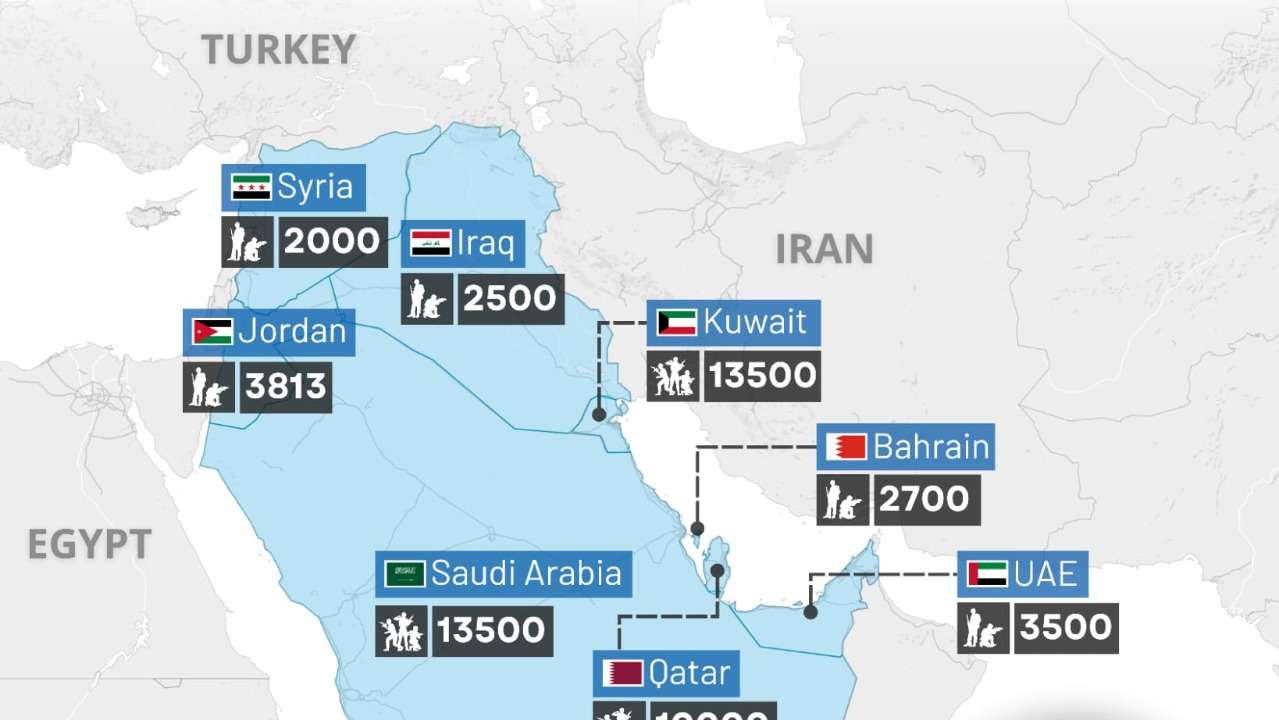
Thousands of U.S. service members are stationed across key partner nations, including Kuwait, Saudi Arabia, Qatar, Bahrain, the United Arab Emirates, Iraq, Syria and Jordan.
Thousands of U.S. service members are stationed across key partner nations, including Kuwait, Saudi Arabia, Qatar, Bahrain, the United Arab Emirates, Iraq, Syria and Jordan.
While troop levels fluctuate depending on operational needs, Pentagon briefings and Congressional Research Service (CRS) reports confirm that the United States maintains a substantial and strategically positioned presence across the Gulf and Levant.
According to U.S. Department of Defence data, Kuwait and Saudi Arabia host some of the largest concentrations of American personnel in the region.
Kuwait has historically served as a logistics and staging hub for operations in Iraq and Syria. Following the 2003 invasion of Iraq, U.S. troop levels there surged, and while numbers have fluctuated, thousands remain stationed at bases such as Camp Arifjan.
RECOMMENDED FOR YOU

Premier League dominates summer transfer spending as clubs set new record
Saudi Arabia also hosts significant U.S. forces, particularly since Washington redeployed troops there in 2019 after heightened tensions with Iran. Reuters reported at the time that the move aimed to strengthen regional deterrence.
Qatar hosts Al Udeid Air Base, the largest U.S. military installation in the Middle East. The base serves as the forward headquarters for U.S. Central Command’s air operations. According to the Pentagon and reporting by Reuters, Al Udeid plays a central role in air operations spanning Iraq, Syria and Afghanistan during the height of those conflicts.
Bahrain hosts the headquarters of the U.S. Navy’s Fifth Fleet. The naval presence underpins maritime security operations across the Persian Gulf, Red Sea and Arabian Sea. The U.S. Navy states that the Fifth Fleet oversees operations covering roughly 2.5 million square miles of water.
Despite the formal end of major combat operations in Iraq in 2011 and the withdrawal from Afghanistan in 2021, U.S. forces remain in Iraq and Syria under a mission focused on preventing the resurgence of the Islamic State.
Pentagon statements and Reuters reporting confirm that approximately 2,500 U.S. troops are deployed in Iraq in an advisory and counterterrorism role. In Syria, around 900 to 2,000 personnel are reported to be operating in support of local partner forces in the northeast.
These deployments have occasionally drawn scrutiny following attacks by Iran-aligned militias, prompting periodic U.S. retaliatory airstrikes, according to Reuters coverage.
Jordan hosts several thousand U.S. troops at facilities used for training, logistics and regional response operations. The United Arab Emirates also hosts U.S. forces at Al Dhafra Air Base, supporting air operations and missile defence coordination.
The U.S. military presence in the Middle East is rooted in decades of security agreements, counterterrorism operations and energy security concerns. The Congressional Research Service notes that U.S. basing arrangements are designed to provide rapid response capability, reassure allies and deter regional adversaries.
RECOMMENDED FOR YOU

US commands global data centre market as AI boom fuels infrastructure surge